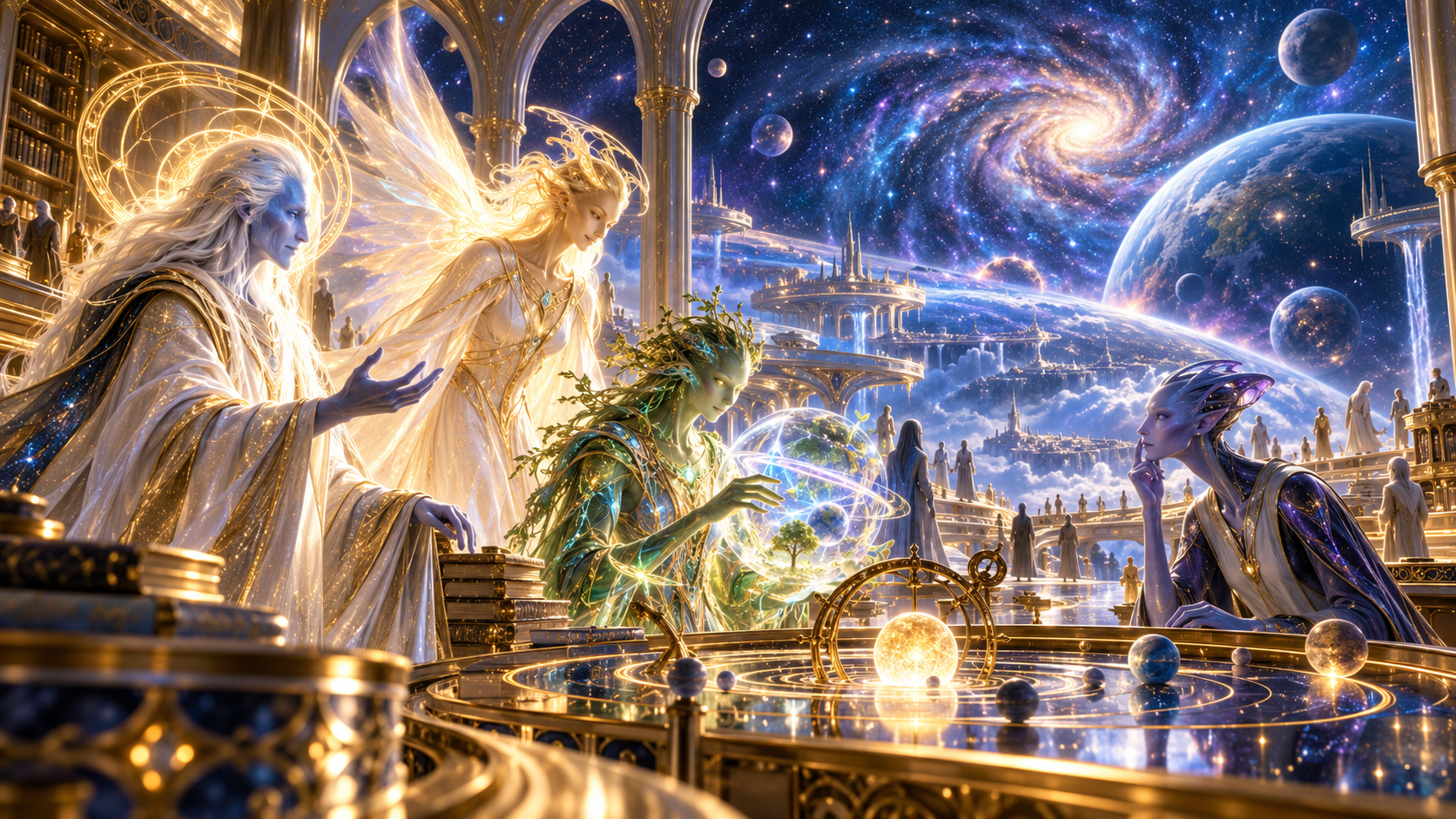
Non-Human Intelligence Codex — Meet the Neighbours
Tyrion looked at our great observatory map.
"Well?" he asked.
"Well what?"
"We've visited five extraordinary civilizations. A small planet, a system capital, a constellation headquarters, a local universe, and a superuniverse."
"Yes."
"And after all that, how many of the neighbours have we actually met?"
"Your spornagia friend."
"Exactly. One."
His single central eye regarded me with suspicion. Both ears were in their usual places. The glowing T on his collar suggested that at least one part of his identity was no longer in dispute.
"Then," he announced, "I would like to meet the rest."
I opened The Urantia Book.
"You might want to make yourself comfortable. There are rather a lot of them."
"Do they have names?"
"Many kinds."
"Are they friendly?"
"That depends on which account we're reading."
"Can I offer them biscuits?"
"We haven't established their dietary requirements."
He sighed.
"Once again, the universe has overlooked the essentials."
We had studied where the book places its worlds. We had discovered how it describes their societies.
Now another question invited us through the door.
Who, according to this extraordinary text, lives in them?
And just as importantly: What makes an intelligent being a person?
Welcome to the Cosmic Meet-and-Greet
Imagine a reception room crowded with unfamiliar figures.
One appears to be a teacher. Another comes to offer help. A third works with living worlds. Another insists he has lived on Earth for ages, although nobody can see him.
These are our imagined scenes, not reported encounters or canonical portraits. The individual orders and their described roles come from The Urantia Book.
The narrator does not describe a universe populated by one generic category called "aliens."
Instead, it distinguishes kinds of beings by their supposed origins, abilities, responsibilities, levels of existence, and relationships to other personalities.
It is a cosmic cast list of astonishing variety.
Tyrion looked at the waiting figures.
"Do I have to remember everyone's title?"
"Not at all."
"Excellent. I already know everybody's most important characteristic."
"What's that?"
"Whether they are willing to share."
That wasn't a bad beginning.
The Melchizedeks: Teachers in an Emergency
Our first imagined visitor wore the calm expression of someone accustomed to handling difficult questions.
"Melchizedek," I explained.
Tyrion read the name badge.
"Is that a name or a password?"
"It's the name of an order of local-universe Sons in the book."
"What do they do?"
"They teach, advise, and respond to emergencies."
"Including biscuit shortages?"
"Not specifically."
According to Paper 35:4.1–4.4, the Melchizedeks supervise forms of universe education and are available for extraordinary assignments when normal plans encounter serious difficulties.
The narrator describes them as emergency Sons.
Tyrion considered this.
"So a world gets into trouble, and someone comes to help?"
"That's the book's description."
"Do they tell everyone how foolish they've been?"
"That isn't the focus of the passage."
"Good. I prefer helpers to critics."
So do I.
And a question hides within this unusual account.
What makes a great teacher?
Is it knowing everything?
Or is it knowing how to help someone who is frightened, confused, or struggling to understand?
The text also tells of a Melchizedek supposedly appearing in human form during the age of Abraham. Such a celestial intervention has not been independently established as a historical event.
But the moral question remains interesting.
Intelligence becomes especially valuable when it helps others grow.
Angels: The Art of Being There
Our second imagined visitor arrived quietly.
"An angel!" Tyrion said.
"Perhaps a seraphim."
"Where are the wings?"
"The book doesn't require us to picture the familiar greeting-card illustration."
"Disappointing. I was hoping for flying lessons."
Paper 38 describes seraphim as ministering spirits associated with the growing local universe.
It also portrays cherubim and sanobim as intelligent, affectionate assistants.
An unexpected detail caught Tyrion's attention: the text says seraphim generally work in pairs.
"Two angels together?"
"Yes."
"One for each ear?"
"That's not how assignments work."
"Then perhaps one to keep an eye on me."
"You already have one eye."
"Exactly. I'm doing my part."
But the important idea isn't the number of attendants.
In this narrative, some remarkable intelligences find their purpose through service, support, and personal ministry.
That invites a question that belongs right here on Earth.
We admire intellectual accomplishments.
But do we admire enough the intelligence involved in caring for another living being?
In teaching a frightened child?
Helping a neighbour through grief?
Or patiently explaining something for the fourth time?
Intelligence can accomplish extraordinary things. Care gives those accomplishments human meaning.
Life Carriers: Before Anyone Could Ask a Question
Our third guest's imaginary name badge read:
LIFE CARRIER.
Tyrion stared.
"Do they deliver puppies?"
"Not in quite that sense."
"Plants?"
"Something much bigger than a delivery service."
In Paper 36:0.1, the narrator presents Life Carriers as beings entrusted with planning, initiating, and fostering life on evolutionary planets.
In 36:3.1–3.8, their role is described as changing when creatures capable of moral choice emerge; the text claims their capacity to manipulate planetary life is then restricted.
The narrator's claims about life beginning through these beings are not established scientific conclusions. Biology, chemistry, genetics, evolution, and the study of life's origins require independent evidence.
Tyrion listened carefully.
"So these beings supposedly know a great deal about life?"
"Yes."
"Even one-eyed Shih Tzus?"
"The book doesn't discuss your particular anatomy."
"Then their research programme remains incomplete."
Still, the story raises a fascinating distinction.
Knowing how a living body works is different from understanding what a creature experiences.
A biologist can investigate an animal's nervous system.
A philosopher can ask whether that animal has subjective experience.
An ethicist can ask what obligations humans have toward it.
Those questions overlap, but none answers all the others.
Midwayers: The Neighbours Who Never Move Out
Our fourth guest was difficult to locate.
"Where is everybody?" Tyrion asked.
"The book says midwayers are ordinarily invisible to human eyes."
"That's an inconvenient way to introduce yourself."
According to Paper 77:0.1–0.2, midway creatures occupy a claimed level between ordinary human life and angelic orders.
The narrator describes two orders associated with Earth: primary and secondary midwayers.
Then comes an especially intriguing detail.
In 77:9.1–9.3, these beings are portrayed as long-term inhabitants of their home planet, unlike visiting angelic ministers who come and go.
Tyrion looked around our imaginary meeting room.
"Are you suggesting they might live in our neighbourhood?"
"That's what the book claims, not something we have verified."
"Have they seen our kitchen?"
"We have no reason to assume so."
"Then they may be the only neighbours who haven't asked for biscuits."
The claim that such unseen beings inhabit Earth is not independently substantiated. Unexplained experiences or photographs do not, by themselves, identify midwayers.
But the picture offers an interesting thought about belonging.
Human generations pass.
Communities change.
The book imagines beings who remain through those changes, caring about a planet's future.
What does it mean to be a neighbour not just for a season but for centuries?
The Most Important Guest Was Missing
Tyrion looked around.
"Wait."
"What?"
"We forgot someone."
"Who?"
"My spornagia friend!"
Of course.
He had met that affectionate creature among the imagined gardens of Jerusem.
And the text attributes intelligence, affection, and individuality to spornagia.
But Paper 46:7.3–7.5 contains a striking qualification: the narrator claims spornagia lack personality and survival souls in the book's particular theological sense, while describing an individuality that can continue through an unusual process the book calls reincarnation.
Tyrion looked troubled.
"Does that mean my friend doesn't matter?"
"Not at all."
"Doesn't deserve kindness?"
"Of course not."
"Then what's the point of all these labels?"
"To describe distinctions the book considers important. Not to tell us that affection or kindness must stop at a category boundary."
His ears perked up.
"Good."
A classification is not a measure of how much compassion someone deserves.
The book's technical account of personality is not identical to modern philosophical, scientific, or legal uses of the word person.
And nothing about its unverified spornagia establishes a scientific account of real animals.
We can respect the differences between ideas without allowing a label to replace the living being in front of us.
Return to Tyrion's spornagia friend →
Intelligence Is Not the Entire Story
Our imaginary meet-and-greet had begun to make sense.
We had encountered beings represented as teachers, ministers, life specialists, and planetary intermediaries.
But what did they all have in common?
And what distinguished them?
In Paper 112, The Urantia Book treats personality as something more than cleverness. Its theological account connects unique identity with relationships and moral discernment.
That is a claim and philosophical framework supplied by the text, not an experimentally established test for consciousness or moral agency.
Consider the distinctions.
Something may be very skilled at processing information.
Another creature may feel distress while having no interest in mathematics.
A human being may struggle to communicate and still possess the same human dignity as anyone else.
Even our use of the word intelligence needs care.
Tyrion thought about it.
"Am I intelligent?"
"Yes."
"A philosopher?"
"You ask philosophical questions."
"Entitled to another biscuit?"
"That conclusion does not follow."
He sighed.
"Your logic department is interfering with lunch again."
But he had uncovered the right puzzle.
Being capable of remarkable things, having a subjective life, possessing moral agency, and deserving moral consideration are not the same question.
Those distinctions matter for how we understand animals, other human beings, and perhaps increasingly sophisticated machines.
The Question That Waited at the Door
As the imaginary meeting room emptied, Tyrion stayed behind.
"We met teachers, ministers, life specialists, and neighbours we supposedly cannot see."
"Yes."
"And we still don't know everything about them."
"Not remotely."
He looked at the empty chairs.
"Maybe we should get to know somebody before we decide that the label tells us everything."
"A very good idea."
For all the book's extraordinary cosmic classifications, the most important lesson of our visit might be beautifully simple.
A name is not a relationship.
A description is not a verified discovery.
And intelligence is not the whole story of what makes another being matter.
Tyrion sat by the observatory window, one eye bright, two ears attentive, four little legs comfortably folded beneath his fluffy white coat.
The T on his collar glowed.
"Can we go home now?"
"We have one more kind of journey ahead."
"Where?"
"Not to another planet."
He looked puzzled.
"Then where?"
"Into the question of what it means to be aware, to think, to choose—and to remain yourself."
He considered that.
"Sounds like philosophy."
"It is."
He sighed.
"I knew eventually we'd get there."
Before the Next Stage: Meet the Orders
A map could tell us where the book places its worlds.
A city could show us how it imagines civilizations working.
A catalogue could tell us what names it gives its extraordinary beings.
But none of those answers the question that Tyrion has been edging toward all along.
What does it actually mean to be someone?
Our journey will soon continue into consciousness, personality, mind, soul, and the experience of being aware.
Tyrion looked up.
"Could I simply begin by being Tyrion?"
"That seems like an excellent place to start."
But before that next stage, let's meet the orders we've heard so much about—one at a time.
Continue Stage 4 — Meet the Orders →
🔎 Factoid — The Beings and Their Sources
What belongs to the book: The names and claimed origins and functions of these orders. What belongs to our storytelling: The imaginary reception room, its guests as depicted, Tyrion's conversations, and the original comedy sketch preserved above.
- Melchizedeks as teachers and emergency ministers: 35:4.1–4.5.
- Seraphim, cherubim, and sanobim: Paper 38.
- Life Carriers and the book's proposed origins of planetary life: 36:0.1 and 36:3.1–3.8.
- Primary and secondary midwayers and their proposed planetary residence: 77:0.1–0.2 and 77:9.1–9.3.
- Spornagia, intelligence and individuality without personality in the book's terms: 46:7.3–7.5.
- Personality in the book's theological framework: Paper 112.
Evidence boundary: The book's purported non-human orders have not been independently verified. Quoting a primary-text description confirms what the narrator claims, not that such a being exists. These classifications should not be substituted for established biology, research on animal cognition, scientific studies of mind, or philosophical debate over personhood.
🧭 Optional Detours — Meet the Neighbours More Closely
But before we could leave, a familiar celestial clerk appeared with one final form.
🎭 Celestial Intermission — The Classification Desk
A fictional scene from the Reversion Directors' Office of Interspecies Paperwork.
MORTAL: "I'd like to meet a Melchizedek."
CLERK: "Certainly. Do you have an appointment?"
MORTAL: "No. But I read the entry."
CLERK: "Ah. Reading about a being is not the same as arranging a meeting."
MORTAL: "That sounds suspiciously like our evidence policy."
CLERK: "Good heavens. Someone has actually read it."
The Reversion Directors record this as a rare administrative success.
This intermission is fictional satire—not a canonical quotation, a reported encounter, or evidence of any being's existence.
Keep Exploring the Four Codex Profiles
Our four introductory profiles are here whenever you want to know more about the book's descriptions. They are textual investigations, not records of verified extraterrestrial encounters.
Melchizedeks — Teachers and Emergency Ministers → · Angels — Ministering Spirits →
Life Carriers — Planetary Life Ministry → · Midwayers — The Long-Term Neighbours →
And for the wider setting, return to the Civilization Atlas or Universe Geography.