Appearance
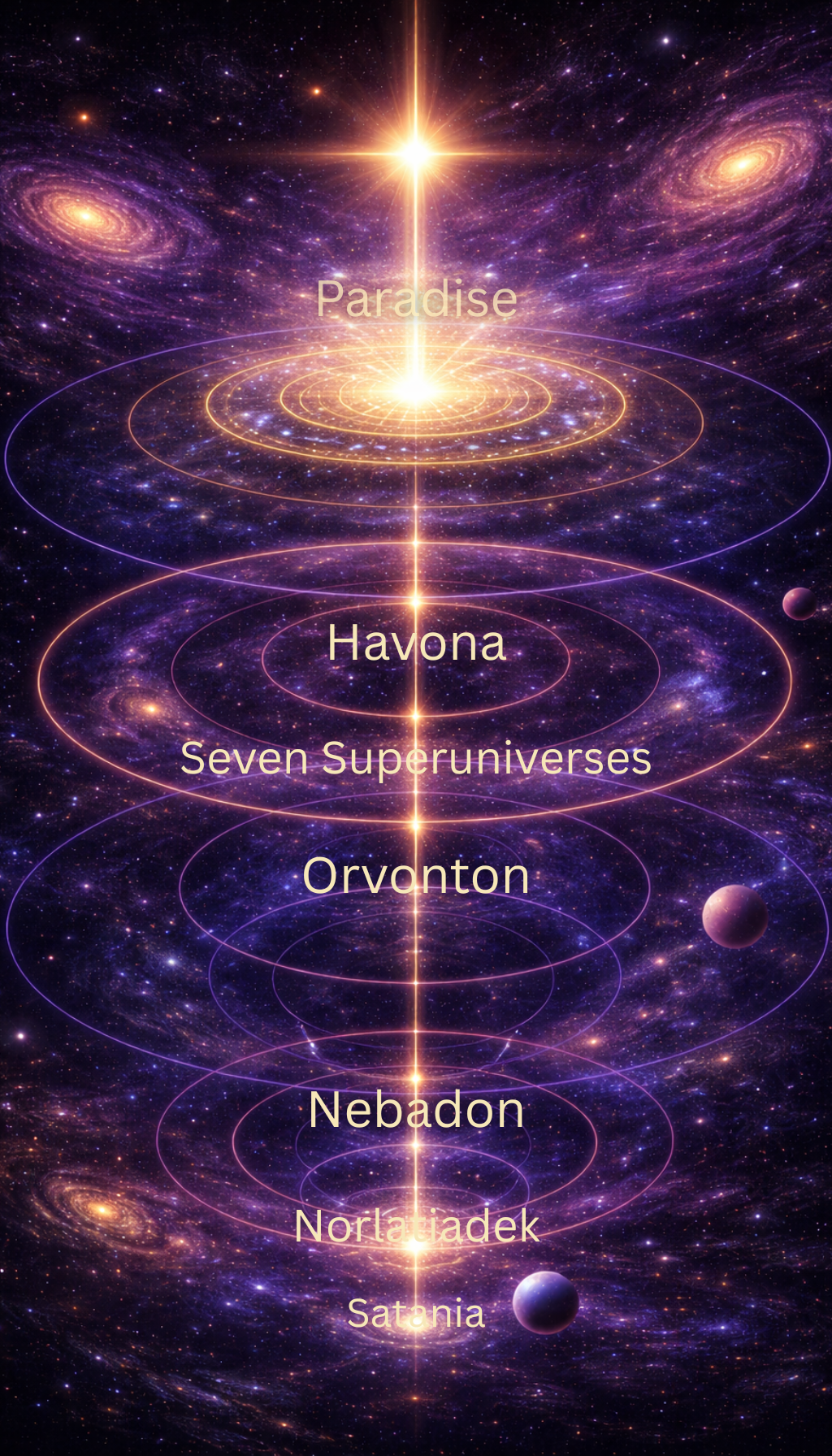
Atlas SectionUniverse Geography
Universe Geography
A map of cosmic scale and nested placement, from central perfection to inhabited-world context.
Overview
The Universe Geography section explores the large-scale spatial architecture described in The Urantia Book, approached here as a visual and conceptual map rather than a doctrinal system.
This section explores cosmic structure not only as something to be catalogued, but as a map of meaning: a way human beings organize the unknown into orientation, hierarchy, relationship, and significance.
If the Civilization Atlas asks what kinds of worlds and centers exist, Universe Geography asks a different question:
Where are things placed within the larger cosmic structure, and what kind of orientation does that structure create for the reader?
This section follows the nested ladder of location from the central universe outward and then downward toward the more local setting connected to Urantia.
Why this section matters
Without this section, the atlas would lack orientation.
With it, the project gains a clear sense of scale, sequence, and nested position. The map becomes more than a list of names. It becomes a structure the reader can climb, and a framework through which distance, hierarchy, center, threshold, and nearness begin to carry meaning.
This is where cosmic location becomes human orientation.
Current entries
Paradise
The still point at the center of the cosmic map.Havona
The perfect universe encircling the still center.The Seven Superuniverses
Seven immense regions where outer creation takes organized form.Orvonton
The seventh superuniverse and the great regional setting of our cosmic neighborhood.Nebadon
The local universe that brings the cosmic map closer to home.Norlatiadek
The constellation layer that sharpens the path toward Urantia.Satania
The local system that directly includes the inhabited world known as Urantia.
How to read these pages
These entries are best read as a layered map of cosmic placement.
Each page asks questions like:
- What scale of structure is this?
- Where does it sit in relation to the levels above and below it?
- Is it central, regional, local, or planetary in relevance?
- How does it help orient the reader within the larger framework?
The goal is not to force certainty. The goal is to build a navigable sense of structure.
Relationship to Civilization Atlas
The two atlas sections work together.
Universe Geography provides the location ladder:
txt
Paradise
└── Havona
    └── The Seven Superuniverses
        └── Orvonton
            └── Nebadon
                └── Norlatiadek
                    └── Satania
                        └── Urantia

 ` ``` `

 Civilization Atlas begins at the inhabited-world level and then explores the centers associated with larger and larger frameworks:

 ` ```txt `

 Urantia
└── Jerusem
    └── Edentia
        └── Salvington

` ``` `