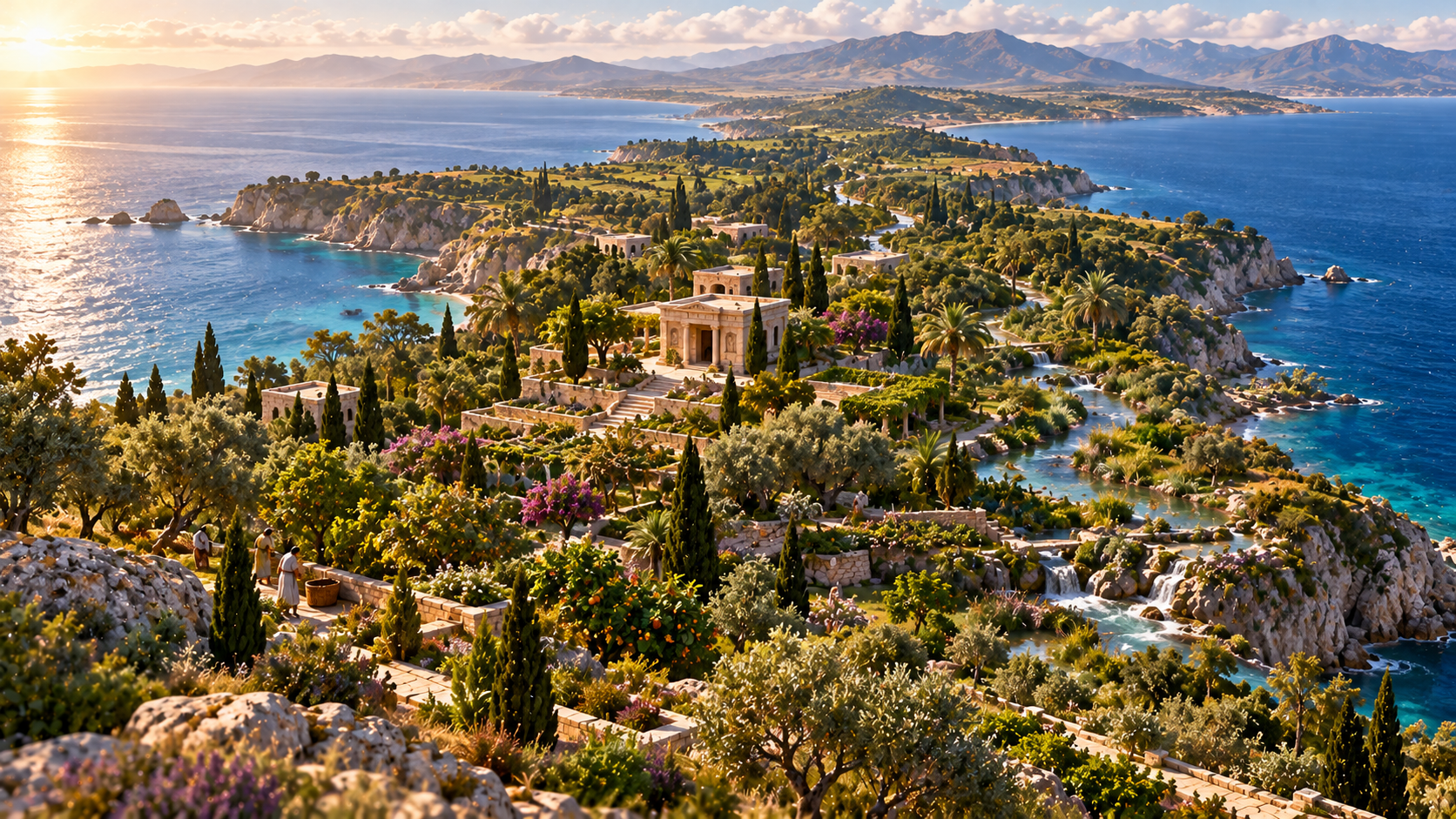
The Garden of Eden — Paradise Had a Planning Department
"Before we go in," Tyrion announced, "I want to make one thing perfectly clear."
We stood at the entrance to the Garden of Eden—or rather, at the entrance to the extraordinary Garden imagined in The Urantia Book.
"Go on," I said.
"I am not eating the apple."
"There's no apple incident in this version."
"And I'm not talking to a snake."
"The book tells a different story."
"Good," he said. "Then perhaps, for once, we can enjoy a garden without someone blaming the entire history of humanity on a snack."
I couldn't argue with that.
On our last visit, we met Adam and Eve and learned about their difficult mission on an already inhabited Earth. Now we had come to see the place prepared for them.
We expected flowers.
We found something closer to a civilization.
A Peninsula with an Extraordinary Job Description
The book places the first Eden on a long peninsula stretching westward into the eastern Mediterranean. In Paper 73:3, the narrator describes a neck of land approximately twenty-seven miles wide, nearby highlands, streams, and conditions suited to an ambitious settlement.
This is the text's proposed geography, not a location independently identified through archaeology.
Tyrion examined the coastline on our imaginary map.
"Twenty-seven miles wide?"
"That's what the book says."
"That's a fairly substantial garden gate."
"And the Garden was much larger than the sort of place you visit with a watering can."
He narrowed his single eye.
"Do not tell me we're going to need a map inside the map."
We were.
The book describes a vast planned landscape, prepared under Van's direction before Adam and Eve arrived. Its purpose wasn't merely to look magnificent.
It was supposed to become a centre of education, culture, family life, agriculture, and the book's proposed programme of planetary improvement.
Eden was intended to help an entire world grow—not to give two people a luxurious private retreat.
The World's Most Ambitious Landscaping Project
We followed an imaginary road past irrigated gardens and carefully arranged buildings.
There were schools, homes, cultivated spaces, meeting places, and a central temple.
The text goes so far as to describe more than five thousand brick buildings and over twelve thousand miles of paved paths and roads at the time of Adam's arrival (73:5.2).
Tyrion stopped.
"Twelve thousand miles of paths?"
"According to the narrator."
"Who walks them?"
"People working and living in the Garden, I suppose."
"Then someone should have supplied very comfortable shoes."
A wall guarded the narrow approach to the peninsula. Gardens and waterways were laid out carefully. Different districts served different needs.
It sounded beautiful.
It also sounded exhausting.
And the sheer scale of those specifications matters. Archaeology has not verified this settlement, its roads, buildings, or claimed prehistoric chronology. We shouldn't mistake the precision of a description for the precision of an excavation.
But as a story, the Garden presents a fascinating question:
Can a beautiful place be designed to encourage beautiful ways of living?
"A Garden, and Only a Garden"
One detail delighted Tyrion.
The book describes Eden as a place devoted to cultivation and orderly life rather than animal slaughter within its boundaries. It emphasizes the idea of a garden dedicated to its special purpose.
"A garden," Tyrion repeated.
"Yes."
"With government offices?"
"Yes."
"Schools?"
"Yes."
"Administrative departments?"
"Quite a few."
He tilted his head.
"I believe we have encountered the first known case of a garden suffering from excessive paperwork."
The humour writes itself. But the distinction behind it is interesting.
A place can be more than its appearance.
A school isn't simply a building with desks.
A hospital isn't merely a collection of rooms.
And a garden, in this narrative, wasn't simply a collection of plants. It was a deliberate attempt to organize a community around a set of ideals.
The real test would be whether those ideals survived contact with ordinary life.
The People Who Made Paradise Work
Our imaginary journey took us past workers tending irrigation channels, families preparing meals, and teachers speaking with students.
These particular scenes are our fictional reconstruction, not reported incidents from the book or observations of excavated ruins.
Yet they help us imagine the human reality beneath the Garden's enormous plan.
Someone still had to feed people.
Someone still had to repair things.
Someone had to teach children, respond to illness, settle disagreements, and keep the shared spaces pleasant.
Tyrion watched the workers.
"So paradise needed maintenance?"
"Apparently."
"Even paradise?"
"Especially a place where people are trying to live together."
He considered this carefully.
"Then I hope they appreciated the gardeners."
So do I.
The most remarkable community isn't necessarily the one with the most impressive buildings.
It may be the one where people understand that everyone contributes something worth caring about.
The Tree Nobody Could Agree About
Near the centre of the Garden, the book places a temple associated with the Universal Father and the famous tree of life.
But this isn't quite the conventional story of a forbidden apple.
Within the book's account, the tree is connected to the special physical constitution of Adam and Eve. The narrator describes its fruit as part of the maintenance of their material bodies.
That is a theological and biological claim, not an independently verified plant species or a finding in human genetics.
Tyrion looked at the tree.
"May I eat one?"
"We don't know what it would do."
"So the answer is no."
"That would be prudent."
"Finally. A safety rule everyone can understand."
The book also links its Garden narrative to later traditions about Eden, including the imagery of rivers and sacred trees.
But resemblance to a later religious tradition doesn't establish an actual chain of historical transmission. That would require independent evidence.
The Garden Was Never Supposed to Stay Behind Its Walls
The Garden's most ambitious purpose lay beyond its boundary.
In the book's narrative, Adam and Eve were meant to teach, cultivate, and eventually influence the wider planet. Its schools and social institutions were to demonstrate ways of living that could spread beyond the original settlement.
Tyrion studied the walls.
"Then why build a beautiful garden if the important work is outside it?"
"Because the Garden was supposed to help prepare people for that work."
"Like learning to drive in a quiet parking lot before going into traffic?"
"Something like that."
He nodded.
"Except this particular driving lesson involves an entire planet."
There is a useful principle in that image.
A wonderful idea proves its worth not only by how well it works in ideal conditions, but by how it helps people when conditions are difficult.
And in the book's account, difficult conditions were coming.
When Paradise Couldn't Stay Paradise
Adam and Eve arrived on a world the narrative describes as deeply affected by the earlier Caligastia rebellion.
Their mission carried immense expectations. The Garden offered a beautiful beginning.
But as we learned in the previous chapter, the book tells of an impatient attempt to accelerate the plan—and of consequences that the original Garden could not escape.
The supposed mission faltered. Adam and Eve left the settlement. Later groups occupied it, according to the text.
And then comes the haunting part.
Paper 73:7 describes the peninsula eventually sinking beneath the Mediterranean.
Tyrion gazed at our imaginary coastline.
"The entire Garden?"
"That's the book's claim."
"Underwater?"
"Yes."
He was quiet.
"Has anyone found it?"
"Not in any independently established identification matching the book's account."
The Mediterranean has experienced real geological and shoreline changes. But such changes don't verify a particular submerged Eden, its thousands of buildings, or the story of its inhabitants.
A lost paradise can be an extraordinary narrative without being a demonstrated archaeological site.
What Would We Carry Out of Eden?
The image on the map slowly dimmed.
The temples, schools, avenues, and cultivated gardens were gone.
For a moment, Tyrion said nothing.
Then he looked up.
"That's sad."
"It is."
"All that work. All those hopes."
"Yes."
He thought about it.
"Do they get to try again?"
"In the book's account, they do. But not in the same place, and not under the same conditions."
He looked back toward the vanished Garden.
"So the next chapter isn't really about losing paradise."
"Not only that."
"It's about what you build after you've lost it."
Exactly.
The first Eden, as the book portrays it, was a place of extraordinary planning and aspiration.
But its most enduring human question may have nothing to do with its alleged location:
When the beautiful future you imagined disappears, can you still do something good with the future that remains?
Tyrion straightened his glowing collar.
"All right. Let's visit this Second Garden."
"Ready?"
"Yes. But this time, nobody gets to start a renovation without reading the instructions."
Continue the Adventure — The Second Garden of Eden →
🔎 Factoid — The Garden, the Sources, and the Evidence Boundary
- The proposed Mediterranean location and peninsula: Paper 73:3.
- The Garden's layout, buildings, and roads: Paper 73:5.
- The Garden's alleged submergence: Paper 73:7.
- The Garden's social and educational life: Paper 74.
- The subsequent Adamic narrative: Paper 75 and Paper 76.
Evidence boundary: This is an imaginative retelling of claims found in The Urantia Book. No independently verified excavation establishes this particular Garden, the stated prehistoric construction programme, or its alleged submergence. The narrative also includes a proposed biological mission whose racial assumptions require scrutiny rather than acceptance; see Race, Human Unity, and Historical Context.
🧭 Optional Detours — Evidence, Comedy, and Further Exploring
The original Garden comedy sketch:
🎭 Celestial Intermission — The Eden Department of Parks and Recreation
An imaginary performance by the Reversion Directors, inspired by The Urantia Book.
CELESTIAL INSPECTOR: "Good morning! I'm here to inspect the Garden of Eden."
GARDEN ADMINISTRATOR: "Welcome! We've prepared thousands of buildings, paved roads, schools, residential districts, and a complete administrative system."
CELESTIAL INSPECTOR: "Impressive! And what exactly are you building?"
GARDEN ADMINISTRATOR: "A garden."
CELESTIAL INSPECTOR: "A garden?"
GARDEN ADMINISTRATOR: "Yes. A garden, and only a garden."
CELESTIAL INSPECTOR: "You have government offices!"
GARDEN ADMINISTRATOR: "A very well-organized garden."
CELESTIAL INSPECTOR: "You have an entire educational system!"
GARDEN ADMINISTRATOR: "We believe in cultivating young minds."
CELESTIAL INSPECTOR: "And why are there so many administrative departments?"
GARDEN ADMINISTRATOR: "Someone has to manage the paperwork."
CELESTIAL INSPECTOR: "Paperwork? In paradise?"
REVERSION DIRECTOR: "Of course. What did you think the original tree was for?"
The celestial horticultural faculty requests an immediate recess.
This performance is fictional satire, not a quotation from The Urantia Book.
Archaeological comparison:
Geological and Archaeological Cross-Check
1. The proposed location. Paper 73:3.1–3.4 claims that the first Garden occupied a peninsula extending west from the eastern Mediterranean coast, with a neck 27 miles wide and a river fed by four tributaries. The precise peninsula remains unidentified in accepted archaeological research.
2. The proposed buildings. Paper 73:5.2 describes more than 5,000 brick buildings and over 12,000 miles of paved paths and roads at Adam's arrival. These are extraordinary source-text claims, not verified archaeological measurements. By contrast, the Smithsonian's human-origins program places the transition to agriculture and food-producing settlements mainly within the last 12,000 years.
3. The proposed submergence. Paper 73:7.1–7.2 says the peninsula sank gradually over centuries, long after Adam's departure, in conjunction with Mediterranean geological events. A 2026 review of eastern Mediterranean submerged settlements documents real shoreline changes, but does not independently corroborate this particular sequence or settlement.
Assessment: NOT INDEPENDENTLY ESTABLISHED. This is an initial source comparison, not a registered EVR verdict or a comprehensive geological survey. The absence of corroboration is not proof of impossibility; evidence of general coastal submergence is not evidence for a specific named settlement.
Continue exploring: Adam and Eve · The Second Garden · Planetary History.