
Atlas Section🗺️ Visual Maps & Diagrams
Visual Maps & Diagrams
What if one picture could make a complicated idea easier to understand—but not necessarily prove it true?
You've read about Paradise, Havona, distant headquarters worlds, and the mysteries of mind. Then you encounter a diagram, and the relationships that once felt like a maze suddenly become easier to follow.
That's what a good map can do. It helps us see how ideas fit together.
But there's an important second question: Does the picture show something we've observed—or simply organize what a book describes?
The Visual Maps & Diagrams section brings those two questions together. Here you'll find illustrations of the cosmic hierarchy and the Consciousness Framework in The Urantia Book, clearly identified as interpretations of the text, not independent scientific observations.
Two visual resources are published now: a cosmic hierarchy illustration and a Consciousness Framework relationship map. Other diagram categories are ideas for future development, not finished resources.
1. Cosmic Hierarchy — Paradise to Urantia
Start with the biggest possible question: Where does the book place Earth in its universe of universes? Follow the names from its proposed eternal centre toward the world we know. The image helps organize the sequence; it isn't a telescope's view of the cosmos.
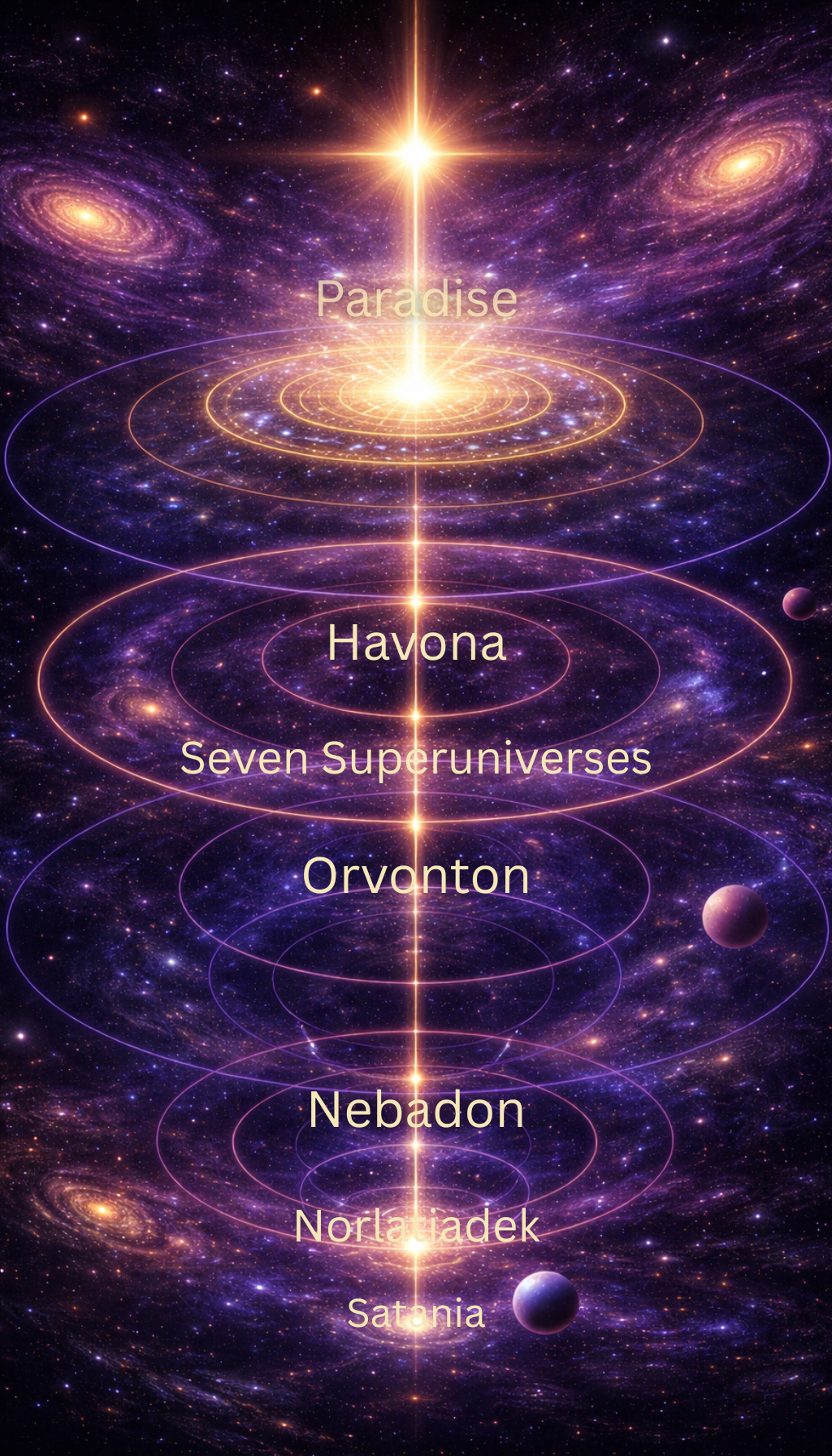
This Atlas illustration interprets the book's cosmic hierarchy. It is not an observed astronomical image, a scale-accurate model, or independent evidence that the depicted places exist.
Read the sequence as a textual itinerary, moving outward from the centre the book describes and then down through the reported administrative levels toward Earth:
Paradise → Havona → seven superuniverses (including Orvonton) → Nebadon → Norlatiadek → Satania → Urantia.
These names refer to differing kinds of realms, universes, and administrative levels within the source text. The arrow sequence helps readers navigate the account, not measure literal distances.
Explore Universe Geography and the original labeled diagram →
Original texts: Paper 11 — The Eternal Isle of Paradise · Paper 15 — The Seven Superuniverses
2. Consciousness Framework — Five Linked Concepts
Now leave the immense cosmic map behind and look inward. If the first diagram asks where, this one asks how the book connects its ideas about a person.
The illustration gathers five concepts explored in the Consciousness Framework: Thought Adjusters, Mind Circuits, Soul Development, Spirit Influence, and Personality Survival. Its connections are interpretive guides, not measured pathways in the brain or verified spiritual processes.
Consciousness Framework Signal Map
Indwelling Axis
Thought Adjusters
The inward divine presence, orienting consciousness toward truth, value, and destiny.
Human Consciousness • Choice • Meaning
Mental Infrastructure
Mind Circuits
The signal network through which perception, learning, choice, and response become possible.
Growth Process
Soul Development
The emerging morontia self, built through value-laden choice, meaning, loyalty, and growth.
Spiritual Current
Spirit Influence
The layered atmosphere of uplift acting upon human awareness, values, and receptivity.
↘↓↙
Continuity Threshold
Destiny Horizon
Personality Survival
The continuity of the self through soul growth, freedom, spiritual alignment, and enduring identity.
This diagram represents the book's proposed relationships as interpreted by the Atlas. It is not a clinical model, a neurological scan, or a demonstration that its proposed spiritual mechanisms exist.
Open the dedicated Consciousness Framework Map and explanation →
Explore all five Consciousness Framework entries →
Original texts: Paper 107 — Origin and Nature of Thought Adjusters · Paper 111 — The Adjuster and the Soul
How to Read an Atlas Diagram
A persuasive picture can feel like an explanation—and an explanation can be mistaken for proof. Before drawing a conclusion from any Atlas diagram, ask three small questions:
- Original text: The Urantia passages supply the names, terms, and asserted relationships. A citation establishes what the text claims, not whether its claims are true.
- Atlas interpretation: Shapes, arrows, and visual placement simplify material that may involve distinct descriptive levels or symbolic choices. Not every arrow means a physical path or causal mechanism.
- Independent evidence: A compelling or internally coherent chart does not count as an observation of a cosmic realm or a supernatural process. Such claims require evidence of a different kind.
A separate question about meaning: What does this picture draw our attention toward? The cosmic hierarchy might lead a reader to reflect on belonging in a larger whole; a diagram of mind, soul, and personality might invite questions about identity or responsibility. Those responses are optional interpretations, not a fourth kind of evidence. The diagram cannot prove the depicted realms or spiritual relationships exist—or tell us what the book's authors intended readers to feel.
For close textual analysis, see Logic Analysis. For externally testable questions, see Evidence & Verification.
Future Maps — Not Yet Published
There are more questions we'd like to make easier to see: how the book classifies celestial orders, how its planetary-history claims unfold over time, and how difficult propositions relate to one another.
Those are possibilities for future diagrams, not existing completed maps. Any new visualization should identify the source material and distinguish what the book proposes from what independent evidence establishes. Clarity is useful; invented certainty is not.
🎭 Celestial Intermission — The Map Department
A fictional visit to the Reversion Directors' Office of Cosmic Cartography.
MORTAL: "This is an impressive map. Does it prove the universe looks like that?"
CARTOGRAPHER: "No. It proves I can draw arrows."
MORTAL: "Then where do I find the evidence?"
CARTOGRAPHER: "Another department. Please watch for epistemological potholes."
The Reversion Directors decline to authorize a shortcut.
This exchange is fictional satire, not a canonical quotation or scientific finding.
When a diagram succeeds, a reader may finally understand a complicated claim well enough to ask a better question about it.
A clear picture can guide an investigation. It cannot take the place of one.
Explore the maps. Follow the sources. Keep the questions open.