A remarkable connection: Part IV of The Urantia Book identifies Jesus of Nazareth with Michael of Nebadon. Explore the book's portrait of his human life and teachings in our new Jesus of Nazareth gateway. This identification is a religious claim, not an independently established historical fact.
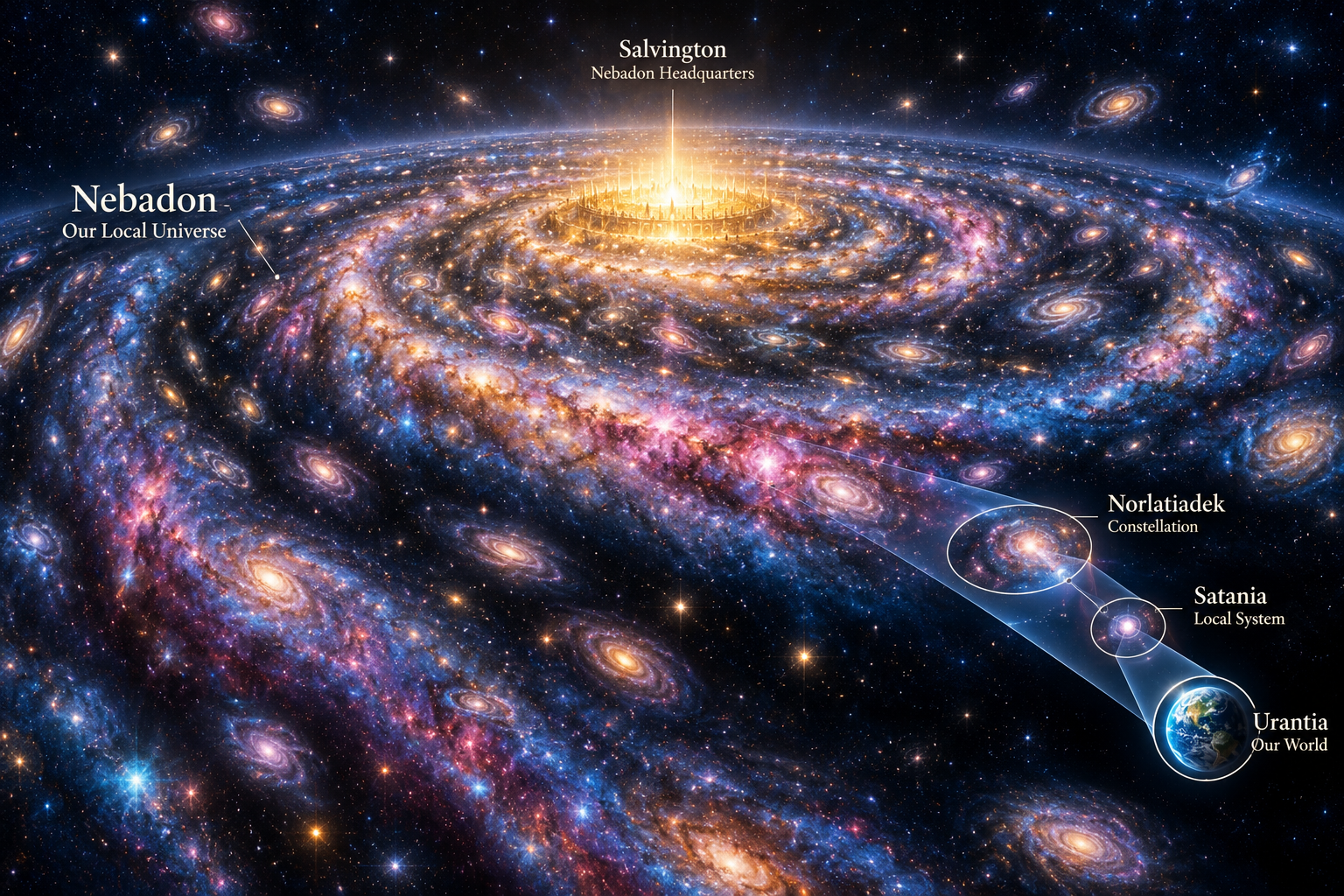
Nebadon — The Universe Where a Creator Learned to Understand
"So we're finally going to meet the person Lucifer was arguing with?"
Tyrion had asked that as we left Orvonton. Now the observatory map answered with a single glowing name:
NEBADON.
"Excellent," he said. "A smaller neighbourhood. Perhaps this one has fewer administrators."
"It's an entire local universe."
He looked at me with his single central eye.
"Your idea of local is becoming increasingly suspicious."
Fair enough.
According to The Urantia Book, Nebadon is our local universe, within Orvonton. It is immensely smaller than a superuniverse—but hardly small by any human standard.
And its Creator Son is Michael.
The same Michael whose authority Lucifer challenged.
Tyrion studied the map.
"So the man who rebelled thought he knew better than his Creator?"
"That's one part of the book's account."
"And what do we know about the Creator?"
"An extraordinary amount about his government. But the really interesting part is what he chose to learn about the people living under it."
Tyrion adjusted his little travel bag.
"Good," he said. "I've heard quite enough about government for one holiday."
A Universe Still Growing Up
We had travelled past the perfect circuits of Havona and through the great evolutionary superuniverses. Now, at last, we could begin to see how one particular evolving universe takes shape.
In Paper 32, a local universe is described as the work of a Creator Son: not something that appears fully finished in an instant, but a tremendous creation developing through stages.
First, says the book, cosmic energies are organized. Suns stabilize. Planets form. Headquarters spheres are prepared. Gradually, realms become ready to support life and the long adventure of growing personalities.
The book even describes Nebadon as a relatively young, still-developing cluster within Orvonton.
"Still developing?" Tyrion said.
"Yes."
"So creation itself hasn't finished growing?"
"Not in this account."
He looked relieved.
"Wonderful. I've been growing for years, and nobody calls me a defective universe."
The book's point is more profound than it first appears.
Perfection may be the goal of a developing creation without being its starting condition.
A child is not a failed adult. An apprentice is not a failed master. And in the book's vision, an evolving universe is not an embarrassing mistake waiting to be corrected.
It's a place where growth actually means something.
Welcome to Salvington
The map drew us toward a brilliant headquarters world.
SALVINGTON — CAPITAL OF NEBADON.
It looked extraordinary: a place of luminous architecture, surrounding spheres, and enough celestial activity to make an earthly airport seem pleasantly quiet.
According to the text, Salvington is an architectural sphere, specially organized as Nebadon's administrative centre. Paper 32:2 places it at the universe's energy-mass centre.
But there's an important complication: the same paper says Nebadon is not one single astronomical system. Its local systems and inhabited worlds are distributed through a much larger creation. It would be a mistake to identify Nebadon simply with one familiar star system or galaxy.
Tyrion examined Salvington's surrounding worlds.
"Do they have hotels?"
"The book describes an extraordinary network of educational and administrative spheres."
"So that's a maybe?"
We zoomed in.
The book associates Salvington with a circuit of seventy primary spheres and 420 tributary spheres devoted to specialized activities, including the training of ascending mortals.
Tyrion's tail stopped wagging.
"Four hundred and ninety educational worlds?"
"Yes."
"I thought we'd come here on holiday."
"Apparently the universe has other plans for us."
Meet the People Running the Place
In the book's account, Nebadon is governed by Michael, a Paradise Creator Son, together with the Creative Mother Spirit, also called the Divine Minister.
That partnership matters.
The local-universe Mother Spirit is not portrayed as a minor assistant standing somewhere behind the throne. She is Michael's creative associate, closely connected to the emergence and nurturing of life, the ministry of mind, and spiritual care throughout the universe.
Indeed, 33:3.6–3.8 describes a proclamation acknowledging their equality in personality attributes and divine character. The chapter also describes their complementary responsibilities. Partnership, not merely a cosmic chain of command, belongs to the picture.
Tyrion looked interested.
"Two creative partners?"
"Yes."
"Good. I was worried someone had decided to run an entire universe alone."
"They haven't."
"That would be a very long day."
And then there is Gabriel, the Bright and Morning Star, described as the chief executive of Nebadon.
We have met Gabriel before. During the Lucifer rebellion, he opposed the rebels' claims and defended loyalty to Michael's government.
In the book's proposed administration, he also has an ongoing practical role: when Michael is absent from Salvington, Gabriel can act as his regent. The Melchizedeks serve widely in education, counsel, adjudication, and special assignments.
A whole universe, then, is not portrayed as a one-person operation. It is a community of different kinds of personalities doing different kinds of work.
Tyrion nodded.
"At last, a sensible division of labour."
"How would you divide it?"
"I would supervise morale, snacks, and emergency walks."
"A remarkably specific portfolio."
"I believe in playing to my strengths."
An Address Too Big for a Postcard
Tyrion searched the map for the little blue world we called home.
He found Nebadon. Inside it, a constellation named Norlatiadek. Inside that, the system Satania. And deep in the system, Urantia—Earth.
"We really are getting closer," he said.
"The book imagines a local universe still growing toward an enormous number of inhabited worlds."
"How enormous?"
"Enough that I think we should put the arithmetic in the optional Factoid."
"Bless you."
🔎 Factoid — Ten Thousand Systems and a Greeting-Card Department
The next part of the map was, frankly, unfair to anyone who likes tidy numbers.
The book describes a local universe as containing one hundred constellations, each with one hundred local systems. In its projected completed organization, each system will encompass approximately one thousand inhabited worlds.
The arithmetic suggests a future full organization approaching ten million inhabited worlds.
That is the book's organizational design, not a claim that the entire projected number had already been inhabited at the time of its narration.
Tyrion tried to count on his paws.
"One hundred constellations. Ten thousand systems. Potentially ten million inhabited worlds."
"That's the projected arrangement."
"Do they all receive birthday cards?"
"I don't know."
"Then I'm not applying for the greeting-card department."
The book gives a smaller tally for the number of worlds actually inhabited in Nebadon at the point described in 32:2.9. Its point is that the universe is still evolving toward its projected capacity.
And somewhere inside this immense creation lies Norlatiadek, our own constellation.
Inside Norlatiadek lies Satania.
Inside Satania lies Urantia—Earth.
We really were getting closer to home.
Source precision: Paper 32:2.9 gives a snapshot of 3,840,101 inhabited planets in Nebadon at the narrator's reported registry, against a projected full local-universe arrangement approaching ten million. These are the book's figures, not a verified census of extraterrestrial civilizations.
Why Would a Creator Leave Home?
Now we reach the part of Nebadon's story that changes everything.
The book's portrait of Michael is not merely that of a powerful celestial sovereign directing a very large creation from Salvington.
It describes a Creator who deliberately undertakes experiences as different kinds of creatures.
Seven times.
The account in Paper 119 calls these his seven bestowals. In each, Michael takes on the lived circumstances of a different order of creature. The narrator says this enables him to acquire their viewpoint through personal experience, rather than ruling solely through inherent wisdom or distant observation.
These are claimed incarnations in the book's religious narrative, not events independently verified as celestial history.
Tyrion seemed puzzled.
"If he created the universe, why would he need to learn what it's like to live in it?"
That's exactly the question.
According to 119:0.4–0.6, Michael's innate wisdom and justice are not the whole story. His bestowals give him experiential understanding—the perspective of creatures who face limits, uncertainty, dependence, moral choice, and the daily difficulties of life.
This is more than administrative training.
Tyrion stared at the map.
"Let me see whether I've understood."
"Go ahead."
"Lucifer thought he knew enough to change everything for everybody."
"That is how the rebellion story presents him."
"And Michael, who supposedly made this whole universe, chose to experience life as the beings he governs?"
"That is what Paper 119 describes."
Tyrion was quiet.
"So one ruler demanded that everyone understand him. The other tried to understand them."
There it was.
The difference between knowing about someone and knowing what it feels like to be in their place.
Imagine being told how to climb a steep hill by someone who has never had to make the climb. Then imagine meeting a guide who has carried the weight, felt the exhaustion, and knows when to offer a hand.
The hill is our metaphor; the bestowals are the book's claim. But the lesson can matter without treating the underlying cosmology as proven.
Perhaps authority becomes more humane when it listens long enough to learn what life is like on the receiving end of its decisions.
Tyrion thought for a moment.
"So the ultimate management course is to spend time doing the job of the people you manage?"
"In this story, something like that."
"An idea I would strongly recommend to whoever invented vacuum cleaners."
The Tiny World That Became the Centre of Attention
The final bestowal brings us straight back to Earth.
In one of its most distinctive religious claims, The Urantia Book identifies Michael of Nebadon with Jesus of Nazareth. It portrays his mortal life on Urantia as the last of his seven bestowals, after which his sovereignty over Nebadon is fully confirmed.
This is the book's interpretation of Jesus' identity and cosmic significance, not a historical or astronomical fact established independently of its revelatory claims.
But look at what the narrative is trying to communicate.
The sovereign of an entire local universe, the one whom countless beings supposedly recognize as their Creator, does not make his culminating appearance surrounded by celestial ceremony.
The book says he comes into the world as a helpless human infant.
Not to a headquarters planet.
Not to a spectacular superuniverse court.
To Earth.
The same small world where Lucifer's rebellion had helped produce so much confusion.
Tyrion stood completely still.
"So the ruler of this enormous universe chose to live as one of the people on a very troubled planet?"
"That's what the book describes."
"And not as someone with all the advantages?"
"Not as an earthly prince."
He regarded our little blue world for a long moment.
"That's rather different from the sort of executive we've been meeting."
It is.
The narrative doesn't ask us simply to admire authority. At its most moving, it asks whether greatness might be measured partly by willingness to serve and understand.
Even readers who do not accept the book's account of Michael can consider that question.
The Universe Gets Personal
Our map had carried us across regions with intimidating names and astonishing numbers. We had encountered headquarters worlds, administrative hierarchies, and educational circuits beyond anything an earthly university could accommodate.
But Nebadon brings the grand story closer to home.
The book's most remarkable claim here isn't simply about where the universe is.
It's about what kind of relationships ought to matter within it.
Creation, in this account, isn't merely making things. Authority isn't merely giving orders. And mercy isn't merely overlooking wrongdoing.
A good ruler should understand those who live with the consequences of the rules.
A good teacher should know what it feels like to be a student.
A good neighbour should remember that every life contains experiences invisible from the outside.
Tyrion climbed onto the observatory bench beside me.
"Well," he said, "I think I've learned something."
"What?"
"A universe can be enormous, complicated, and still unfinished."
"Yes."
"And the person in charge might still need to learn how other people feel."
"Yes."
He considered that.
"Then perhaps there's hope for the rest of us."
I couldn't think of a better conclusion.
The Next Door: The Gardens of the Most Highs
The cosmic map illuminated a constellation deep within Nebadon.
NORLATIADEK.
"Another name?" Tyrion groaned.
"One more step toward our own little world."
"What's there?"
"The book describes a headquarters called Edentia, with extraordinary gardens—and a government that takes learning how to live together very seriously."
"Gardens?" Tyrion asked, suddenly interested.
"Yes."
"With somewhere to walk?"
"According to the book, you could spend quite some time exploring."
He picked up his travel bag.
"Then perhaps I won't put my paws up just yet."
Continue the Adventure — Norlatiadek: The Gardens of the Most Highs →
🔎 Factoid — The Nebadon Source Trail
The observatory, our conversations with Tyrion, and the contemporary comparisons are original literary fiction. The following descriptions and claims derive from The Urantia Book.
- Local universes as evolutionary creations; proposed hundred-constellation and system structure: Paper 32:0–3
- Salvington's architectural headquarters and Nebadon's developing inhabited-world population: 32:2.3–2.11
- Michael, Gabriel and local-universe administration: Paper 33
- The Creative Mother Spirit and the Divine Minister: Paper 34
- The Melchizedeks and Salvington's surrounding educational worlds: 35:1–3
- Michael's seven bestowals, the purpose of creature experience, and his final mortal experience on Urantia: 119:0.4–0.6 and 119:7.1–7.8
Evidence boundary: Nebadon, its alleged governing personalities, its census, and the identification of Jesus with Michael are claims of the book. The Atlas does not present them as independently established astronomy or history. Its ethical themes can be contemplated without assuming that its cosmological claims have been verified.
🧭 Optional Detours — Before Leaving Nebadon
The main adventure continues to Norlatiadek above. These side trips are available if you'd like to explore a little further first:
You can return here and continue the chapter journey whenever you're ready.