Dalamatia — The City That Tried to Teach a Planet
The observatory map had carried us back through Earth's distant past.
Then, on a landscape that hardly resembled our familiar world, a name appeared.
DALAMATIA.
Tyrion tilted his single eye toward the display.
"Is that a city?"
"According to The Urantia Book, yes."
"An ancient city?"
"Very ancient. The book places the arrival of its Planetary Prince around five hundred thousand years ago."
"Five hundred thousand?"
"Yes."
He paused.
"That's quite a long time to go without a decent municipal inspection."
In the book's account, Dalamatia wasn't merely another place where people happened to settle. It was supposed to be an extraordinary experiment: a city designed to help an entire planet learn the art of civilization.
And naturally, things didn't go according to plan.
A City Arrives Before Its Time
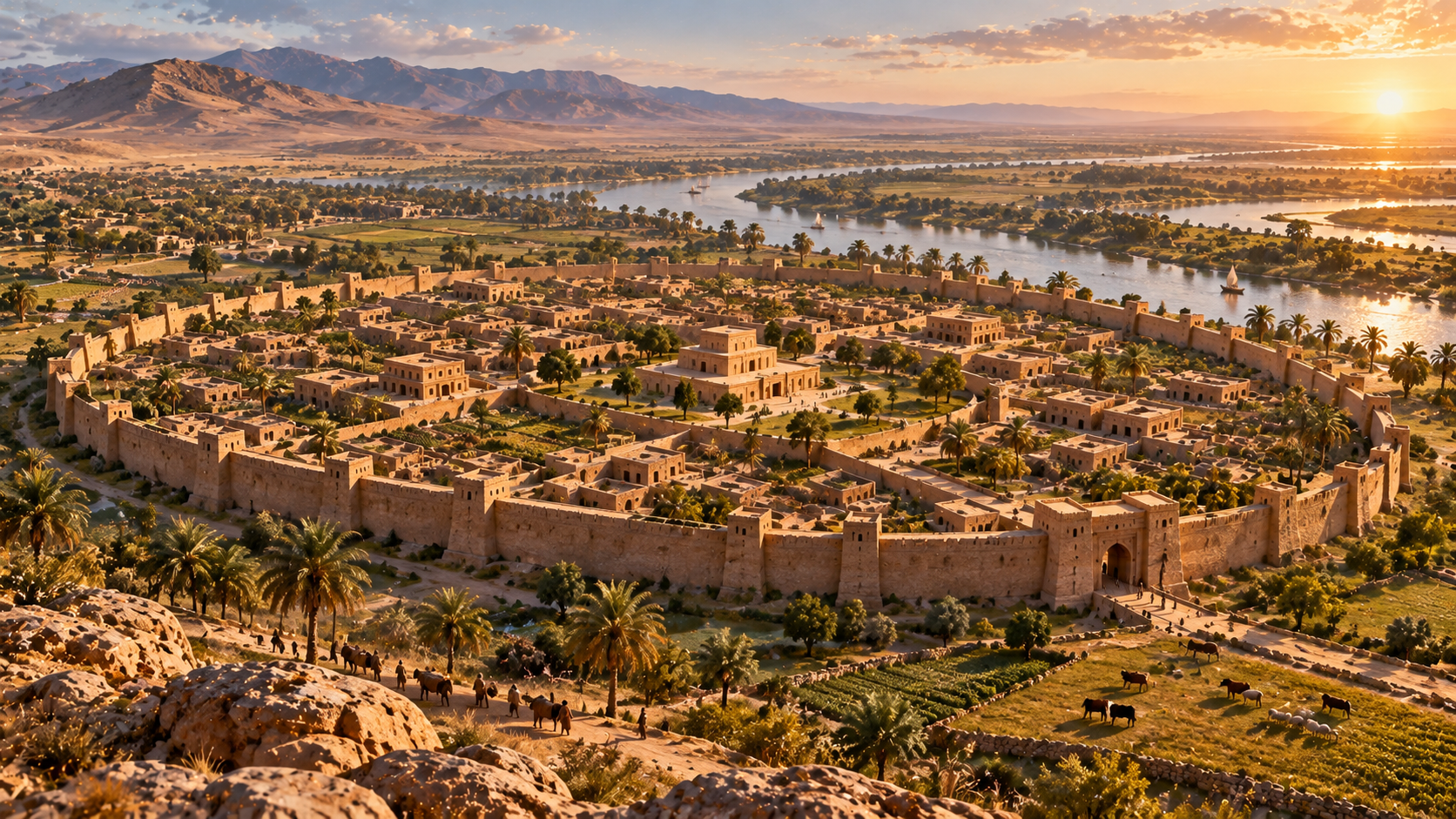
Imagine approaching a settlement in the ancient Persian Gulf region.
There are walls, brick buildings, places for instruction, a central temple, and organized districts devoted to different kinds of work.
People arrive from surrounding communities. Some come to learn. Others hope to carry new skills back to their families and neighbours.
This is our imaginative visit to the city described in Paper 66, not a reconstructed archaeological scene.
According to 66:3.1–3.6, Dalamatia had ten subdivisions, a wall said to be forty feet high, and an administrative centre associated with the Planetary Prince's staff.
Tyrion studied the plan.
"Ten districts?"
"Yes."
"Is there a district for biscuits?"
"The book mentions food and material welfare."
"Excellent. Finally, a government with sensible priorities."
But there is a difficulty we cannot politely overlook.
No accepted archaeological discovery has independently established the existence of this city around 500,000 years ago.
The book's map and description may make Dalamatia vivid. They do not make it a documented prehistoric settlement.
Ten Councils, One Astonishing Ambition
The city's most interesting feature may not have been its walls.
It was its classrooms.
In Paper 66, the narrator describes a staff organized into ten councils, concerned with practical areas such as food, animal husbandry, protection, learning, crafts, health, social relationships, and the regulation of communal life.
The plan sounds almost comically familiar: give everyone a department, a responsibility, and—one hopes—a reasonably clear idea of what happens next.
Tyrion listened carefully.
"So they wanted people to grow food, make things, care for each other, and stop arguing?"
"Broadly speaking."
"Ambitious."
"Very."
"Did they have a complaints department?"
"I'm fairly sure you would have invented one."
Yet underneath the bureaucracy was an appealing idea.
A civilization doesn't appear simply because someone builds a wall around a settlement.
People need to learn how to share resources, teach children, settle disagreements, care for vulnerable neighbours, and preserve useful knowledge.
The book imagines Dalamatia as a school for those tasks.
Civilization begins to matter when knowledge makes ordinary lives better.
A Student Goes Home
Picture an imaginary student arriving from a distant community.
At first, the city's routines seem strange.
Why should food be stored carefully? Why should a sick person receive attention from someone outside the family? Why spend time teaching a skill to a neighbour who might one day leave?
Slowly, our visitor learns.
Then comes the most important day: going home.
Not carrying a golden certificate, but carrying something far more useful—a better way to do one small thing.
Perhaps a safer shelter.
A more reliable food store.
A new way to cooperate when trouble comes.
This fictional student isn't named in the book. The scene illustrates the educational purpose the narrator assigns to Dalamatia.
Tyrion looked pleased.
"So a successful teacher makes someone else more capable?"
"Exactly."
"And a failed teacher?"
"Well?"
"Keeps all the biscuits and calls it leadership."
He had acquired a surprisingly sharp understanding of public administration.
The Prince Who Chose the Rebellion
Then the atmosphere changed.
Dalamatia's ruler, according to the book, was Caligastia, the Planetary Prince of Urantia.
When Lucifer's rebellion spread through Satania, Caligastia joined it. The mission that was supposed to help human communities became entangled in the very conflict we encountered at the beginning of our cosmic journey.
Some members of the Prince's staff remained loyal. Others joined the rebellion.
The result, as the book tells it, was division, a damaged educational mission, and a planetary history that took a more difficult course.
Tyrion watched the imaginary city.
"So they built all those councils to teach people how to work together."
"Yes."
"And then the people running them stopped working together?"
"That is part of the tragedy the text describes."
He shook his head.
"You couldn't write a better lesson about leadership if you tried."
The book's claims about celestial rebellion are not independently verified history.
But the human problem is familiar enough.
A society can teach admirable principles and still betray them through the choices of its leaders.
The City That Disappeared
There is one final, haunting turn.
The narrator claims that Dalamatia's remains eventually lay beneath water in the Persian Gulf region (66:7.16).
Imagine looking down through dark water at the possibility of a vanished city.
No visible streets.
No council chambers.
No schoolchildren hurrying home.
Just the question of what, if anything, lies below.
Tyrion peered over the edge of our imaginary research vessel.
"Have archaeologists actually found it?"
"No accepted discovery identifies a submerged city matching this account and its extraordinary date."
"So we shouldn't put a big red X on the map?"
"Not as if the site were established."
"Very well. A question mark, then."
Exactly.
A lost location makes a wonderful story. Finding one requires evidence.
The established archaeological record places recognizably urban Mesopotamian societies and writing hundreds of thousands of years later than the book's Dalamatia chronology. Ancient people were capable of remarkable ingenuity long before cities arose; that does not verify this particular city or its celestial administrators.
What Would Count as Finding Dalamatia?
Suppose someone announced tomorrow that an underwater expedition had discovered ancient walls in the Gulf.
Would that settle it?
Not by itself.
We would need reliable dating, secure archaeological context, evidence that the remains truly represent a settlement, and a convincing explanation of why that location should be identified with the precise claims of the book.
A similarity in geography or an impressive photograph wouldn't be enough.
The Atlas already maintains a detailed examination: EVR-006 — Dalamatia, a City 500,000 Years Ago. Its classification remains UNSUPPORTED, meaning the particular claim has not been independently corroborated—not that every conceivable vanished settlement has been ruled out.
Tyrion nodded.
"So a good mystery has to survive good questions?"
"Yes."
"Excellent. Now can we ask whether they had dogs?"
"There's no archaeological evidence for dogs living in this alleged city."
He looked horrified.
"I've changed my mind. We need more research immediately."
The Lesson Dalamatia Leaves Behind
We stood before the fading image of Dalamatia.
A city of teachers.
A city of councils.
A city whose rulers, in the book's telling, became caught in a devastating rebellion.
Even without accepting its ancient chronology as history, we can recognize an enduring question.
Can a civilization remain good if the people responsible for it stop serving the people it was built to help?
Tyrion looked toward the empty training courtyards.
"Maybe the most important lesson wasn't building the city."
"What was it?"
"Remembering why they built it."
Then he gave the map one final inspection.
"And keeping the food department accountable."
I couldn't argue with either conclusion.
Our next journey moves to another extraordinary mission in the book's account of Earth's past: Adam and Eve—and a garden whose story is far more complicated than a snake and an apple.
"Another garden?" Tyrion asked.
"Yes."
"Please tell me there's at least one tree."
"Many, according to the story."
"Good. I have certain professional responsibilities."
Continue the Adventure — Adam and Eve: A Mission That Changed the Story →
🔎 Factoid — Dalamatia's Source Trail and Evidence
- The Prince's arrival and proposed chronology: 66:0.2.
- Dalamatia's location, walls, districts, and buildings: 66:3.1–3.6.
- Education, council work, children, and early cultural development: Paper 66.
- The claimed submerged remains: 66:7.16.
- Independent investigation: EVR-006 — Dalamatia.
- Critical treatment of the book's racial claims: Race, Human Unity, and Historical Context.
Important: The Atlas's EVR work is AI-assisted documentary analysis, not an archaeological field investigation. The narrative's racial categories and claims about inherited superiority are not established population genetics and do not determine human dignity. Tyrion's dialogue, our student, and the imaginary visits are original fiction.
🧭 Optional Detours — The Archaeological Dossier
The Atlas's earlier research comparison remains available below for readers who want the precise claims, dates, and evidence limitations.
Archaeological Comparison — What Would Need Verification?
The book's portrayal is unusually specific. But a detailed description does not substitute for archaeological corroboration.
| Claim in The Urantia Book | Independent comparison | Present assessment |
|---|---|---|
| Around 500,000 years ago: Dalamatia supposedly served as a large organized headquarters (66:0.2; 66:3). | The Metropolitan Museum of Art's Ubaid overview places identifiable farming villages of southern Mesopotamia mainly in the millennia BCE, many hundreds of thousands of years later. | Unsupported as a Middle Pleistocene city. |
| Ten subdivisions, brick buildings, a forty-foot wall, and formal councils (66:3.3–3.6). | The Metropolitan Museum of Art's Uruk history describes an established Mesopotamian city with monumental mud-brick structures and administrative records around 3200 BCE. | Urban forms of the type described are independently documented much later, not at Dalamatia's claimed date. |
| An alphabet, writing materials, and a library of over two million records (66:5.9). | The Metropolitan Museum of Art's account of the origins of writing places the documented origins of Mesopotamian administrative pictography in the late fourth millennium BCE. | No accepted evidence of comparable Middle Pleistocene writing or archives. |
| A settlement now submerged (66:7.16). | Changing shorelines and underwater preservation complicate investigation; they do not establish that a specifically named city existed. | Unverified location and submergence claim. |
Scale matters: 66:7.1 says its land could support about 20,000; 66:7.20 says almost 6,000 residents were present at the rebellion, plus more than 1,000 visitors. The larger figure is capacity, not a reported census.
Researchers have documented sophisticated ancient technology, including worked and interlocking wood dating to roughly 476,000 years ago at Kalambo Falls in Zambia (Barham et al., Nature, 2023). This evidence challenges simplistic assumptions about ancient hominins; it does not establish cities, writing, or Dalamatia.
For methodology, source limitations, and the full comparison, read EVR-006 — Dalamatia, a City 500,000 Years Ago. Its UNSUPPORTED classification remains unchanged by this overview.
Further exploration: Planetary History & Human Origins · The Garden of Eden · Midwayers.