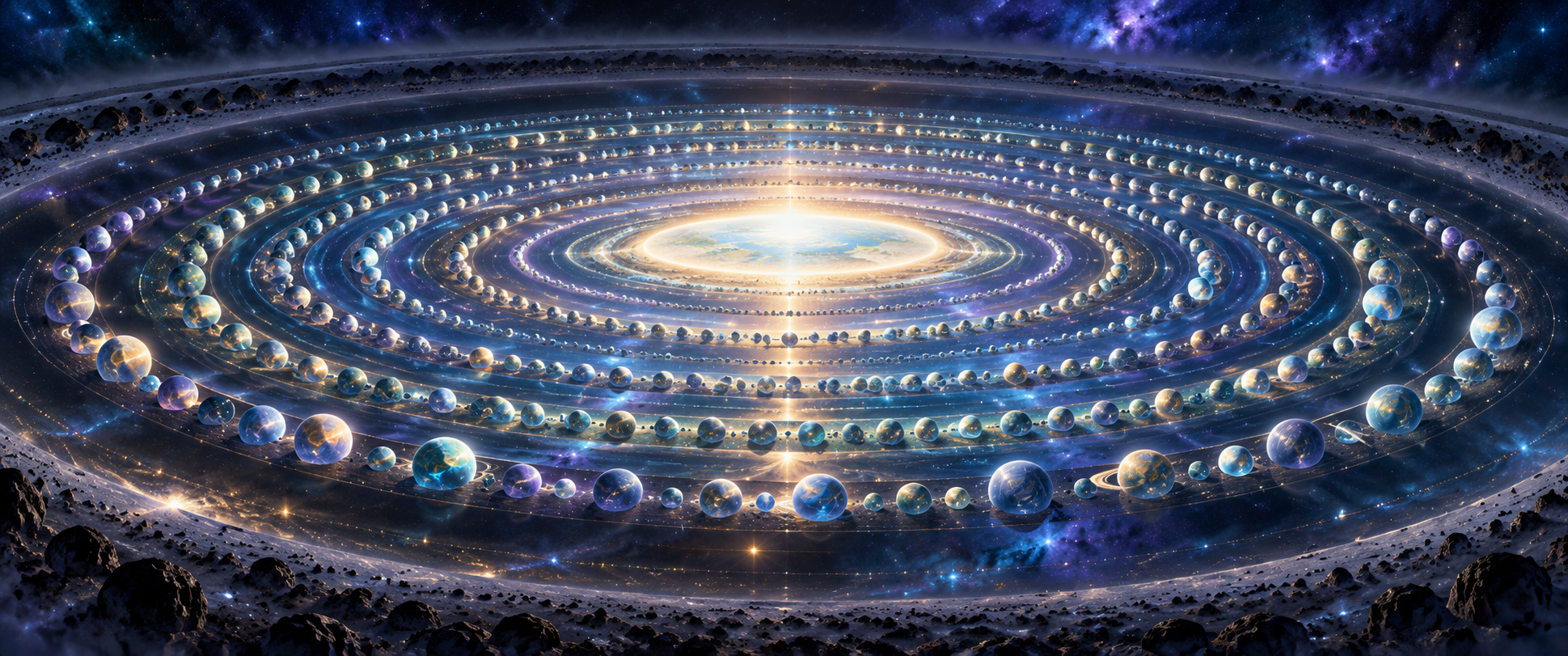
Havona — A Billion Worlds of Wonder
At Paradise, Tyrion had asked a reasonable question.
What could anybody possibly do with a billion worlds?
Now the observatory map was preparing to answer.
Seven luminous circuits appeared around the eternal Isle, one beyond another. The book calls this surrounding central universe Havona.
"Please," Tyrion said, his single central eye fixed on the glowing rings, "tell me those are parking areas."
"Not quite."
"Then what are they?"
"Worlds. One billion of them."
He sat down, both ears drooping.
"One billion worlds. I didn't even finish exploring Paradise."
"No one's asking you to visit them all this afternoon."
"That's the first reasonable thing you've said since we opened this map."
The Universe That Was Never Under Construction
Imagine a universe where no one has ever needed to put up a sign saying SORRY FOR THE INCONVENIENCE — PERFECTION UNDERWAY.
No half-finished galaxies. No temporary arrangements while somebody figures out the laws of nature. No celestial construction crew insisting that the whole thing will be finished by Thursday.
According to The Urantia Book, this is Havona: an eternal, already-perfect central universe surrounding the stationary Isle of Paradise.
Unlike the evolving superuniverses beyond it, Havona is described as complete, not gradually assembled through ages of trial and error. And yet it is anything but empty.
Its one billion worlds occupy seven concentric circuits, with more than 35 million in the innermost circuit and more than 245 million in the outermost. The text describes them as real, inhabited spheres—not vague patches of luminous mist.
Tyrion looked at the figures.
"One billion worlds. Seven circuits. I assume someone has compiled a visitors' guide."
"I imagine the contents would be extensive."
"Would it fit in my little travel bag?"
"Not if you want room for biscuits."
For all its astonishing arithmetic, the book's most appealing claim may be much simpler:
Not two of those billion worlds are alike.
The seven circuits aren't seven identical tracks filled with interchangeable worlds. Paper 14 describes each circuit as distinct and each world as a unique creation.
Tyrion brightened.
"So the number isn't the interesting part?"
"The number is impressive. The variety is the adventure."
"Good," he said. "Because I was starting to worry that the brochure would have one billion identical pages."
A Billion Different Ways to Be Wonderful
Think of the most beautiful place you have ever seen.
Perhaps a lake at sunrise. A forest after fresh snow. A city whose lights glitter across the water.
Now imagine that every world in an immense universe possesses its own beauty—its own architecture, landscapes, experiences, forms of life, and character.
The book says the worlds of Havona are individually designed and embellished. It even describes real rivers and lakes on them, while insisting that their physical organization is fundamentally unlike that of our evolutionary planets.
That last qualification matters. We are not supposed to imagine a billion copies of Earth with nicer sidewalks.
The text goes further: an unprepared human transported straight from Earth into Havona would, it says, lack the sensory capacity to perceive the surrounding environment. The beauty being described belongs to a level of existence for which ordinary human perception would not suffice.
Tyrion frowned.
"Are you telling me there could be a magnificent universe around me and I wouldn't even be able to see the biscuit bowl?"
"According to the book, our present senses wouldn't be adequate."
"An important argument for continuing my education."
Still, the underlying idea is enchanting: perfection need not erase individuality.
A perfect symphony does not require every instrument to play the same note. A beautiful garden does not become more beautiful by making every flower identical.
Why should a perfect universe be any less wonderfully varied?
The Perfect Place with No Parliament
Having recently witnessed the Lucifer rebellion, Tyrion was understandably interested in how Havona was governed.
"So," he asked, "who makes the rules?"
The answer sounded impossible.
According to Paper 14, Section 3, Havona has no regularly constituted courts and no legislative assemblies. Its inhabitants are described as so advanced in their relationships and judgment that ordinary political machinery is unnecessary.
"None?" Tyrion said.
"That's the account."
"No committees?"
"Not the kind you're imagining."
"No seven-hour speeches?"
"No guarantee about speeches."
His relief was brief.
This doesn't mean nobody coordinates anything. The book describes Havona as exquisitely administered, with each world directed by an Eternal of Days, a Trinity-origin personality.
That is an important distinction: the book portrays perfect self-government and wise administration, not the absence of organized life.
In the rebellion story, a magnificent administrator had tried to redefine liberty according to his own wishes.
Here, the narrative offers a contrasting ideal: beings who do not need to be constantly restrained because they have learned—or, in the case of Havona natives, inherently possess—the qualities that make cooperative freedom possible.
It's a thought worth taking home, even for those of us whose earthly committees remain in vigorous operation.
A School Without a Final Bell
Here's something that makes Havona more interesting than a collection of beautiful planets.
It's a place where people are still learning.
Not because the narrator thinks the worlds are unfinished. Havona itself is described as eternally perfect.
But a place can be complete while its visitors still have much to discover.
The book's native Havoners are not merely tour guides waiting for mortals from Earth. In 14:4.14–4.17, they have paths of their own development—progressing outward, inward, or within a single circuit.
And the ascending pilgrims from evolving worlds have their own astonishing route.
In Paper 26:3.1–3.2, the book says they enter through the outermost seventh circuit, then advance inward through all seven toward Paradise. There is no fixed universal timetable.
Tyrion examined the vast outer circle.
"So if you arrive from an ordinary planet, you start way out there?"
"According to the book."
"And then you move inward as you learn?"
"Yes."
"How long is orientation?"
"That's where the story becomes rather more personal."
The First Face at the Door
Imagine—and this is our own fictional scene—a newcomer arriving on one of Havona's receiving worlds.
The traveller has crossed the evolving universes, encountered wonders beyond description, and survived a great deal of learning.
Yet now, standing at the entrance to a perfect world, the traveller feels something remarkably familiar.
Will I belong here?
Tyrion's ears perked up.
"That's a rather important question."
It is.
And the book supplies an unexpectedly gentle detail.
According to 26:5.1, a group of ministering spirits called pilgrim helpers welcome the ascending arrivals to Havona.
Their work involves patient instruction and understanding, not merely assigning a number and directing everyone to a waiting room.
Tyrion looked relieved.
"Someone actually comes to welcome you?"
"That's what the passage says."
"Not simply hands you a form?"
"Not in the description."
"Marvelous. Perhaps eternity has finally improved its customer service."
It is difficult not to like the picture.
An enormous universe. One billion different worlds. And the first thing the weary traveller encounters is someone prepared to help.
A grand destination means more when there is a place for the newcomer.
The text continues to describe definite tasks, challenges, and progressive spiritual experiences, not a shortcut around learning.
Nor are all the worlds simply interchangeable stops on an endless tourist itinerary.
In the book's vision, spiritual growth means expanding the capacity to understand, to serve, and to appreciate what is good.
Perfection, in this story, doesn't end the adventure. It makes a deeper kind of adventure possible.
The Strangest Thing About a Perfect Universe
At this point Tyrion made an entirely reasonable objection.
"Wouldn't you eventually get bored?"
It was an interesting question. A universe without ordinary disorder, frustration, or danger might sound peaceful—but could it still be exciting?
The book answers with a startling insistence on curiosity.
In 14:5.6–5.11, Havona's worlds are described as endlessly individual, astonishing, and rewarding to explore. The narration portrays new discoveries as continuing from world to world, rather than petering out once a pilgrim has seen a few lovely landscapes.
The perfection of a world and the completeness of a visitor's understanding are not the same thing.
A beautiful piece of music can be complete while a listener continues discovering something new in it. A friendship can be deeply good without exhausting everything the friends might come to know about each other.
Perhaps, then, the ultimate adventure is not finding a place where every question has vanished.
Perhaps it is becoming the sort of person who can appreciate ever greater depths of beauty and truth.
Tyrion was quiet for several seconds.
Then he said, "So even in a perfect universe, I could still discover something new?"
"That's the idea."
"Good. Because I haven't even finished investigating the couch."
Beyond the Last Light
The map widened once more, revealing something unexpected around the outer Havona circuits.
Darkness.
Not simply the ordinary blackness between stars. In the book's account, vast belts of dark gravity bodies surround the central universe, moving in opposing directions and contributing to its gravitational balance.
The narrator says these bodies neither reflect nor absorb light and that they conceal Havona from nearby inhabited universes. The text also describes two belts revolving in opposite directions.
These are extraordinary claims belonging to the book's cosmology. No such Havona-encircling belts have been independently identified by astronomy, and we shouldn't equate them with black holes or conventional dark matter merely because they sound mysterious.
Tyrion regarded the darkened region.
"So the most beautiful place imaginable is behind an enormous cosmic curtain?"
"Something like that."
"Whoever designed this place certainly understands dramatic entrances."
Beyond those mysterious belts lies the next great setting of our adventure: the seven evolutionary superuniverses, including Orvonton, the one the book says contains Earth.
And the contrast could hardly be sharper.
Havona, the completed central universe. Outside it, vast evolving creations, still growing, still learning, still wrestling with the kinds of problems we met in the Lucifer rebellion.
One Last Look at a Billion Possibilities
Before leaving, I glanced back at the seven radiant circuits.
The book's Havona is not something we have independently mapped or observed. Its billion worlds, distinctive physics, celestial inhabitants, and dark gravity belts remain claims of its narrative.
But there is a remarkable philosophical invitation inside the story.
What if improvement does not have to mean becoming identical? What if growing wiser makes the world more interesting rather than less?
The good things in life do not become meaningless because we come to understand them better. Sometimes a new understanding is precisely what makes them beautiful again.
Tyrion leaned against the observatory rail, gazing at the circuits.
"One billion different worlds," he whispered.
"Quite a journey."
"And after all that, we're still not finished?"
"Not even close."
His tail began to wag.
"Excellent."
🔎 Factoid — The Havona Source Trail
This literary adventure draws primarily on Paper 14 — The Central and Divine Universe of The Urantia Book. The observatory, Tyrion's dialogue, and the contemporary comparisons are original fiction.
- One billion worlds in seven circuits: 14:0.1; 14:1.9–1.10
- Havona's distinctive material nature and the limits of ordinary human senses: 14:2.1–2.4
- Administration without regular courts or legislative assemblies: 14:3.1–3.4
- Native Havona lives and progressive development: 14:4.10–4.17
- Education, exploration, originality, and curiosity: 14:5.1–5.11
- Dark gravity bodies: 14:1.14–1.18
- Native Havoner development in three directions: 14:4.14–4.17
- Pilgrims progressing from the outer circuit toward Paradise and pilgrim helpers welcoming arrivals: 26:3.1–3.2 and 26:5.1
The original claims are treated as the book's claims, not as independently established physical discoveries or verified accounts of spiritual life.
An Appointment with the Orientation Department
As we were preparing to leave, Tyrion noticed a desk marked Celestial Orientation.
His face brightened.
"At last. Somebody who will understand my questions."
I had my doubts.
🎭 Celestial Intermission — Havona's Orientation Department (fictional)
An entirely imaginary briefing from the Reversion Directors.
MORTAL: “One billion worlds, and no two alike?”
REVERSION DIRECTOR: “That's the description.”
MORTAL: “So how long does orientation take?”
REVERSION DIRECTOR: “You are still thinking in weekends.”
MORTAL: “Fine. Can AI summarize the itinerary?”
REVERSION DIRECTOR: “It already did.”
MORTAL: “And?”
REVERSION DIRECTOR: “Nice place. Great atmosphere. Would visit again.”
MORTAL: “That's one billion reviews reduced to seven words!”
REVERSION DIRECTOR: “To be fair, it spent the rest of eternity formatting the footnotes.”
Original fictional satire inspired by the book's imagery—not a canonical passage, an actual celestial communication, or evidence that Havona exists.
The Next Door: Where Perfection Isn't Finished Yet
Beyond the dark gravity belts, our map revealed seven immense regions.
Not Havona.
Not Paradise.
The seven evolutionary superuniverses—the realms where the book places worlds still developing, personalities still learning, and governments still wrestling with difficult choices.
"Wait," Tyrion said. "Havona doesn't need regular courts or a parliament."
"That's the narrator's description."
"And out there?"
"Entire systems of government. Courts. Administrators. Conflicts."
He looked back toward the quiet perfection of Havona.
"Then why would anybody leave?"
"Perhaps because the adventure of becoming is as important to the story as the beauty of having arrived."
Tyrion considered that.
"So we're going back into a universe where people still make mistakes?"
"According to the book, very much so."
"Wonderful," he said. "I was beginning to feel suspiciously well behaved."
Continue the Adventure — The Seven Superuniverses →
🧭 Optional Detours — Take Another Path
The next chapter follows the main adventure into the seven superuniverses. If you want to revisit an earlier part of the cosmic map first:
These side paths are optional; the next chapter is ready above.