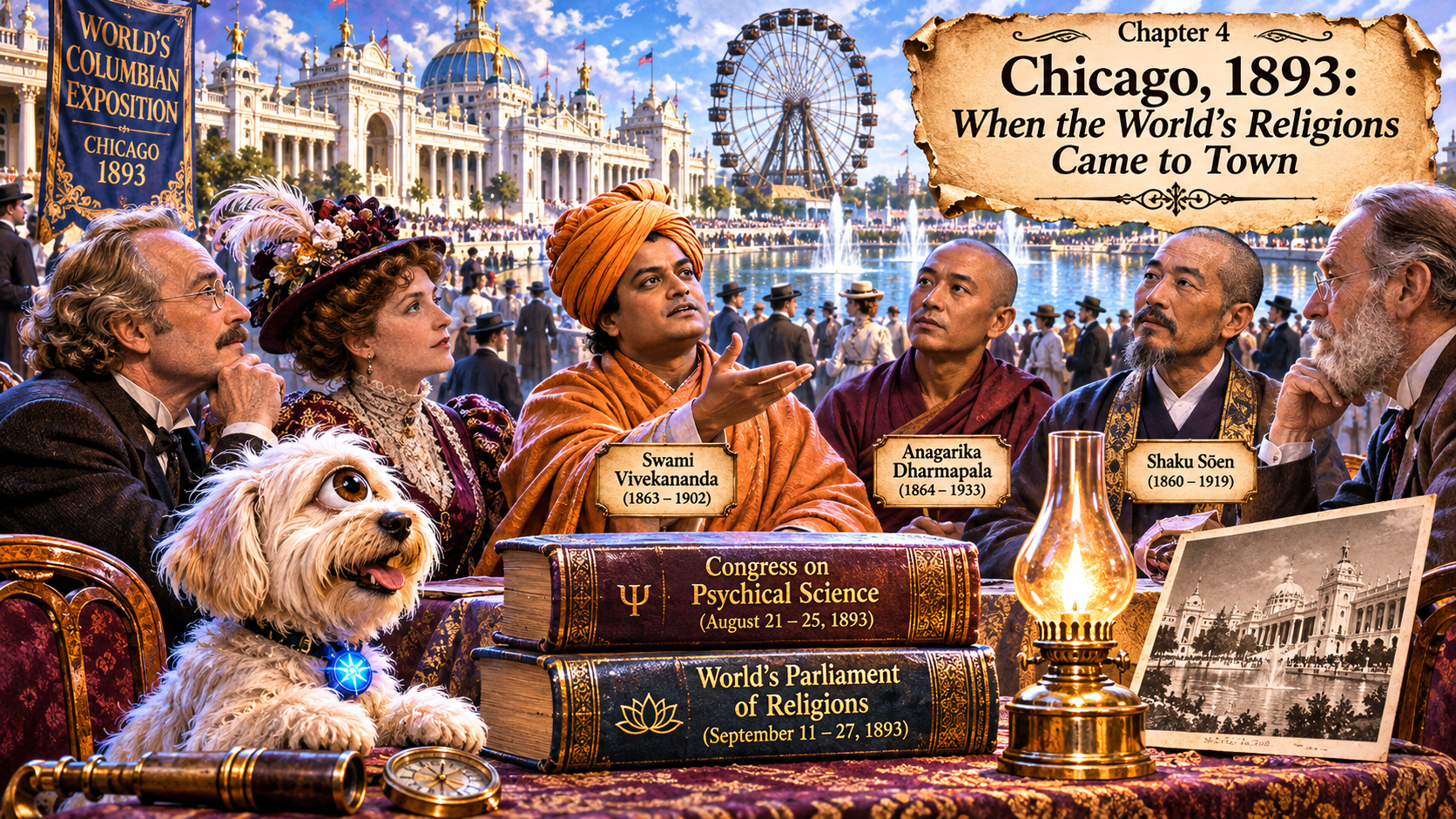
Chicago, 1893: When the World's Religions Came to Town
Historical Specials · Chapter 4 · Return to the historical introduction
The city that built the White City, welcomed the world's religious traditions, and invited investigators to discuss invisible realities—all in one extraordinary year.
The Year Chicago Decided to Show Off
Chicago, Illinois.
May 1, 1893.
The city had something to prove.
Twenty-two years earlier, the Great Chicago Fire had devastated much of its commercial centre.
Now, rising beside Lake Michigan, stood an astonishing exhibition of architecture, engineering, technology, industry, and human ambition.
The World's Columbian Exposition.
Its visitors would call its architectural centrepiece the White City.
And it was spectacular.
White neoclassical buildings surrounded immense lagoons.
Columns rose above landscaped avenues.
Fountains sparkled.
Electric lights transformed the evening landscape into something that must have seemed almost magical.
Beyond the main exhibition grounds stood the enormous original Ferris wheel.
Twenty-seven million admissions would be recorded during the fair's six-month run.
People arrived to experience what many regarded as a preview of the modern world's future.
Imagine walking into that environment.
The noise of machinery.
The crowds.
The languages.
The architecture.
The wonderful and occasionally bewildering sensation that humanity was inventing tomorrow faster than anyone could properly understand today.
The whole exposition seemed to proclaim:
Look what human intelligence can accomplish!
And it was difficult not to be impressed.
Of course, the name White City referred primarily to the pale architectural appearance of its buildings.
But the exhibition also reflected the racial assumptions, colonial attitudes, and unequal social arrangements of its age.
Its presentation of human progress was far from equally welcoming to everyone.
We will not confuse its extraordinary engineering achievements with a perfect vision of civilization.
Still, the atmosphere must have been intoxicating.
The future seemed to have arrived.
And it had brought a Ferris wheel.
Our little celestial investigator, Tyrion, would undoubtedly have requested an immediate inspection.
Especially after learning that the wheel carried passengers high above Chicago.
Apparently, the nineteenth century had discovered that the ground was no longer a compulsory feature of sightseeing.
But something even more remarkable was happening beyond the exhibition's dazzling buildings.
Chicago had invited the world to discuss its ideas.
Its science.
Its social problems.
Its religions.
And, rather unexpectedly, its ghosts.
More Than a World's Fair
The great exhibition was not simply a collection of impressive buildings and mechanical inventions.
Organizers had also arranged a remarkable series of intellectual gatherings known collectively as the World's Congress Auxiliary.
More than two hundred congresses would address subjects ranging from education and medicine to government, science, philosophy, religion, and women's progress.
These meetings brought speakers and audiences together to consider the challenges facing a rapidly changing world.
And here our story takes a fascinating turn.
Two of the year's gatherings deserve particular attention.
One would become famous for bringing representatives of different religious traditions into an unprecedented American public conversation.
The other would attract investigators interested in telepathy, mediumship, unusual mental phenomena, and the possibility of forces that conventional science had not explained.
They were separate congresses, held on different dates.
But they belonged to the same extraordinary intellectual environment.
The first was the Congress on Psychical Science, held August 21–25.
The second was the World's Parliament of Religions, held September 11–27.
Think about the contrast.
At one gathering, people asked whether invisible intelligences might communicate with humanity.
At another, religious representatives debated how human beings might understand God, truth, and one another.
Different questions.
Different participants.
Different approaches.
But both reflected a world increasingly unwilling to assume that its inherited explanations were complete.
And both would leave traces in the intellectual history leading toward the twentieth century.
The Strange Congress Nobody Should Forget
August 21, 1893.
Chicago's newly built Art Institute was hosting a gathering whose title sounded almost reassuringly scientific.
The Congress on Psychical Science.
A person unfamiliar with the subject might imagine discussions about psychology, human perception, and experimental investigation.
And those subjects were certainly relevant.
But the proposed agenda reached into considerably stranger territory.
Telepathy.
Trance states.
Apparitions.
Spiritualism.
Mediumship.
Experiences attributed to extraordinary mental powers.
And the possibility that human consciousness possessed capacities not yet explained by conventional science.
This was serious business to many participants.
The organizing effort had originated with John Curtis Bundy, editor of the Chicago-based Religio-Philosophical Journal.
After Bundy's death in 1892, Elliott Coues, an established naturalist who also pursued esoteric interests, assumed a leading organizational role.
The congress attracted the participation or contributions of researchers associated with the Society for Psychical Research, including Frederic W. H. Myers and Richard Hodgson.
Consider the significance.
Only forty-five years had passed since the Fox family's alleged knocking phenomena in Hydesville.
Now subjects associated with Spiritualism were being discussed under the auspices of an international gathering devoted to psychical research.
The questions had entered a new arena.
Not merely the parlour.
Not simply the public auditorium.
But an organized intellectual conference.
And that represented a development worth examining.
It did not mean the alleged phenomena had been proven.
Nor did official recognition of a topic as worthy of discussion establish the truth of its claims.
It meant that some investigators believed the questions merited serious attention.
The distinction is important.
You can study a claim without endorsing it.
You can investigate a phenomenon without accepting the explanation offered by its witnesses.
And you can respect someone seeking answers without agreeing with the answers they believe they have found.
That is exactly the kind of distinction our Atlas should preserve.
When the Investigators Disagreed
The Psychical Science Congress brought together individuals whose approaches were not always compatible.
Some were sympathetic to Spiritualism.
Others wanted stricter controls and more reliable observations.
Some regarded psychical phenomena as potentially revolutionary evidence that conventional science had overlooked important aspects of human existence.
Others worried that investigators were too willing to accept unreliable testimony.
And then there were the inevitable disputes over methods.
How do you control an experiment involving a person who claims unusual powers?
How do you verify a message allegedly received through a medium?
What counts as an independent witness?
How should investigators respond when an extraordinary phenomenon occurs only under conditions chosen by the person demonstrating it?
And what happens when the alleged ability disappears as soon as stricter controls are introduced?
These were not trivial questions.
They went to the heart of scientific investigation.
Consider a simple example.
A medium appears to know information that nobody present has consciously supplied.
One observer concludes that the information must have come from a spirit.
Another suggests ordinary communication, prior knowledge, inference, coincidence, or deliberate deception.
A third proposes an unknown psychological process.
And a fourth insists that everyone has overlooked the dog beneath the table.
That last investigator is Tyrion.
He has discovered an unusual smell.
Unfortunately, it is a biscuit.
The experiment continues.
But behind the humour lies a fundamental difficulty.
Observing something unusual does not necessarily identify its cause.
And even when observers agree about what happened, they may disagree profoundly about what it means.
A detailed historical study of the 1893 congress places it within Chicago's lively occult and Spiritualist culture. It concludes that the congress failed to establish psychical science as a recognized scientific discipline, despite its organizers' hopes.
The gathering's historical importance is nevertheless undeniable.
It shows that Chicago had become a meeting place for people attempting to investigate claims about the unseen world.
And it reveals something else.
The city was already familiar with extraordinary spiritual claims long before The Urantia Book appeared.
That does not establish any direct connection between the 1893 congress and the Urantia movement.
But it does establish a meaningful cultural setting.
And there is more to discover.
Because only a few weeks later, another gathering would begin.
One that would become far more famous.
September 11: The World's Religions Enter the Room
Chicago.
September 11, 1893.
Inside the newly constructed Permanent Memorial Art Palace—today's Art Institute of Chicago—an extraordinary assembly gathered.
Religious leaders.
Scholars.
Representatives of different traditions.
Journalists.
Curious members of the public.
The occasion was the opening of the World's Parliament of Religions.
For seventeen days, speakers would present religious teachings, discuss questions of faith, and consider the possibility of greater understanding between traditions.
The gathering included approximately four hundred delegates associated with forty-one religious denominations or traditions.
Audiences numbered in the thousands.
Imagine the atmosphere.
Christian ministers and scholars.
Jewish representatives.
Hindu teachers.
Buddhist delegates.
Other participants representing traditions unfamiliar to many members of the American audience.
There were differences in clothing, language, theology, religious practice, and cultural background.
And under one roof, these people were attempting something ambitious.
They were discussing religion in public.
Together.
An extraordinary undertaking.
Humanity had spent centuries discovering how to disagree about religion.
Now it was experimenting with something even more difficult.
Listening.
The opening ceremonies included a symbolic ringing of a bell.
The organizers hoped the gathering might encourage understanding and friendship among different religious communities.
The hall was crowded.
The speeches began.
And then a young Hindu monk stood to address the audience.
His name was Swami Vivekananda.
Five Words That Opened a Door
Swami Vivekananda, only thirty years old, had travelled from India to participate in the Parliament.
He stood before an American audience, far from home, representing a religious tradition that many Western observers knew primarily through secondhand accounts.
He opened with five memorable words:
Sisters and Brothers of America
The response was enthusiastic.
His address emphasized religious tolerance, acceptance, and the possibility that diverse traditions might contain genuine spiritual insight.
Over the following days, Vivekananda became one of the Parliament's most celebrated speakers.
Think about what made the moment significant.
For many Americans, Hinduism existed largely as a subject described by missionaries, scholars, and travellers.
Now a Hindu teacher was addressing them directly.
He was not asking permission for someone else to explain his religious tradition.
He was explaining it himself.
And his words challenged assumptions about which traditions deserved serious attention.
The implications extended far beyond one speech.
Religious understanding could no longer depend exclusively upon descriptions supplied by outsiders.
People from different traditions were demonstrating that they possessed their own voices.
Their own arguments.
Their own interpretations.
And their own criticisms of Western assumptions.
That mattered.
It still matters.
And the Parliament's significance becomes even clearer when we consider other participants.
Other Voices, Other Worlds
Vivekananda was not the only speaker asking the audience to look beyond familiar religious assumptions.
Among the Buddhist representatives was Anagarika Dharmapala.
He had travelled from Ceylon—now Sri Lanka—to participate in the gathering.
Dharmapala spoke about Buddhism as a religious and philosophical tradition worthy of serious intellectual attention.
He challenged Western misconceptions and emphasized features of Buddhist thought that he considered compatible with rational inquiry.
Another participant was the Japanese Zen teacher Shaku Sōen.
His presentations helped introduce American audiences to Buddhist perspectives that were frequently misunderstood or oversimplified.
The Japanese participant Hirai Kinzo also challenged anti-Japanese prejudice, demonstrating that religious dialogue could not be separated entirely from political and social realities.
These were not merely exotic visitors assembled for the entertainment of an American audience.
They were educated people with developed intellectual traditions, religious commitments, and independent perspectives.
Some were willing to challenge their hosts.
Others sought common ground.
Still others hoped the gathering might produce greater understanding between societies.
And this is where the Parliament becomes particularly meaningful.
People were encountering traditions they had previously known largely through the interpretations of others.
Now they could listen directly.
They might disagree.
They might remain unconvinced.
They might discover that an unfamiliar belief was more sophisticated than they had imagined.
But the encounter itself mattered.
It's difficult to imagine genuine understanding developing without the willingness to hear what another person actually believes.
Not what we assume they believe.
Not what their opponents say they believe.
What they believe.
And why.
That is a lesson worth carrying beyond 1893.
Indeed, it belongs at the very heart of our Atlas.
The Parliament Wasn't Quite as Universal as Its Name
Now, before we become too enthusiastic about the birth of modern interfaith dialogue, we should acknowledge a rather uncomfortable fact.
The World's Parliament of Religions did not actually represent all the world's religions equally.
Its leadership and organizational structure reflected the Christian-dominated American society in which it operated.
Christian speakers received a disproportionate share of the programme.
The Lord's Prayer opened daily sessions.
African American Christian leaders were underrepresented.
Indigenous religious leaders and traditions were excluded from meaningful representation.
The Church of Jesus Christ of Latter-day Saints was deliberately omitted.
That's quite a list of omissions for an organization with World's in its name.
One might reasonably wonder whether the organizers had consulted the entire world before selecting the title.
Apparently, not everyone received an invitation.
But the shortcomings do not erase the achievement.
They help us understand its limitations.
The Parliament expanded the possibilities for religious conversation while remaining constrained by assumptions inherited from its own society.
Both observations matter.
The organizers could sincerely promote brotherhood while still treating Christianity as the preferred framework for understanding other religions.
Non-Christian delegates could appreciate the opportunity to participate while disagreeing with the assumptions underlying the event.
Women could gain public visibility while continuing to encounter restrictions elsewhere.
Progress rarely arrives in a perfectly organized package.
It often emerges through incomplete attempts by imperfect people.
And there is something encouraging about that.
We don't have to pretend our predecessors were flawless to appreciate the doors they helped open.
But we should notice who was left standing outside.
The Theosophists Arrive With Their Own Questions
Another familiar name appeared during the Parliament's proceedings.
Theosophy.
Remember Helena Blavatsky from our previous chapter?
She had died in 1891.
But the movement she helped establish remained active.
From September 15 through 17, 1893, the Theosophical Society held its own congress in connection with the Parliament.
Its proceedings survive in a volume published that same year. The Library of Congress preserves a digitized copy.
Theosophists believed that the religious traditions of humanity contained insights into a deeper wisdom.
Their movement promoted comparative religion, spiritual development, and investigations of realities allegedly inaccessible to ordinary perception.
Those interests made the Parliament an especially attractive setting.
After all, here was a gathering devoted to bringing religious traditions into conversation.
And Theosophists believed the connections between those traditions held enormous significance.
But their presence also raised questions.
Could similarities between religions demonstrate a shared spiritual origin?
Or might those similarities arise from historical contact, common human concerns, and patterns of cultural development?
How should investigators distinguish historical influence from apparent resemblance?
And when someone claims access to hidden knowledge, what establishes that the information actually came from its purported source?
Those questions sound remarkably familiar.
They should.
We've been asking versions of them since the Fox sisters' farmhouse.
And we will encounter them again when our journey reaches The Urantia Book.
Tyrion Attends the Parliament
An entirely fictional Atlas time-travel interlude.
Tyrion had obtained a visitor's pass.
This was an achievement.
His official application had presented several difficulties.
Under Religious Affiliation, he had written:
Universal Brotherhood of Small Fluffy Dogs.
Under Educational Qualifications:
Advanced biscuit recognition.
And under Special Abilities:
Possesses one eye, but misses very little.
His application was initially rejected.
He appealed.
The committee reconsidered.
Someone suggested that a gathering devoted to religious understanding should perhaps demonstrate a little understanding toward an unusually inquisitive dog.
Tyrion was admitted.
He listened attentively as speakers described the spiritual traditions of humanity.
One emphasized compassion.
Another discussed truth.
A third spoke of moral development.
Tyrion was deeply impressed.
He concluded that many religious differences might become considerably less troublesome if their adherents spent more time practising kindness.
Then he asked whether kindness included sharing biscuits.
The delegates were unable to reach a unanimous position.
The matter was referred to a committee.
End fictional interlude.
A City With Two Extraordinary Conversations
Now consider something we've uncovered.
During August and September 1893, Chicago hosted two very different conversations.
At the Psychical Science Congress, investigators debated the evidence for extraordinary mental phenomena and alleged communication with unseen intelligences.
At the Parliament of Religions, participants presented competing religious teachings, discussed spiritual experience, and considered the possibility of greater understanding between traditions.
The Theosophical Congress added another dimension to the gathering.
And all these events unfolded against the spectacular backdrop of the World's Columbian Exposition.
It was an unusual convergence.
Technology.
Religion.
Psychology.
Spiritualism.
Philosophy.
Social reform.
Scientific ambition.
And an almost boundless fascination with the future.
But we must resist another tempting conclusion.
The presence of these movements in the same city does not prove that their participants shared a common hidden project.
Nor does it establish a direct relationship between these gatherings and the later origin of The Urantia Book.
What we have established is more modest.
And more historically defensible.
Chicago possessed a lively environment in which unusual religious ideas and claims of extraordinary knowledge received public attention.
People were already asking questions that would remain relevant in the twentieth century.
Could the universe contain unseen personalities?
Could extraordinary communications provide new religious knowledge?
How should unusual mental experiences be investigated?
Could humanity's religious traditions be reconciled within a larger understanding of spiritual reality?
And what should we do when extraordinary claims exceed the available evidence?
Those questions did not originate in Chicago.
But Chicago was becoming an important place to ask them.
The Young Man Who Wasn't There
Here our story approaches a person who will eventually become central to the historical mystery surrounding The Urantia Book.
His name was William Samuel Sadler.
Born in Indiana in 1875, Sadler was eighteen years old during the great Chicago exposition.
But we have no verified evidence that he attended the Parliament of Religions or the Psychical Science Congress.
And we should not place him in either audience simply because it makes a compelling story.
According to later biographical accounts, Sadler moved to Chicago in 1895 to work with the Chicago Medical Mission.
That distinction is important.
The intellectual environment preceded Sadler's documented Chicago career.
We can trace the city's developing religious and investigative culture.
We can examine the institutions he later entered.
We can investigate his own writings and professional interests.
But we cannot invent a meeting, a conversation, or a moment of inspiration merely because history provides a convenient setting.
Our story doesn't need those inventions.
The documented events are fascinating enough.
Young Sadler would eventually pursue medicine, public speaking, psychology, religious questions, and investigations of purported psychic phenomena.
His career would bring him into contact with debates concerning the human mind and extraordinary experiences.
And many years later, he would become closely associated with the group that brought The Urantia Book into publication.
But we have some ground to cover before reaching that point.
A great deal, actually.
And Tyrion has already expressed concern about the reading requirements.
Apparently, the nineteenth century possessed no mechanism for limiting the length of religious investigations.
The Lights Go Out
October 30, 1893.
The World's Columbian Exposition closed.
The enormous exhibition had attracted millions of visits.
Its buildings and electrical displays had impressed audiences.
Its Ferris wheel had demonstrated an extraordinary triumph of engineering.
Its congresses had brought together people whose ideas sometimes differed profoundly.
For six months, Chicago had presented an ambitious vision of modern civilization.
Then the crowds began to disperse.
The visitors went home.
The lectures ended.
The exhibits were dismantled or dispersed.
Much of the White City would eventually disappear.
But the conversations did not vanish with the buildings.
Religious pluralism continued developing.
Theosophical ideas travelled through books and organizations.
Psychical investigators continued debating unusual phenomena.
Spiritualist communities remained active.
And the intellectual questions that had animated the congresses persisted.
Some would become part of organized academic research.
Some would remain within religious communities.
Some would attract sensational publicity.
Others would become entangled in accusations of fraud.
And still others would find new expression in the extraordinary religious literature of the twentieth century.
Chicago had demonstrated that humanity could construct an astonishing temporary city.
But its deeper legacy may lie partly in the conversations that continued after the lights went out.
Sixty-Two Years Before October 1955
We began our historical adventure with two young girls in a farmhouse.
Then came the public demonstrations.
Victorian séances.
Scientific investigations.
Kardec's Spiritism.
Blavatsky's Theosophy.
Newbrough's Oahspe.
And now, Chicago in 1893.
Look how far the questions have travelled.
From a reported knock in a wooden wall to international gatherings debating the nature of mind, religion, and spiritual reality.
The next chapter of our historical journey will move into the early twentieth century.
Medicine and psychology are developing rapidly.
Investigators are reconsidering hypnosis, dreams, dissociation, trance states, and unusual experiences of consciousness.
Meanwhile, William S. Sadler is building his career.
And somewhere along that road, an unidentified sleeping subject will enter the historical accounts associated with The Urantia Book.
That is where our investigation will become especially intriguing.
Because we'll have to distinguish between what Sadler claimed, what surviving documents establish, what later participants remembered, and what subsequent researchers have inferred.
Eventually, Edgar Cayce will enter the discussion.
Not because we've already decided he was connected with the Urantia phenomenon.
We haven't.
But because some readers have proposed that connection, and a serious historical investigation should examine the claim rather than ignore it.
For now, though, our time machine remains parked in Chicago.
The fairgrounds are quiet.
The electric lights have dimmed.
The religious delegates have returned home.
And the investigators of psychical phenomena are continuing their arguments elsewhere.
Tyrion stands beside Lake Michigan.
His glowing collar illuminates the evening.
He looks toward the city.
Then toward the stars.
One enormous eye.
One unanswered question.
And a very small dog who has somehow developed an interest in the history of human religious thought.
He seems pleased.
The universe, apparently, contains an impressive number of mysteries.
And we've barely begun investigating them.
The Question Chicago Left Behind
The World's Parliament of Religions did not establish that all religions taught identical truths.
The Psychical Science Congress did not establish that humans could communicate with the dead.
The Theosophical Congress did not verify the extraordinary sources claimed for its teachings.
But these gatherings revealed something deeply important.
People were willing to bring difficult questions into public conversation.
Sometimes they listened.
Sometimes they disagreed.
Sometimes they misunderstood one another.
And sometimes they discovered that the person across the room possessed a wisdom they had never encountered before.
Perhaps that's a lesson worth preserving.
We don't have to agree about the universe to explore it together.
We do, however, owe one another intellectual honesty, curiosity, and respect.
And perhaps a little humour.
After all, humanity managed to build a giant Ferris wheel, organize hundreds of congresses, and debate the nature of invisible reality—all in a single summer.
That's quite an accomplishment.
And somewhere, undoubtedly, an exhausted conference organizer was wondering whether the universe could possibly contain fewer committees.
Next historical chapter: The Doctor, the Mind, and the Unexplained — William S. Sadler Enters the Story.
Our historical journey is drawing closer to Chicago's most intriguing twentieth-century mystery.
Truth. Beauty. Goodness. HUMOUR.
🔎 Factoid — What the Historical Evidence Establishes
| Event | Date |
|---|---|
| World's Columbian Exposition | May 1–October 30, 1893 |
| Congress on Psychical Science | August 21–25, 1893 |
| World's Parliament of Religions | September 11–27, 1893 |
| Theosophical Congress | September 15–17, 1893 |
| Sadler's move to Chicago, according to later biographical accounts | 1895 |
An important location detail: The Parliament and the Psychical Science Congress met in the newly built Memorial Art Palace, today the Art Institute of Chicago on Michigan Avenue. That building was not one of the temporary White City exhibition palaces in Jackson Park.
One source correction: The University of Illinois dissertation discussed earlier was written by historian John M. Andrick, not Douglas F. Johnson. Its title is A Modern Mecca of Psychic Forces: The Psychical Science Congress and the Culture of Progressive Occultism in Fin-de-Siècle Chicago, 1885–1900 (2016).
Recommended historical sources
- Chicago History Museum — Parliament of the World's Religions
- Library of Congress — The 1893 Exposition
- University of Illinois — Psychical Science Congress dissertation
- Chicago Public Library — Congress programmes and archival records
- Library of Congress — Original 1893 Theosophical Congress proceedings
- Harvard Pluralism Project — Buddhist participants
Our historical boundary: The events, dates, institutions, and named participants are historically documented. Scenes of everyday experience are literary reconstructions. Tyrion's appearances are explicitly fictional. The existence of these congresses establishes neither the paranormal claims discussed there nor a causal connection to the later creation of The Urantia Book.