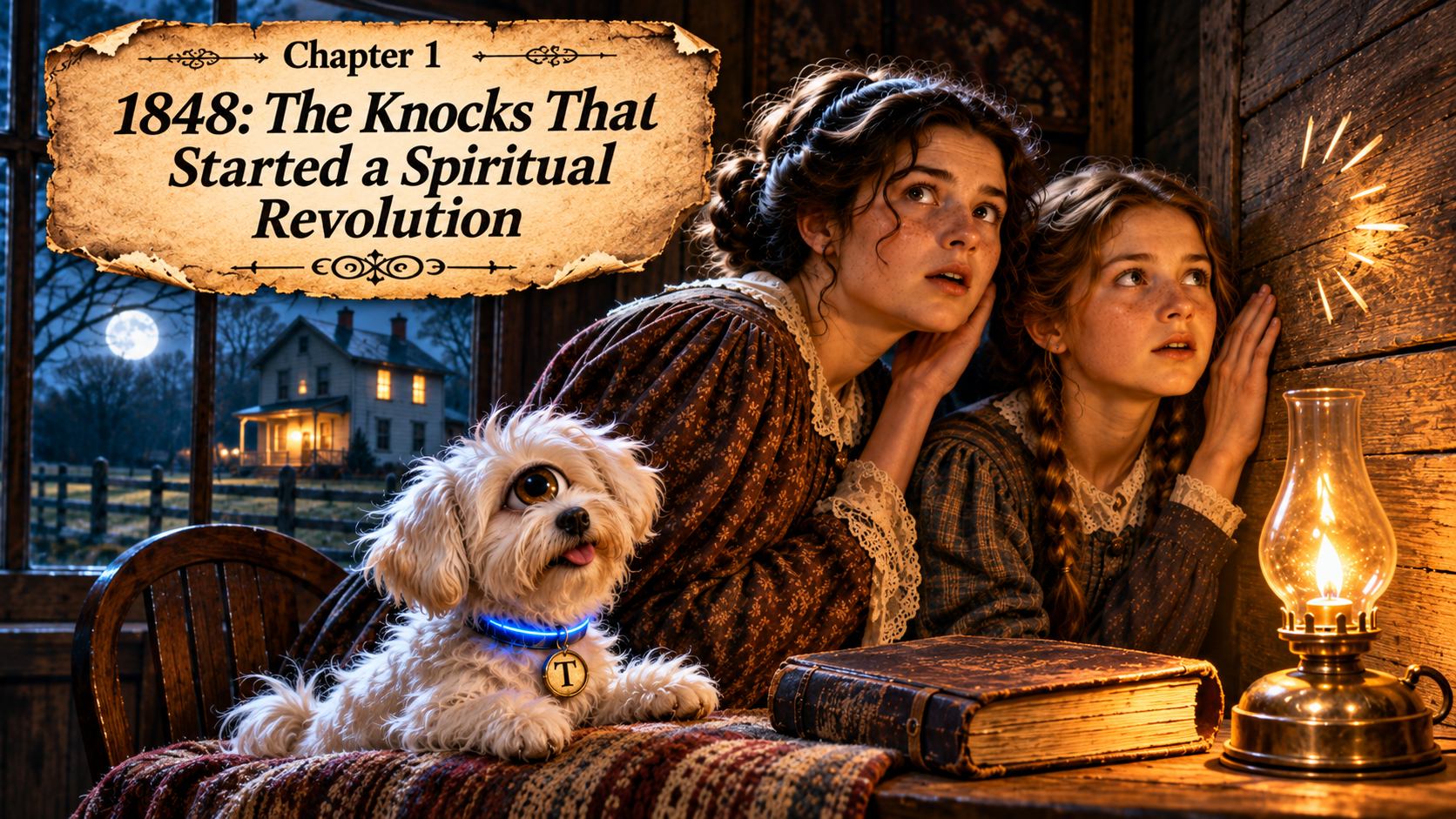
1848: The Knocks That Started a Spiritual Revolution
Historical Specials · Chapter 1 · Return to the historical introduction
Before there was a mysterious book in Chicago, there was a farmhouse in New York—and a sound that made people wonder whether death had finally learned to answer back.
The Night Someone Knocked Back
Hydesville, New York.
March 31, 1848.
A farmhouse stood in the countryside, its occupants preparing for another night's sleep.
Outside, the American spring was slowly waking.
Inside, the Fox family had a problem.
Something kept knocking.
Not the ordinary groaning of an old house settling into its foundations.
Not simply the wind rattling loose boards.
According to the family's account, these knocks appeared to respond to people.
And that made matters considerably more interesting.
Two young sisters, Maggie and Kate Fox, had heard the strange noises repeatedly.
Their parents were understandably concerned.
Because there's something unsettling about hearing unexplained sounds in your home.
Especially when the house appears to be answering questions.
One of the girls reportedly challenged the mysterious presence to imitate the sound she made.
It did.
Or, more precisely, witnesses reported hearing a corresponding series of knocks.
Imagine the moment.
A young girl makes a sound.
Something answers.
She tries again.
Another answer.
Suddenly, the family isn't simply investigating a noisy house.
They're wondering whether someone—or something—is trying to communicate.
And here the story takes its extraordinary turn.
Margaret Fox, the girls' mother, began asking questions requiring numerical answers.
How many?
How old?
Could the unseen presence identify particular facts?
According to later accounts, the knocks appeared to respond correctly.
The family became increasingly convinced that they were communicating with an intelligence they couldn't see.
A neighbour was summoned.
Then others became interested.
Soon the question extended beyond the farmhouse.
If the dead could communicate with the living, what else might they know?
It was an extraordinary possibility.
It was also the beginning of a controversy that would continue for generations.
The Most Important House in the Neighbourhood
There is something delightful about the sheer modesty of the setting.
Nobody had constructed a grand temple.
No famous university had announced a revolutionary discovery.
No scientific institution had unveiled a machine capable of detecting invisible beings.
The excitement began in a farmhouse.
With two girls.
And knocking.
Of all the ways an alleged spirit might introduce itself to humanity, this one demonstrated a remarkable commitment to keeping expenses down.
No expensive laboratory equipment.
No elaborate instruments.
Just a wall, a few questions, and an audience willing to listen.
But the people gathering around the Fox family weren't necessarily foolish or unusually gullible.
They lived in a world undergoing enormous change.
Railroads were transforming travel.
Telegraph lines were making it possible to exchange messages across distances that would once have seemed astonishing.
Established religious teachings were being challenged by new movements and competing interpretations.
People were asking difficult questions about the nature of reality.
What could science explain?
What remained mysterious?
Could religious truth be discovered outside traditional institutions?
And perhaps the most personal question of all:
What happens to the people we love when they die?
There was no shortage of grief in nineteenth-century life.
Illness, accidents, childbirth complications, and childhood mortality were familiar realities.
For someone who had recently buried a husband, wife, parent, or child, the possibility of hearing from the dead wasn't merely intellectually fascinating.
It could represent hope.
The chance of one more conversation.
One more reassurance.
One more opportunity to say something left unsaid.
That longing deserves our sympathy, even while the evidence for particular spirit communications demands critical examination.
A Message from the Other Side?
As word spread, the Fox family's experiences attracted increasing attention.
The sisters eventually travelled to Rochester, where their older sister Leah lived.
There, their claims reached people involved in religious reform and progressive social movements.
Among those interested were Isaac and Amy Post, Quakers who supported causes including abolition and women's rights.
The Posts were willing to investigate the unusual phenomena.
They also understood something important.
If an unseen intelligence could really communicate, the implications would extend far beyond a single supposedly haunted farmhouse.
A new kind of religious authority might become possible.
Not simply scripture inherited from the past.
Not merely doctrine interpreted by religious institutions.
But communication allegedly occurring in the present.
Imagine the appeal.
People could ask their questions directly.
What happens after death?
Do our loved ones survive?
Are departed spirits aware of our lives?
What does the spiritual world look like?
Suddenly, the universe seemed potentially more conversational.
And considerably more crowded.
The Fox sisters began attracting larger audiences.
Public demonstrations followed.
Some witnesses reported convincing phenomena.
Others remained skeptical.
And the growing movement took on a name:
Modern Spiritualism.
The idea of contacting spirits was hardly new. Human cultures had described encounters with unseen beings for thousands of years.
What made this movement distinctive was its claim that ordinary people could seek relatively regular, sometimes experimentally observed communication with the departed.
The nineteenth century was developing an astonishing new technology.
It was also developing a popular religion in which invisible personalities allegedly communicated through coded knocks.
The parallels were irresistible.
The telegraph carried messages through wires.
Spiritualists claimed that mediums could carry messages across the boundary of death.
One system had demonstrable electrical machinery.
The other had claims that still needed to be tested.
But both captured an age fascinated by communication across seemingly impossible distances.
The Living, the Dead, and the People in Between
As Spiritualism grew, the methods of alleged communication expanded.
Knocking was only the beginning.
Some mediums reported entering trances.
Others claimed to speak in voices belonging to departed personalities.
Some produced written messages without consciously composing them.
Groups gathered around tables, waiting for movements interpreted as responses from unseen beings.
These practices became known through terms such as séances, trance mediumship, and automatic writing.
And wherever extraordinary claims attracted enthusiastic believers, they also attracted investigators.
Some researchers approached the subject with sincere curiosity.
Others suspected trickery from the beginning.
Stage magicians recognized methods by which audiences could be deceived.
Scientists worried about inadequate controls and unreliable observations.
Religious authorities debated whether the alleged communications represented divine revelation, human imagination, dangerous spiritual interference, or outright fraud.
Meanwhile, grieving families continued arriving.
That contrast matters.
For an investigator, a séance might represent an experimental claim.
For an entertainer, it could represent a paying audience.
For a religious reformer, it might suggest a revolutionary new spiritual truth.
For a mother mourning her child, it might simply represent the hope that love had not ended at the grave.
The same room could contain very different reasons for wanting the knocks to be real.
And that leads us to a difficult question.
What happens when people desperately want an extraordinary claim to be true?
The Confession That Shook the Movement
Forty years after the Hydesville events, Maggie Fox made a sensational public confession.
In 1888, she stated that the mysterious knocking phenomena had been produced through deliberate deception.
She described methods involving objects and bodily movements, including cracking joints to generate sounds.
According to her account, what began as a childhood trick had grown into something neither sister could easily escape.
The revelation was devastating to those who regarded the sisters as founding witnesses of Modern Spiritualism.
For skeptics, it appeared to confirm what they had suspected.
But the controversy didn't end there.
Maggie subsequently withdrew her confession.
Supporters argued that the retraction cast doubt on the earlier admission.
Critics argued that a retraction didn't erase the demonstration of how the sounds could be produced.
And historians faced the more difficult task of distinguishing the sisters' various statements, motivations, performances, and documentary evidence.
The result?
The famous Hydesville story remains historically important.
But the reported knocks do not provide established evidence of communication with the dead.
A movement had been launched.
Millions of questions had been raised.
Lives had been changed.
And the original phenomenon remained entangled in accusations of deception and disputed testimony.
We should pause over that.
A claim can have enormous historical consequences without being true.
A story can transform religious culture without proving its supernatural explanation.
And a person can sincerely believe something extraordinary while being mistaken about what happened.
Those distinctions will become extremely important when our historical journey eventually reaches Chicago.
An Idea That Refused to Die
One might imagine that a founding medium's public confession would bring the Spiritualist movement to an immediate halt.
It didn't.
By then, Spiritualism had developed far beyond the Fox sisters.
Its supporters had established organizations, publications, lecture circuits, and communities.
Its teachings appealed to people with many different religious backgrounds.
Some understood it as a scientific investigation of survival after death.
Others viewed it as a religious path.
Still others combined Spiritualist beliefs with established Christianity or broader philosophical ideas.
The movement also intersected with campaigns for social reform, including women's public participation.
In a society where women's opportunities for religious leadership were often restricted, mediumship could offer a surprising degree of public influence.
Of course, the same environment that elevated some women also exposed many to exploitation, public scrutiny, and intense personal pressure.
The history is not a simple celebration.
Nor is it merely an amusing catalogue of supernatural claims.
It is a story about people.
Their hopes.
Their vulnerabilities.
Their ambitions.
Their disagreements.
And their willingness to imagine that reality might contain more than could be seen.
The Questions Travel West
By the end of the nineteenth century, the Spiritualist movement had become one part of a much larger spiritual and intellectual landscape.
Other currents were developing.
In France, Allan Kardec had organized a distinct movement known as Spiritism.
In the United States and Europe, Theosophy attracted people interested in ancient wisdom, reincarnation, and esoteric interpretations of religion.
Investigators began organizing systematic studies of allegedly paranormal phenomena.
Some researchers hoped to uncover genuine evidence of unknown forces or surviving personalities.
Others wanted to expose deception and understand the psychology of belief.
Religious reformers explored alternatives to traditional doctrines.
The unseen world had become a subject not only of faith, but of public debate.
And among the cities where these debates would find an audience stood a rapidly expanding American metropolis.
Chicago.
Its railroads carried goods and travellers across the continent.
Its newspapers carried sensational stories and serious arguments.
Its growing cultural institutions reflected a city eager to participate in the intellectual life of the modern world.
And as the nineteenth century drew toward its close, Chicago would become a gathering place for people examining religion, mystical experience, and psychical claims.
A city of industry.
A city of science.
A city of religious experimentation.
And eventually, a city in which an unusual group of people would gather around a mysterious series of writings.
But we are not there yet.
We still have several decades to travel.
A Question We Must Not Answer Too Quickly
There is a temptation to draw a straight line.
The Fox sisters began with mysterious knocking.
Spiritualists developed séances.
Other movements explored trance states and automatic writing.
Later, in Chicago, individuals associated with The Urantia Book reported an unusual sleeping subject and communications attributed to nonhuman personalities.
Therefore, one might conclude, the Urantia phenomenon must have been another example of Spiritualism.
But that conclusion would move faster than the evidence permits.
Historical resemblance does not establish identical causes.
Shared cultural surroundings do not establish direct influence.
And claims of supernatural communication cannot be verified merely because witnesses sincerely reported them.
Dr. William S. Sadler would eventually distinguish the Urantia sleeping-subject case from conventional Spiritualism and mediumship.
Whether his distinction withstands careful historical analysis remains a question for a later chapter.
And then there is Edgar Cayce.
The celebrated sleeping psychic.
The man whose name some readers would later associate with the mysterious Urantia subject.
Could the two histories be connected?
Or have later enthusiasts confused similarities with evidence?
We will investigate that question carefully.
Not because we expect a sensational answer.
But because an unanswered question deserves more than an attractive rumour.
For now, we should leave the mystery where the evidence leaves it.
Open.
The Knock That Became a Century of Questions
Return with me for a moment to that little farmhouse in Hydesville.
A mother asks a question.
A sound is heard.
The family wonders whether someone invisible has answered.
Nobody in that room could have known exactly how influential the resulting story would become.
They could not have anticipated the religious controversies, scientific investigations, public performances, and spiritual movements that would follow.
And they certainly could not have imagined that, nearly a century later, people investigating the origins of a mysterious book published in Chicago would still be asking related questions.
Who communicates?
Who receives?
What constitutes evidence?
How do we distinguish revelation from imagination?
And how should we respond when someone insists that the extraordinary has happened?
The Fox sisters did not resolve those questions.
Neither did the movement they helped inspire.
But their story reminds us of something important.
Human beings possess a remarkable capacity for curiosity.
We want to know whether death ends personal existence.
We wonder whether the universe contains intelligences beyond our own.
We search for meanings larger than our individual lives.
Sometimes these questions lead to discovery.
Sometimes to disappointment.
Sometimes to deception.
And sometimes to stories so captivating that we forget to ask whether they are true.
The challenge is to preserve both capacities.
The imagination to consider extraordinary possibilities.
And the judgment to examine them carefully.
Because the universe may indeed contain more than we presently understand.
But if it does, we owe that mystery something better than unquestioning belief.
We owe it our curiosity.
Our honesty.
And perhaps a sense of humour.
After all, our journey began with a reported knock.
And look how much conversation followed.
Next in our historical adventure: a nineteenth-century world captivated by invisible intelligences, spirit messages, religious reform, and the surprising intersection of science and the supernatural.
Our road eventually leads to Chicago, William Sadler, Edgar Cayce, and the extraordinary publication of October 1955.
But first, we need to meet the people who made the unseen world an international subject of debate.
🔎 Factoid — What the historical evidence establishes
The Hydesville events: March 31, 1848, has become the traditional founding date of Modern Spiritualism. Contemporary and later accounts differ in some details, but the movement's growth following the Fox sisters' reported experiences is well documented.
The confession: Maggie Fox publicly repudiated the claimed spirit communications in 1888, then withdrew her confession. Historians can document these conflicting statements without assuming they prove the supernatural phenomena genuine.
Recommended sources: Smithsonian Magazine — The Fox Sisters and the Rap on Spiritualism and National Spiritualist Association of Churches — Hydesville Park History. The latter documents the movement's own interpretation and should be read as a participant-tradition source.
Our historical boundary: The farmhouse dialogue and atmosphere have been reconstructed for storytelling. We have not established that any spirit communicated with the Fox family. Nor have we established a direct historical connection between the Fox sisters and the origins of The Urantia Book.