Planetary History & Human Origins — The Earth Before Our Stories
The observatory had gone quiet.
We had investigated distant celestial capitals, met an improbable cast of cosmic neighbours, and arrived at the mystery of being ourselves. The map should have been ready for retirement.
Instead, Tyrion found another button.
EARTH: EARLIER EDITIONS.
He pressed it.
The continents began moving. Ice sheets spread and retreated. Forests appeared and vanished. Familiar cities melted away until the world looked nothing like home.
Tyrion watched his favourite walking route disappear under the landscape of another age.
"Wait. Where's the pavement?"
"There isn't any yet."
"The houses?"
"Not yet."
"The biscuit shops?"
"Definitely not."
He stared at the map.
"So we're going to visit Earth before civilization?"
"Yes."
He seemed to consider the matter gravely.
"That explains a lot about the customer service."
But there was something astonishing about that little blue world, even with the shops missing.
Long before anyone wrote a history book, people loved their children, shared food, quarrelled, learned from mistakes, and wondered what might be waiting beyond the next hill.
What if the story of how we got here is stranger than anything we imagined during our journey through the stars?
And what happens when an extraordinary religious account of our past meets the evidence beneath our feet?
Before the First History Book
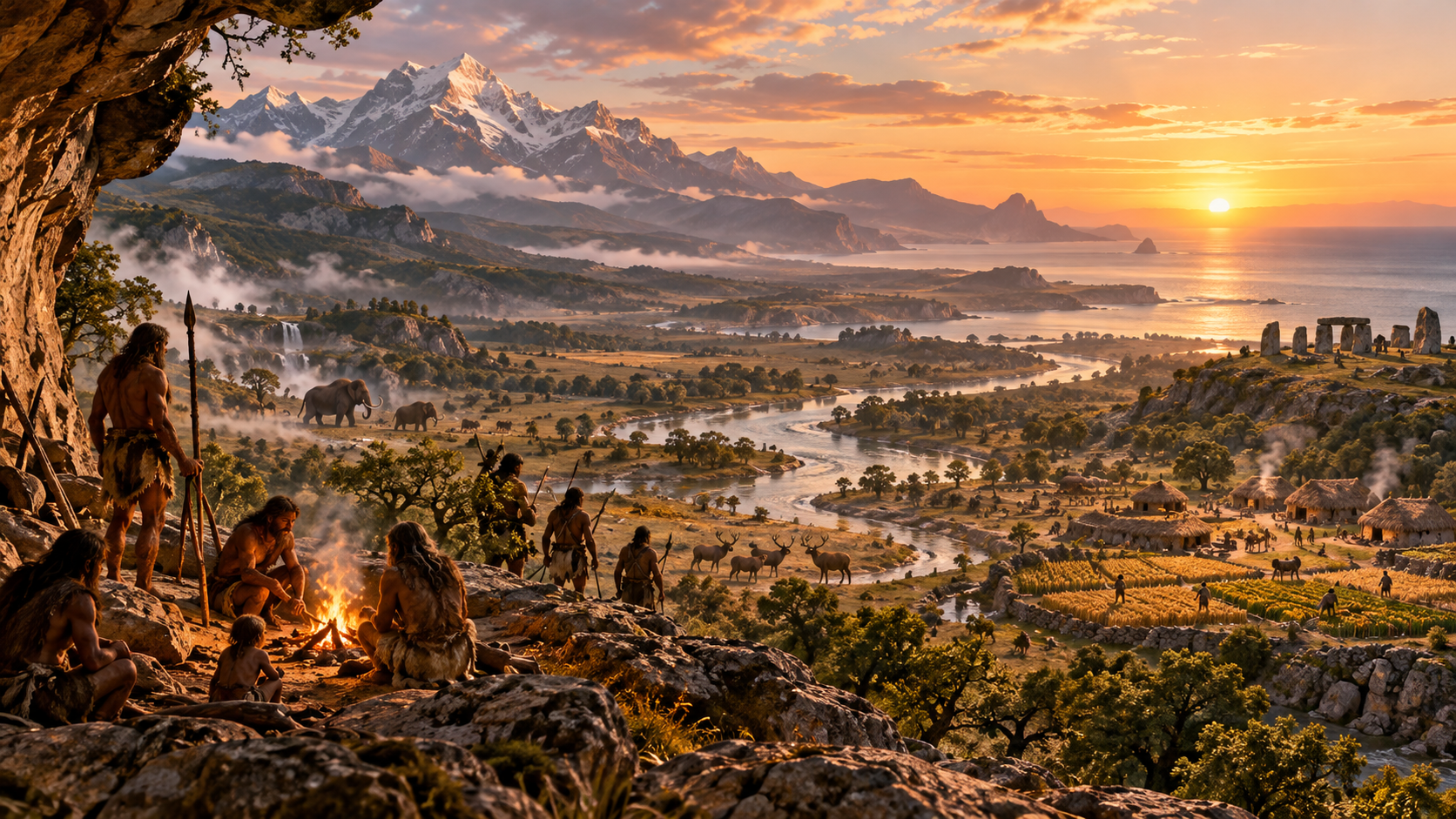
Picture an ancient evening.
A small group of human beings shelters from the cold. Someone tends a fire. A child listens to older voices. Beyond the light lie an unfamiliar landscape and a world that makes no promises.
The scene is ours to imagine; it is not a reconstruction of a particular archaeological site or an event recorded in The Urantia Book.
But the evidence for humanity's ancient past is real. Fossils, stone tools, archaeological sites, ancient DNA, and geological dating help investigators reconstruct parts of a history vastly older than written records.
Those discoveries do not tell us every ancient person's name or every conversation by a fire.
Tyrion peered into the imagined scene.
"Was there a dog?"
"Not necessarily. We're looking far back."
"Then I have serious concerns about their quality of life."
Our questions, however, are serious too.
How did humans emerge? When did people begin forming communities? How did cooperation, invention, conflict, and belief shape the world we inherited?
Science can investigate those questions with evidence that other people may inspect, criticize, and test. It cannot recover every private hope or tell us with certainty what every prehistoric person thought.
And into those gaps, humanity has always told stories.
Then Along Comes The Urantia Book
The Urantia Book offers a particularly elaborate account of Earth's distant history.
It describes the emergence of early human beings, an alleged planetary administration under Caligastia, a settlement called Dalamatia, and a later mission involving Adam and Eve and the Garden of Eden.
It goes on to describe disrupted teaching missions, migrations, ancient peoples, and the long effort to build civilization.
Tyrion blinked.
"So we have evolution, prehistoric cities, celestial visitors, a rebellion, and a garden?"
"That's part of the book's account."
"And nobody thought to make this a television series?"
"The history would still need checking."
"Ah. The inconvenient research department."
Exactly.
A compelling narrative does not establish that its events happened.
The alleged celestial governors, interventions, ancient settlements, and unusual biological lineages belong to the text's claims. They must not be presented as independently established history merely because the book provides names, dates, or a detailed explanation.
And when claims concern human ancestry, genetics, archaeology, or geology, evidence matters especially.
Two Stories on the Same Table
I placed two objects before Tyrion.
On one side, The Urantia Book.
On the other, an imaginary museum tray containing a carefully documented stone tool.
"Which one tells us what happened?" he asked.
"Each can tell us something—but not the same thing."
The book can tell us what its authors or narrators claim about ancient events.
A securely dated artifact may offer independent evidence about material human activity.
Comparing them requires care. An ancient tool cannot answer every theological question. A theological narrative cannot authenticate an archaeological site simply by describing it.
Tyrion studied the tray.
"So we don't have to mock the story?"
"No."
"Or pretend we've proved it?"
"Also no."
He nodded.
"That seems suspiciously reasonable."
Our task is to remain curious enough to listen, and careful enough to ask what would actually count as evidence.
The First Great Complication
The book's planetary history is not simply a peaceful parade of celestial teachers.
It tells of an early mission coming apart during Lucifer's rebellion, a planetary prince choosing the wrong side, and people left to navigate the consequences.
Later, its account of Adam and Eve introduces another great mission and another disappointment.
Underneath the extraordinary cosmology runs a familiar human theme:
A civilization can inherit both the achievements and the mistakes of those who came before it.
We know that without proving the book's ancient chronology. Every generation receives institutions, languages, technologies, conflicts, and possibilities it did not create.
Tyrion looked toward the dark prehistoric landscape.
"So the question isn't just what happened back then."
"What else?"
"It's what we do with what we've inherited."
For a dog who had recently tried to resolve celestial politics with biscuits, that was a perceptive observation.
An Important Question About Humanity
Some of the book's accounts of ancient populations use racial categories and claims of inherited hierarchy that conflict with modern scientific understandings of human variation and require critical scrutiny.
The Atlas will not present those categories as established biology or treat anyone's dignity as determined by supposed ancestry.
Modern research recognizes humans as sharing deep evolutionary ancestry, with variation that does not sort humanity into fixed, inherently ranked biological races.
Our Race, Human Unity, and Historical Context investigation addresses these issues directly.
Tyrion looked up from the map.
"Can we tell a story about human origins without deciding some people matter more than others?"
"We certainly can. And we should."
"Good. Because that would be a terrible way to welcome the neighbours."
The First Door Opens: Dalamatia
One name on the prehistoric map began to glow.
DALAMATIA.
In The Urantia Book, this is the proposed headquarters of the Planetary Prince's early mission—a settlement associated with the teaching of practical skills and the beginnings of organized social life.
Our story will visit it as the book describes it.
Then we'll ask a separate question: what independent evidence, if any, supports its supposed location, chronology, and history?
Tyrion read the name again.
"Does it have an archaeological department?"
"We'll be checking the evidence."
"Good. And a snack department?"
"We're still checking."
"Some mysteries really are eternal."
He put one small paw on the map.
And our next adventure began—not across imaginary star systems, but into the deep past of the only inhabited world we can presently examine for ourselves.
Continue the Adventure — Dalamatia: An Extraordinary City Before Recorded History →
🧭 Optional Detours — Explore the Planetary History Investigations
These pages examine individual claims and stories rather than asking readers to accept them as established events.
- Adam and Eve
- Dalamatia
- The Garden of Eden
- The Second Garden
- The Violet Race
- The Andites
- Race, Human Unity, and Historical Context
Deeper evidence reviews: EVR-005 — Sangik Races, EVR-006 — Dalamatia, EVR-008 — Early Humans, and EVR-009 — Andon and Fonta.
Optional comedy: Eden's Most Awkward Walking Tour — original satire, not historical evidence.
🔎 Factoid — Where the Claims and Evidence Come From
Primary narrative: The Urantia Book, Part III, especially its accounts of planetary history, early human beings, Caligastia, Dalamatia, and Adam and Eve.
Independent context: The Smithsonian Human Origins evidence guide introduces the fossil, archaeological, and genetic evidence for the human past. The American Association of Biological Anthropologists' statement on race explains why conventional racial categories do not represent discrete, ranked biological divisions.
The Atlas's External Verification Registry records specific claims, evidence limitations, and conclusions.
Evidence boundary: The observatory scenes and Tyrion's dialogue are original fiction. The book's proposed supernatural interventions and prehistoric chronology are claims of a religious text, not established archaeological discoveries. Individual claims require independent assessment; neither narrative detail nor general plausibility proves them.