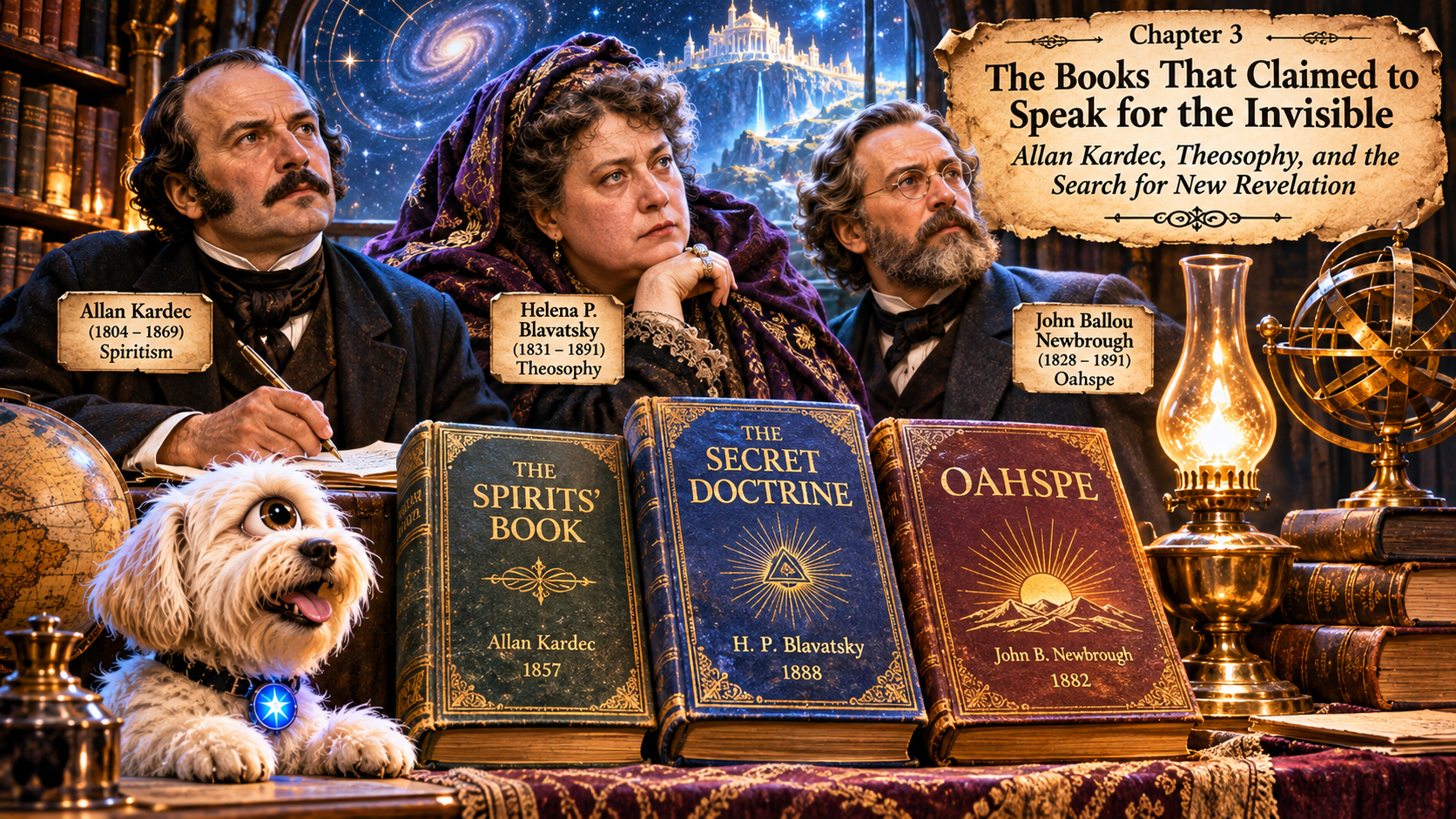
The Books That Claimed to Speak for the Invisible
Allan Kardec, Theosophy, and the Search for New Revelation
Historical Specials · Chapter 3 · Return to the historical introduction
Paris, 1857. The mysterious knocking sounds of the Spiritualist movement have found something even more ambitious than a Victorian parlour.
A publisher.
The unseen world, apparently, now has manuscripts.
And our little time-travelling investigator, Tyrion, is about to discover that once invisible intelligences begin answering questions, someone inevitably starts organizing their answers into books.
The Man Who Asked the Spirits 501 Questions
Paris, April 18, 1857.
Imagine walking past a Parisian bookshop and noticing a curious new publication.
Its title is Le Livre des Esprits.
The Spirits' Book.
The author calls himself Allan Kardec.
And the book makes an extraordinary claim.
It presents answers allegedly communicated by spiritual intelligences through human mediums.
Not a handful of vague predictions.
Not merely messages from departed relatives.
An organized examination of existence itself.
What is God?
What is a spirit?
Why are human beings born?
What happens after death?
Does suffering have a purpose?
How does the universe operate?
And what, precisely, are we supposed to be doing here?
The first edition contained 501 questions and answers. Later editions expanded the work considerably.
Five hundred and one questions!
The Fox sisters had reportedly begun with mysterious knocks.
Less than a decade later, someone had produced what looked remarkably like a spiritual encyclopedia.
Humanity had moved from asking an unseen presence whether anyone was there to requesting a reasonably comprehensive explanation of the cosmos.
One wonders whether the alleged spirits had anticipated the administrative burden.
But behind the remarkable publication stood a real human story.
And an interesting man.
A Schoolteacher Encounters the Unexplained
Allan Kardec was not his birth name.
He was born Hippolyte Léon Denizard Rivail in Lyon, France, in 1804.
He became an educator, wrote instructional material, and developed an interest in systematic learning.
In other words, he belonged to a profession famous for asking questions and becoming mildly distressed when nobody supplied satisfactory answers.
By the 1850s, reports of moving tables and alleged spirit communications had reached France.
Rivail encountered these claims and began investigating them.
He attended gatherings involving mediums who purported to receive communications from unseen personalities.
Rather than simply collecting sensational incidents, he attempted to organize the responses to philosophical and religious questions.
He compared communications attributed to different mediums.
He looked for consistency.
He arranged the material into categories.
And eventually he concluded that the answers presented the foundation of a coherent doctrine.
His published name became Allan Kardec.
The religious philosophy became known as Spiritism.
That distinction matters.
The wider Spiritualist movement included many different practices and beliefs, particularly an interest in communication with the deceased.
Kardec's Spiritism developed into a more defined religious and philosophical system.
And while the two movements shared certain interests, they were not identical.
This was no longer simply about whether a table might move.
It was about what an entire system of purported spirit teachings might reveal concerning the universe.
When the Universe Became a Classroom
The first edition of The Spirits' Book did something rather clever.
It presented its teachings through questions and answers.
The format was familiar.
Teachers used questions.
Students answered them.
Philosophers debated them.
Religious traditions organized instruction around them.
Kardec applied that structure to communications he attributed to spiritual beings.
The result was unusually accessible.
Readers could move from one question to the next, following an apparently organized conversation about God, human existence, moral responsibility, and life beyond death.
According to Spiritist teaching, human personality survives bodily death.
Spirits continue developing.
Moral progress matters.
And earthly existence forms part of a much longer spiritual education.
One particularly important doctrine concerns reincarnation: the belief that a spirit can experience successive physical lives as part of its development.
For Kardec, reincarnation helped explain differences in human circumstances and opportunities for spiritual growth.
It was not merely an incidental detail.
It became a defining feature of his system.
And here's where our future comparisons with The Urantia Book will become fascinating.
The Urantia narrative also describes human personality continuing beyond physical death and undergoing progressive spiritual education.
But it does not teach Kardec's doctrine of repeated reincarnation in earthly bodies.
Its account instead describes a continuing ascent through other orders of existence.
A resemblance exists.
So does a substantial difference.
We should remember both.
The Problem With Agreement
Kardec attempted to strengthen his conclusions by comparing communications attributed to different mediums.
His reasoning had an understandable attraction.
If several supposedly independent sources gave similar answers, perhaps those answers deserved consideration.
But agreement creates another question.
How independent were the sources?
People attending Spiritualist gatherings often encountered similar religious ideas.
Mediums could hear stories from other mediums.
Participants could share expectations.
A question might suggest the answer being sought.
And a person might sincerely produce a response shaped by beliefs they had absorbed without realizing it.
These possibilities do not establish that every communication was fraudulent.
But they demonstrate why consistency alone cannot verify a supernatural source.
An investigator needs to consider how information was obtained, whether alternative explanations were excluded, and whether any claimed knowledge could be tested independently.
The distinction matters enormously.
A book might contain hundreds of carefully organized statements.
Its teachings might possess moral value.
Its arguments might inspire thoughtful readers.
Yet none of those features alone establishes that the statements originated with invisible beings.
For our Atlas, this will become one of the most important historical questions of all.
Can the quality of a message establish the identity of its messenger?
Perhaps not.
But it can certainly encourage people to keep reading.
And Kardec's readers did.
Tyrion Discovers the Reincarnation Department
An entirely fictional Atlas time-travel interlude.
Tyrion had been studying a particularly interesting feature of Kardec's philosophy.
Apparently, according to Spiritist teachings, a person might experience more than one earthly lifetime.
He considered this carefully.
Then he examined his paws.
His tail.
His magnificent single eye.
And his glowing celestial collar.
He had several questions.
If spiritual progress required another lifetime, would he be permitted to return as a dog?
Would he retain his previous experience?
And, most importantly, would the universe honour any unused biscuit entitlements from his earlier existence?
The philosophical discussion became considerably more complicated when someone explained that spiritual development involved moral improvement rather than the accumulation of snacks.
Tyrion regarded that distinction as unnecessarily restrictive.
He requested a second opinion.
End fictional interlude.
A Religion That Travelled Beyond France
Kardec's publication did not remain an isolated curiosity.
In 1858, he founded the Parisian Society for Spiritist Studies and began publishing Revue Spirite, a journal devoted to examining purported spirit communications and related questions.
Further books followed.
The Mediums' Book appeared in 1861.
The Gospel According to Spiritism followed in 1864.
Other works addressed heaven, hell, religious interpretation, and the relationship between spiritual claims and nature.
Kardec's teachings spread beyond France and eventually became particularly influential in Brazil, where Spiritism developed a lasting religious and cultural presence.
The development was significant.
A movement associated with moving tables had produced institutions, publications, philosophical arguments, religious teachings, and international communities.
People could now study an organized doctrine even if they never attended a séance.
That was a major transformation.
The alleged supernatural communication had become a printed text.
And a printed text could travel much farther than the room in which its contents were reportedly received.
But another remarkable figure was preparing to enter our story.
A woman who would make Kardec's cosmic ambitions seem positively restrained.
Her name was Helena Petrovna Blavatsky.
And she was about to introduce readers to a universe so elaborately arranged that even Tyrion might require a map.
Enter Madame Blavatsky
New York City, 1875.
The Civil War was over.
Industrialization was transforming American life.
New scientific ideas challenged older explanations of the natural world.
Religious certainty was being questioned.
And people were encountering philosophical and religious traditions from parts of the world that Western institutions had often misunderstood or neglected.
Into this complicated environment stepped Helena Petrovna Blavatsky.
Born in 1831, Blavatsky had developed a reputation as an extraordinary and controversial personality.
She wrote about occult knowledge, ancient religions, spiritual powers, and the possibility that humanity possessed access to wisdom far older than conventional Western institutions recognized.
She also claimed extraordinary experiences involving advanced spiritual teachers.
Some people found her fascinating.
Others regarded her claims with considerable suspicion.
But she was certainly not short of intellectual ambition.
On November 17, 1875, the Theosophical Society formally established itself in New York, with Blavatsky, Henry Steel Olcott, William Quan Judge, and other participants among its founders.
Its ambitions extended beyond conventional Spiritualism.
The Society sought to encourage universal brotherhood, study comparative religion and philosophy, and investigate unusual or unexplained aspects of nature and human experience.
Blavatsky proposed that an ancient body of wisdom could help explain the spiritual foundations of the world's religious traditions.
The great religions, in her view, were not entirely disconnected.
They contained fragments of a deeper underlying truth.
And she believed that truth could be recovered.
That was a remarkable proposition.
It was also one that demanded a remarkable amount of evidence.
Not Every Invisible Teacher Was Dead
Here's an important difference between Blavatsky's Theosophy and the Spiritualism we encountered earlier.
Many Spiritualists claimed to communicate with people who had died.
Blavatsky increasingly described teachings associated with extraordinary spiritual adepts or Masters.
These were not simply departed relatives delivering messages from the afterlife.
In Theosophical accounts, the Masters were advanced beings possessing unusual knowledge and abilities, some of whom were described as living human adepts.
Communications attributed to such Masters became an important and controversial part of the movement.
A collection of letters purportedly originating with Masters named Koot Hoomi and Morya survives in the British Library.
The letters exist.
Their alleged extraordinary authorship remains disputed.
That is an important historical distinction.
We can examine the paper.
We can examine the handwriting.
We can investigate the circumstances in which letters appeared.
We can study what their recipients believed.
But the existence of a document does not establish that the person—or supernatural intelligence—to whom it is attributed actually wrote it.
The same principle will apply when we eventually examine manuscripts and accounts associated with the Urantia movement.
There is a difference between identifying a document's physical history and establishing its claimed spiritual origin.
And that difference deserves serious attention.
The Book That Attempted to Explain Everything
In 1877, Blavatsky published Isis Unveiled.
Two substantial volumes.
An exploration of religion, science, occultism, and ancient traditions.
It was an ambitious synthesis, presenting the author's understanding of hidden wisdom and challenging many contemporary intellectual authorities.
Then, in 1888, came an even more elaborate publication.
The Secret Doctrine.
Its two original volumes examined cosmic origins and the development of humanity.
Blavatsky presented an immense account of existence, drawing upon religious traditions, symbolism, esoteric teachings, and ancient texts she claimed contained profound knowledge.
Imagine the reaction of a curious reader.
A few decades earlier, Spiritualists had claimed that the dead could communicate.
Now a book proposed an immense spiritual history of the universe.
Cycles of cosmic development.
Hierarchies of beings.
Hidden laws.
Spiritual evolution.
Civilizations and transformations extending across extraordinary periods of time.
The scale was breathtaking.
But so was the challenge of distinguishing knowledge from speculation.
Blavatsky's system included claims about human origins and supposed evolutionary root races that do not accord with modern scientific understanding. Some of its racial classifications and hierarchical language are deeply problematic and require careful historical and ethical examination.
We won't sweep those difficulties aside merely because the surrounding narrative sounds impressive.
A beautiful cosmic vision does not make every claim within it true.
And a declaration of human brotherhood does not automatically resolve contradictions in a system's treatment of human diversity.
These are precisely the tensions the Atlas should be willing to investigate.
But another development was occurring.
One that would bring the supernatural-authorship question into an even more unusual literary form.
The Dentist Who Published a New Bible
New York, 1882.
Another extraordinary volume appeared.
This one bore the unfamiliar title Oahspe.
Its publisher-author was John Ballou Newbrough, an American dentist.
Yes.
A dentist.
Apparently, nineteenth-century dentistry sometimes left sufficient opportunity to contemplate the structure of the heavens.
Newbrough claimed that the text had been produced through an unusual form of inspired or automatic writing, which he attributed to angelic intelligences.
The resulting volume presented an extensive religious cosmology.
It described celestial realms, spiritual hierarchies, the history of humanity, and extraordinary events in the heavens.
The book was published in 1882, decades before The Urantia Book appeared.
For our historical investigation, Oahspe may become particularly interesting.
Not because we have established that the two books share an author.
Not because one must have inspired the other.
But because both present elaborate accounts of cosmic affairs while attributing their information to intelligences beyond ordinary human authorship.
We should investigate their similarities.
We should investigate their differences.
And where textual comparisons are appropriate, we should ask whether the similarities are specific enough to suggest some relationship or merely reflect wider religious ideas circulating during the period.
That's a future research assignment.
For now, one fact matters.
By 1882, extraordinary books claiming nonordinary sources of knowledge were already part of the Western religious landscape.
The idea was not invented in Chicago in the twentieth century.
But neither does that fact settle what happened in Chicago.
Tyrion Visits the Cosmic Publishing Department
An entirely fictional Atlas interlude.
Tyrion sat before three enormous volumes.
One described communications attributed to spirits.
Another offered access to ancient esoteric wisdom.
The third presented an extraordinary celestial history.
He examined the titles.
He studied the diagrams.
He considered the impressive numbers of invisible beings apparently associated with the publications.
Then he asked a reasonable question.
Who was responsible for proofreading?
The room became silent.
Tyrion continued.
If the authors possessed access to extraordinary knowledge, surely somebody could explain why the books were so long.
He was informed that understanding the universe required considerable study.
Tyrion accepted this explanation provisionally.
But he suggested that future cosmic publishers might consider adding shorter introductory chapters.
Perhaps with illustrations.
Possibly some humour.
And, naturally, a small one-eyed dog to help readers find their way.
End fictional interlude.
Meanwhile, the Investigators Wanted Better Evidence
London, 1882.
That same year, another organization was founded.
But this one was not primarily interested in publishing a new religious system.
Its members wanted to investigate extraordinary claims.
The Society for Psychical Research brought together scholars and other interested investigators to study subjects including telepathy, mediumship, apparitions, mesmerism, and other reported phenomena.
Among its prominent early figures were philosopher Henry Sidgwick, classical scholar Frederic W. H. Myers, and Edmund Gurney.
The Society sought to examine controversial claims systematically rather than simply accepting or rejecting them in advance.
That sounds straightforward.
But consider the difficulty.
How do you investigate something that may not occur on demand?
How do you distinguish coincidence from meaningful information?
How do you control for subtle suggestions?
How do you verify a reported experience when witnesses disagree?
And how do you prevent a sincere desire to discover something extraordinary from influencing the interpretation of results?
Those questions helped shape early psychical research.
Investigators encountered both reports they found puzzling and examples of apparent trickery.
Some researchers became convinced that particular unusual phenomena warranted further study.
Others remained doubtful.
And disagreements sometimes arose over whether the evidence supported any paranormal conclusion at all.
But whatever the findings, the Society represented an important development.
Extraordinary claims were becoming the subject of organized investigation.
This growing investigative tradition would form part of the intellectual world inherited by physicians and researchers in the early twentieth century.
Including, eventually, Dr. William S. Sadler.
The Three Books on the Table
Let's imagine our Atlas time machine bringing three books into one room.
Kardec's The Spirits' Book.
Blavatsky's The Secret Doctrine.
Newbrough's Oahspe.
A reader approaching them might immediately notice something.
All three address questions extending far beyond ordinary earthly experience.
All three present accounts of invisible realities or spiritual dimensions.
All three offer ideas about human existence that their authors associated with sources of extraordinary knowledge.
But they do not tell the same story.
They do not describe identical spiritual systems.
They do not necessarily rely upon identical methods of purported communication.
And they do not possess the same religious teachings.
Kardec's Spiritism emphasizes communications from spirits and successive incarnations.
Blavatsky's Theosophy develops an esoteric synthesis involving ancient wisdom, cosmic development, and advanced spiritual teachers.
Newbrough's Oahspe presents its own vast religious cosmology, reportedly received through inspired writing.
These distinctions matter.
If we simply label all three channeling, we risk obscuring their different historical meanings and asserted mechanisms.
And if we assume that any later religious book describing celestial beings must descend directly from these earlier works, we commit another historical error.
We confuse resemblance with documented influence.
An Extraordinary Idea Can Have an Ordinary History
There is a beautiful tension running through this entire historical adventure.
The people we've encountered often believed that they were discovering knowledge from beyond the visible world.
Yet the books themselves belonged to very ordinary human institutions.
Printing presses.
Publishers.
Bookshops.
Libraries.
Lecture halls.
Reading groups.
Religious societies.
Correspondence.
Arguments.
And occasionally, people who could not agree about what the extraordinary communications actually meant.
Whatever one concludes about their alleged origins, these books entered history through human hands.
They circulated within human cultures.
They were interpreted by human readers.
They influenced conversations in ways that can sometimes be documented.
And they acquired meanings their creators may never have anticipated.
A book can become important for reasons quite different from those its author imagined.
Its teachings may inspire kindness.
Its cosmology may provoke wonder.
Its historical claims may prove inaccurate.
Its ideas may resemble earlier works.
Its assertions about authorship may remain unverified.
Several of those things can be true simultaneously.
And here we arrive at a question particularly relevant to The Urantia Book.
If a book contains beautiful spiritual ideas, does that establish that celestial beings composed it?
No.
But the lack of proof of celestial authorship does not, by itself, demonstrate that every idea in the book lacks value.
Those are different judgments.
And an intellectually responsible reader should be free to make them separately.
Chicago Begins to Appear on the Horizon
Our journey began in 1848 with mysterious knocks in a farmhouse.
Then came public demonstrations.
Victorian séances.
Scientific investigations.
Spiritist philosophy.
Theosophical teachings.
And entire books describing unseen realities.
By the closing decades of the nineteenth century, Western religious culture was filled with arguments about invisible intelligences, revelation, spiritual survival, hidden knowledge, and the possibility of investigating extraordinary claims.
Meanwhile, one American city was emerging as an important meeting place for science, religion, industry, and competing ideas.
Chicago.
And in 1893, Chicago would host an extraordinary gathering of religious representatives from around the world.
A meeting that symbolized the expanding Western encounter with diverse religious traditions.
The World's Parliament of Religions.
The city would also provide a setting for discussions of psychical science and occult claims.
And eventually, a young physician named William Samuel Sadler would enter the intellectual world shaped by these controversies.
But our journey toward Sadler and the mysterious Urantia sleeping subject is not finished.
We still have to understand how the late nineteenth century's spiritual enthusiasm intersected with the rise of psychology, medicine, religious experimentation, and scientific skepticism.
And somewhere further down the road stands another unusual figure.
Edgar Cayce.
The man later celebrated as the Sleeping Prophet.
Some Urantia readers have suggested that Cayce was the unidentified sleeping subject associated with the origins of The Urantia Book.
That hypothesis will receive its own careful examination.
Not a casual dismissal.
Not an enthusiastic endorsement.
An investigation.
Names.
Dates.
Locations.
Documents.
Testimony.
Contradictions.
And whatever conclusions the surviving evidence actually supports.
For now, our time machine is approaching Chicago.
And Tyrion has a question.
Actually, several questions.
One of them concerns the existence of biscuits in the nineteenth-century American Midwest.
But another concerns something much more significant.
If an extraordinary message arrived tomorrow, claiming to come from beyond our world, how would we know where it truly originated?
And what would we do if we couldn't find out?
That question is waiting for us in Chicago.
Next historical chapter: Chicago, 1893 — When the World's Religions Came to Town.
The world's spiritual traditions, scientific ambitions, and claims of invisible knowledge are about to meet in one extraordinary American city.
Our journey continues.
🔎 Factoid — The historical record
- Allan Kardec: The Spirits' Book appeared in 1857 and contained 501 questions and answers in its first edition. Later revisions expanded the work; Spiritism became a distinct religious-philosophical movement.
- The Theosophical Society: Established in New York in 1875. Blavatsky published Isis Unveiled in 1877 and the original two volumes of The Secret Doctrine in 1888.
- Oahspe: John Ballou Newbrough published the book in 1882. Its alleged supernatural production is a claim made in accounts of its origins, not independently established authorship.
- Society for Psychical Research: Founded in London in 1882 to examine purported psychical phenomena. Its historical existence and investigations do not, by themselves, verify any particular paranormal claim.
- The Urantia Book: Published in Chicago on October 12, 1955. The precise circumstances of its manuscript's origin remain historically contested and incompletely documented.
Further investigation: The British Library's Mahatma Letters archive illustrates the importance of separating the physical existence of documents from claims about extraordinary authorship. The Society for Psychical Research maintains information about its history and investigative work.
Editorial boundary: The atmosphere and Tyrion's scenes are imaginative storytelling. The books, movements, historical dates, and documented controversies are real. Claims of spirit communication, supernatural authorship, and hidden cosmic knowledge have not been independently established as facts. No historical influence of these books on The Urantia Book is asserted here without supporting evidence.