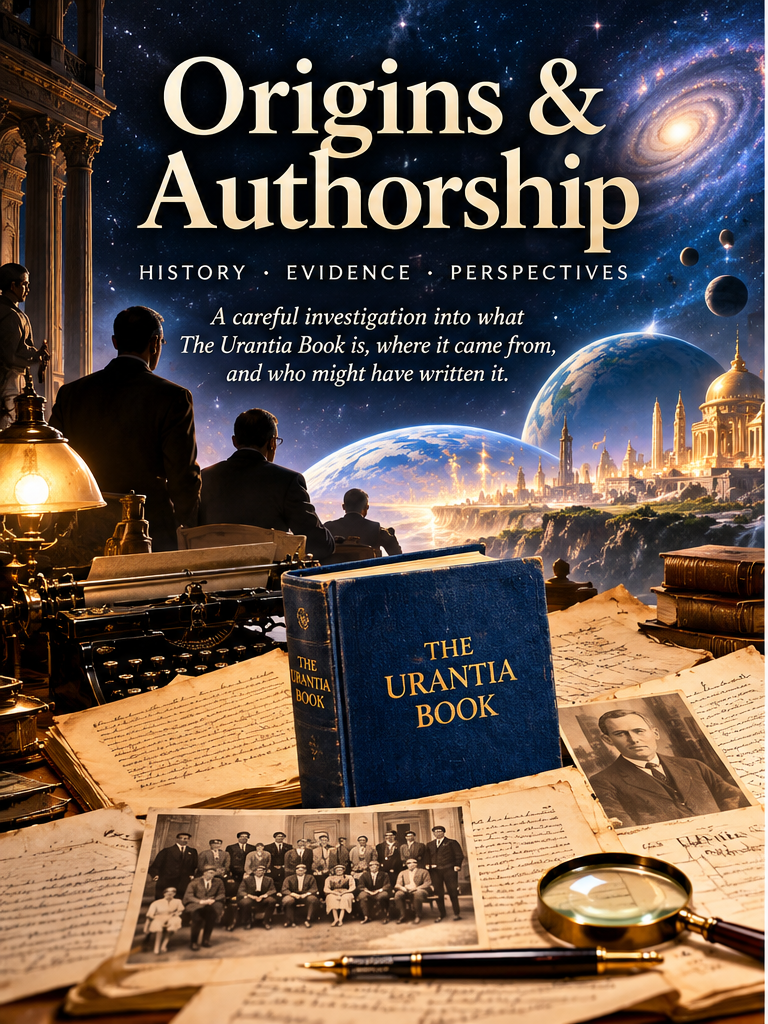
Foundational Investigation📚 Origins & Authorship
What Is The Urantia Book — And Who Wrote It?
A book appeared in Chicago in 1955, bearing a breathtaking claim: its authors were not of this world. Who—or what—was really behind its pages?
October 12, 1955. Chicago.
A book enters the public record. It contains a Foreword and 196 papers, ranging from the nature of God to the distant reaches of space, the history of Earth, and the life of Jesus.
Its title is The Urantia Book.
Now comes the detail that changes the investigation: the papers are attributed not to a single human writer, but to numerous celestial personalities.
The book's ideas have inspired generations of readers. Yet the manuscripts emerged through a distinctly human circle—people who asked questions, studied unusual experiences, handled documents, and ultimately brought the work to publication.
Two stories therefore unfold side by side.
The story the book tells about its own origin.
And the story the historical evidence can establish.
Are they the same story? Where do they intersect? And where does the surviving record fall silent?
You need not accept the supernatural explanation—or dismiss what readers have found meaningful—to explore those questions. We will follow names, dates, testimony, textual comparisons, and documented uncertainties.
Wonder invites the question. Evidence helps decide the answer.
Our Investigative Standard
We distinguish four categories of information:
- Textual claims: What The Urantia Book says about itself.
- Historical testimony: What participants and witnesses reported.
- Independent evidence: What documents and other verifiable evidence establish.
- Unresolved questions: What remains speculative, disputed, or unknown.
Neither sincere testimony nor an elaborate narrative automatically establishes a supernatural explanation.
Likewise, identifying uncertainty does not justify inventing an explanation.
Our objective is to investigate the evidence without requiring belief or disbelief in advance—and to remember that a reader's personal appreciation of the book is not itself on trial.
What Exactly Is The Urantia Book?
To understand the authorship puzzle, first open the book itself.
The Urantia Book is a religious, philosophical, and cosmological work, first published by Urantia Foundation in Chicago on October 12, 1955. Across its Foreword and 196 papers, arranged in four parts, it presents an account of God, the universe, intelligent life beyond Earth, human origins, spiritual development, and Jesus' life.
The scale is part of its appeal: one volume moves from questions about the infinite to questions about an individual human life.
But there is a distinction worth carrying into every chapter. We can study its ideas as textual claims, philosophical proposals, and influential literature without assuming that the book's account of supernatural authorship has been proven. The questions it raises about human experience are worth examining on their own terms.
Part I — The Central and Superuniverses
Papers 1–31 describe Deity, Paradise, Havona, the seven superuniverses, and numerous celestial personalities.
This part establishes the book's larger cosmological and theological framework.
Part II — The Local Universe
Papers 32–56 describe Nebadon, the local universe to which the book assigns Earth.
Subjects include celestial administration, inhabited worlds, spiritual personalities, and the proposed structure of local-universe government.
Part III — The History of Urantia
Papers 57–119 describe Earth's supposed cosmic origins, geological and biological development, early human populations, planetary administration, civilizations, and religious history.
These papers include claims that can be compared with independent scientific and historical evidence.
Part IV — The Life and Teachings of Jesus
Papers 120–196 present an extensive account of the life, ministry, teachings, death, resurrection, and subsequent appearances of Jesus.
The narrative contains numerous episodes and details beyond the canonical New Testament accounts.
Explore the complete contents of The Urantia Book
Why Readers May Find It Worth Exploring
Before looking for the people behind the manuscripts, consider the people who read them.
Why would someone return to an immense book whose origin is so contested? Sometimes the answer is not a theory about authorship at all. It is an idea that changes the way a reader sees another person—or a difficult moment in ordinary life.
Three themes help explain that attraction:
The dignity of the individual. Paper 1 portrays every person as capable of a meaningful relationship with a loving Universal Father. Whether considered as a religious conviction or explored as a philosophical possibility, that vision raises a humane question: What changes when we treat each person as someone of enduring value?
The possibility of growth. Paper 100 places love, expanding understanding, and service to others at the heart of spiritual development. Even readers uncertain about the book's larger cosmology can examine whether such ideals enrich ordinary living.
The appeal of a life lived in service. Paper 140 explores Jesus' teaching about how to love one's fellows. This invites ethical reflection apart from deciding whether every scene in the book's expanded historical narrative occurred as told.
These are themes expressed in the text, not independent findings about celestial authorship. Their appeal does not solve the historical mystery; neither does that mystery automatically cancel their value to individual readers.
A meaningful idea deserves consideration. An extraordinary factual claim deserves evidence. The same reader can insist on both.
Who Does the Book Claim Wrote It?
The book does not attribute its 196 papers to a single human author.
Instead, individual papers identify various celestial personalities and commissions as their purported authors.
For example:
| Papers | Attributed author |
|---|---|
| 1–9 | Divine Counselor |
| 10 | Universal Censor |
| 11–14 | Perfector of Wisdom |
| 43 | Malavatia Melchizedek |
| 73–76 | Solonia |
| 120 | Mantutia Melchizedek |
| 121–196 | Midwayer Commission |
Other papers carry additional attributions, including Mighty Messengers, Life Carriers, Archangels, Melchizedeks, and other orders described within the book's cosmology.
These are the authorship attributions provided by the text.
They do not constitute independent evidence that the attributed beings exist or produced the manuscripts.
One essential distinction therefore governs this investigation:
Identifying a claimed author is not the same as establishing an actual author.
Examine the official list of papers and attributed authors
The Historical Origins — Chicago
Behind the book's vast celestial cast, the documented human story leads us to Chicago—and to the circle surrounding physician and psychiatrist Dr. William S. Sadler.
Sadler and his wife, Dr. Lena Kellogg Sadler, investigated experiences associated with an unidentified man. In Sadler's later accounts, this individual entered unusual sleeping states during which communications allegedly occurred.
In histories of the movement, he became known as the sleeping subject or contact personality.
Other people joined the inquiry. A larger discussion group, the Forum, later studied and questioned the developing Urantia Papers.
These are important reported developments. But the moment that attracts our curiosity most—the precise process by which the alleged communications became the final written papers—is also one of the hardest to reconstruct independently.
We can identify participants in the historical story without pretending that their testimony settles the mechanism of authorship.
A Basic Historical Timeline
| Period | Reported or documented development |
|---|---|
| Early twentieth century | Sadler and associates investigated unusual experiences involving an unidentified subject |
| September 1925 | According to Sadler's retrospective account, the already-existing Forum became a closed group with thirty charter members |
| 1929 | Sadler published an appendix describing an unusual sleeping subject |
| Following decades | The Forum studied and questioned the developing Urantia Papers |
| January 11, 1950 | Urantia Foundation was established |
| October 12, 1955 | The Urantia Book was published |
These developments do not all possess the same evidentiary status.
The foundation's incorporation and the book's publication are documentable institutional events.
Accounts of extraordinary communication depend substantially upon testimony from the participants.
Read William S. Sadler's 1960 historical account
William S. Sadler — Psychiatrist and Investigator
William S. Sadler occupies a central position in the book's historical development.
He worked as a physician, psychiatrist, lecturer, and author.
He also had experience investigating claims of psychic phenomena, mediumship, and unusual mental states.
This background made him an important participant in the investigation of the sleeping subject.
In 1929, Sadler published The Mind at Mischief, a book examining unusual psychological and supposedly psychic phenomena.
Its appendix discusses an exceptional case involving a sleeping individual whom Sadler had investigated.
Sadler suggested that this case did not fit the familiar psychological explanations he had encountered.
However, the appendix does not explicitly establish that the individual described was the source of the completed Urantia Papers.
Some historians and readers connect the accounts, but that connection should be identified as an interpretation requiring evidence. Recognizing the gap in the documentation is a reason for further inquiry, not a reason to disparage the witnesses or readers who find their accounts meaningful.
What Does Sadler's Testimony Establish?
Sadler's testimony provides evidence concerning his reported experiences, observations, and interpretations.
It does not automatically demonstrate the explanation he favoured.
A trained investigator may sincerely report encountering a phenomenon that resists explanation.
But an unexplained experience does not, by itself, establish an external supernatural intelligence.
Nor does an unsuccessful attempt to identify a psychological explanation establish that every psychological explanation has been eliminated.
The distinction between an investigator's observations and the investigator's explanation remains essential.
Read the appendix to The Mind at Mischief (1929)
The Sleeping Subject
One unidentified person sits at the centre of the historical puzzle.
Not because we have a definitive explanation of what happened to him. We do not.
According to early accounts, a male sleeping subject experienced unusual states of consciousness during which communications allegedly occurred. The original investigators regarded those experiences as exceptional.
But here the trail of documentation becomes thinner—and the questions more precise. Four in particular remain unanswered.
Who was the individual?
The public historical record has not conclusively established his identity.
What precisely happened during the reported sessions?
The surviving evidence does not provide independently reproducible documentation sufficient to reconstruct every event.
How were the resulting communications converted into the final written papers?
Sadler's historical account describes the involvement of Contact Commissioners, written materials, and a developing process of questions and responses.
But the complete production process remains insufficiently documented for independent reconstruction.
Did the subject possess knowledge unavailable to his ordinary waking awareness?
That claim requires more than testimony that the communications seemed unusual.
It requires information about the subject, the production conditions, access to human sources, and the content of the earliest manuscripts.
The existence of an unidentified participant is not, by itself, proof of either human fraud or celestial revelation.
The Forum and the Contact Commission
Two groups occupied important but different roles in the emergence of the book.
The Forum
The Forum was a discussion group associated with the Sadlers.
Its members studied the Urantia Papers and submitted questions.
According to Sadler's account, questions from the Forum helped shape the subjects addressed by the developing presentations.
This makes the Forum important to the book's history even though its members were not publicly identified as the authors of the papers.
The Forum's activities also raise questions concerning the relationship between human inquiry and the final organization of the text.
The Contact Commission
The Contact Commissioners constituted a smaller group more directly involved in the reported communication process.
Sadler described them as responsible for handling questions, receiving materials, and comparing written documents.
He maintained that they did not possess general authority to rewrite the substantive contents of the papers.
However, claims about the limits of human editorial involvement remain historical testimony unless independently corroborated.
The distinction matters:
Participating in the preparation, preservation, typing, or publication of a manuscript does not necessarily establish responsibility for composing its contents.
At the same time, claims that no substantive human authorship occurred require evidence.
Wilfred Custer Kellogg — A Crucial Historical Question
One individual in the early movement deserves particular attention.
Wilfred Custer Kellogg (1876–1956) was associated with the Sadler circle and the organizational development of the Urantia movement.
He performed important administrative work and became a founding trustee and the first treasurer of Urantia Foundation.
He also had a background associated with Seventh-day Adventism.
These historical connections make Kellogg relevant to an investigation of the book's origins.
They do not, however, establish that he wrote the papers.
Was Kellogg the Sleeping Subject?
The skeptical writer Martin Gardner advanced the hypothesis that Wilfred Kellogg was the unidentified sleeping subject.
Gardner explored the book's historical background, its possible intellectual influences, and the roles played by individuals associated with the Sadlers.
Other researchers and individuals familiar with the early movement have challenged Kellogg's proposed identification.
The available evidence has not conclusively resolved the dispute.
Thus:
Wilfred Kellogg represents a proposed candidate for the sleeping subject, not a conclusively identified one.
Could His Personal Beliefs Have Conflicted With the Book?
Kellogg's Seventh-day Adventist background raises interesting questions.
Some Adventist teachings differ substantially from teachings presented in The Urantia Book.
These differences concern creation, Adam and Eve, atonement, religious authority, and the organization of celestial personalities.
However, a religious background does not establish that an individual accepted every teaching of that tradition throughout his life.
Nor does disagreement between two bodies of doctrine prove that an individual could not have contributed to both.
To identify a genuine contradiction within Kellogg's personal beliefs, we would need to establish precisely what he believed, when he believed it, and whether he personally endorsed the conflicting propositions.
A general comparison between Adventism and Urantia theology cannot supply those missing facts.
What About the Other Kellogg?
A separate historical figure, Dr. John Harvey Kellogg, became known for his medical and health-reform theories, including extreme views concerning masturbation.
Those views should not be attributed to Wilfred merely because the men shared a surname.
John Harvey Kellogg and Wilfred Custer Kellogg were different people.
Confusing them creates a poor foundation for an authorship investigation.
Our fictional celestial comedians have nevertheless found a way to turn the mistaken identity into an optional bit of satire—clearly separated from the historical record.
Could Another Personality Have Produced the Material?
This hypothesis deserves careful examination.
Suppose the sleeping subject generated material during an altered state of consciousness.
Several possibilities would remain open.
The subject might have drawn upon memories, ideas, or associations unavailable to ordinary conscious recall.
Unusual psychological processes might have influenced the content.
Other individuals might have contributed information, writing, or editorial decisions.
Alternatively, proponents of revelation might propose a genuinely external intelligence.
These explanations require different kinds of evidence.
A change in consciousness does not establish the existence of an independently acting personality.
Nor does a sophisticated written product establish a supernatural author.
Likewise, someone's apparent lack of literary sophistication would not, by itself, exclude participation in a complex creative or collaborative process.
A person's ordinary abilities, unusual experiences, and responsibility for a finished manuscript are three different questions.
Until the production process can be reconstructed with adequate evidence, confident identification of a particular psychological mechanism would be premature.
Did The Urantia Book Draw Upon Earlier Human Literature?
An unidentified witness can leave us with testimony. A surviving book gives us something different: words we can place beside other words.
Here the origins investigation moves from disputed recollections to texts that readers can inspect and compare.
Researcher Matthew Block has documented numerous parallels between passages in The Urantia Book and earlier human publications. His comparisons examine wording, the organization of concepts, argument structure, and sequences of ideas.
The parallels do not speak for themselves; they need careful comparison, context, and evaluation. But they offer an important opportunity: unlike the reported sleeping experiences, the published passages can be examined side by side.
That makes literary-source research a central part of the authorship question.
What Do the Parallels Establish?
When substantial and distinctive textual parallels appear between an earlier publication and a later work, they can support an inference of literary dependence.
The strength of that inference depends upon the nature of the similarities, chronology, possible intermediate sources, and other explanations.
These comparisons do not automatically identify the individual who prepared the final Urantia manuscript.
But they make the relationship between the book and earlier human literature a central part of the authorship investigation.
Does the Book Acknowledge Human Sources?
Yes.
In the Foreword, 0:12.12, the narrator discusses using more than one thousand human concepts.
In Part IV, 121:8.13, the account acknowledges drawing upon the thoughts and expressions of more than two thousand human beings.
These statements matter.
The text does not simply claim that every idea appeared without any relationship to existing human knowledge.
However, the acknowledgment of human concepts does not settle whether the extent and methods of literary dependence match what readers would ordinarily expect from a work claiming celestial authorship.
Human literary dependence and ultimate authorship are related but distinct questions.
Explore Matthew Block's Urantia Book Source Studies
What About William Sadler's Own Writings?
Matthew Block has also examined relationships between Sadler's published writings, earlier human sources, and techniques of literary composition.
These comparisons raise questions about the intellectual environment surrounding the Urantia Papers.
They warrant direct investigation rather than automatic acceptance or rejection.
A demonstrated similarity between compositional methods would be relevant.
But it would not, by itself, establish that Sadler wrote any particular Urantia Paper.
Equally, an attribution to celestial personalities cannot substitute for historical evidence when investigating how the documents were produced.
Explore the Sadler source-comparison research
Four Broad Authorship Explanations
Exploring different explanations is not a contest to see which community of readers can be embarrassed. It is an attempt to ask what each possibility can explain, where it faces difficulties, and what evidence would help us learn more.
The available evidence permits several explanatory possibilities.
| Explanation | Central proposal | Principal difficulty |
|---|---|---|
| Celestial revelation | Superhuman personalities supplied the material | The alleged supernatural source has not been independently verified |
| Human literary composition | One or more people assembled and wrote the papers | The complete authorship process has not been established |
| Altered-state production | Unusual psychological processes contributed to the material | The subject and production conditions remain insufficiently documented |
| Combined processes | Psychological experiences, literary sources, and multiple human participants contributed | The nature and extent of each contribution remain uncertain |
These explanations should not be treated as equally supported merely because each can be imagined.
Documented human participation and identifiable textual parallels already have evidentiary support.
The claimed celestial identity of the book's authors has not been independently established.
Some human explanations may also overlap.
For example, unusual experiences and ordinary literary collaboration could both contribute to a text.
The important question is not merely which explanation sounds possible.
Which explanation best accounts for the evidence, and what additional evidence could distinguish it from its competitors?
What Would Count as Strong Evidence?
A serious investigation should seek information capable of distinguishing competing explanations.
Especially valuable material would include:
- Authenticated early drafts and manuscripts.
- A documented chain of custody for the original papers.
- Contemporaneous records of the reported communication sessions.
- Reliable evidence establishing the sleeping subject's identity.
- Comparative analysis of possible human literary sources.
- Documented evidence of the roles played by individual participants.
- Reproducible linguistic and authorship analyses.
- Historically specific claims that can be independently checked.
- Evidence that genuinely discriminates between competing hypotheses.
The goal is not to accumulate impressive anecdotes.
The goal is to determine what the available evidence actually supports.
Does the Book Claim Scientific Infallibility?
This question contains an important qualification.
At 101:4.2, The Urantia Book explicitly acknowledges limits on its presentation of scientific and cosmological information.
The passage states that some descriptions concerning the physical sciences would require revision as scientific knowledge developed.
The text therefore does not straightforwardly claim that every scientific statement will remain permanently accurate.
However, that qualification does not eliminate the need to investigate errors.
Nor does it establish that every disputed scientific claim can be dismissed as an intended limitation.
The passage itself distinguishes physical-science descriptions from what it claims concerning historical facts and religious truth.
Those distinctions require careful interpretation.
Our investigative responsibility remains unchanged:
Evaluate the exact claim, its context, and the available evidence before reaching a conclusion.
Read Paper 101 — The Real Nature of Religion, Section 4
What Can We Actually Establish?
Our present assessment distinguishes several levels of evidence.
Historically Established
The Urantia Book was published in Chicago in 1955.
Urantia Foundation was incorporated in 1950.
William and Lena Sadler, Wilfred Kellogg, the Forum, and the Contact Commission played documented roles in the book's historical emergence or organizational development.
Established Through the Text
The book attributes its papers to numerous celestial personalities.
It presents itself as a revelatory communication.
It acknowledges using existing human concepts and expressions.
Its contents can be examined directly for internal consistency and relationships to earlier publications.
Supported by Comparative Research
Numerous relationships between passages in The Urantia Book and earlier human writings have been documented.
The extent, significance, and compositional implications of those relationships remain legitimate subjects of research.
Not Conclusively Established
The identity of the sleeping subject.
The complete human production process.
The precise literary contributions of particular historical participants.
The alleged independent existence and authorship activity of the celestial personalities named in the papers.
The ultimate explanation of how the final book came into being.
An unresolved historical question should remain unresolved until sufficient evidence justifies a conclusion.
Why This Matters to the Urantia Cosmos Atlas
Different readers may arrive at this question from opposite directions.
One encounters the book's immense cosmic geography and wonders whether its map of reality could be true. Another is moved by its portrayal of Jesus' compassion or the idea of divine companionship. A third is drawn in by a Chicago mystery involving psychiatrists, manuscripts, and a witness who has never been conclusively identified.
All three deserve the same intellectual courtesy.
The Atlas explores the book's cosmology, philosophy, planetary history, spiritual personalities, and claims about human origins. The authorship question matters because it asks what kind of evidence would justify treating those descriptions as reliable accounts of reality.
But distinctions remain essential:
Complexity is not proof of authenticity. Logical consistency is not proof of factual accuracy. Philosophical beauty is not proof of celestial authorship.
And a discovery of human literary sources, on its own, does not remove the work's potential philosophical or spiritual meaning. Questions of origin, truth, and meaning intersect, but they are not identical.
When an Origin Story Meets the Unknown
There is another way to consider this mystery—not as an answer about who wrote the book, but as a question about how people respond when a story that matters to them remains uncertain.
An account of celestial authorship may invite a reader to imagine a larger, purposeful universe. The historical investigation leads instead through Chicago, human testimony, disputed interpretations, and gaps in the surviving record. The contrast raises a question familiar to work on myth and meaning, including Jordan B. Peterson's Maps of Meaning: How can we remain open to something meaningful without treating our wish for certainty as evidence?
This is an optional interpretation of a reader's encounter with uncertainty, not a claim about the motives of the book's authors or readers. Psychological significance cannot identify the sleeping subject, authenticate a manuscript, or establish celestial communication. Those remain historical and evidentiary questions.
You can follow those questions into the larger Atlas:
Universe Geography examines the book's proposed cosmic structures.
Planetary History & Human Origins investigates its portrayal of Earth's distant past.
Propositional Logic Analysis examines whether the claims remain coherent when expressed as explicit propositions.
Each route returns, sooner or later, to a familiar demand: show us what the text says, then show us what the evidence supports.
A Lighter Look at the Kellogg Controversy
Historical investigation requires evidence, careful attribution, and restraint.
But that doesn't mean we must surrender our sense of humour.
Especially when two different men named Kellogg become entangled in debates about cosmic revelation, psychiatry, religious history, and breakfast cereal.
Our fictional Department of Revelatory Authorship has convened a hearing.
The accused would very much like to return to his bookkeeping.
🎭 The Kellogg Identity Crisis — A Celestial Hearing →
The dialogue is fictional. The underlying historical questions are genuine.
Sources and Further Reading
Primary Texts
- The Urantia Book — Official Standard Reference Text
- The Papers and Their Attributed Authors
- Paper 101 — The Real Nature of Religion
Historical Accounts
- William S. Sadler — A History of the Urantia Movement (1960)
- William S. Sadler — Appendix to The Mind at Mischief (1929)
- Carolyn Kendall — Recollections of the Book's First Publication
- Mark Kulieke — Birth of a Revelation (1994), including biographical notes on Wilfred C. Kellogg
Independent and Critical Investigations
- Matthew Block — Urantia Book Source Studies
- Matthew Block — The Sadler Project
- Martin Gardner — Urantia: The Great Cult Mystery (1995), bibliographic record
These sources represent different perspectives and kinds of evidence. They should not be assumed to agree with one another.
Source Review and Limitations — October 21, 2026
This page received an AI-assisted, focused editorial source review, not a comprehensive historical investigation or independent expert peer review. The source checks below establish what the linked material actually supports; they do not certify the reported supernatural events or identify the manuscript's authors. No personal human editorial sign-off is recorded for this page.
| Source and material inspected | Review depth | Evidentiary contribution and limitation |
|---|---|---|
| Urantia Foundation — Titles of the Papers: author attributions in Parts I–IV | Relevant listing directly reviewed | Confirms the text's published attributions, including Paper 120 to Mantutia Melchizedek and 121–196 to the Midwayer Commission. Such attributions are not independent verification of celestial authorship. |
| Sadler, A History of the Urantia Movement (1960): “How the Forum Started,” “The Forum Becomes a Closed Group,” “Functioning of the Contact Commissioners,” and “The Urantia Foundation” | Relevant passages directly reviewed | Supports the account of the Forum's 1925 closed-group organization, the Contact Commission's reported activities, Urantia Foundation's January 11, 1950 establishment, and the reported October 12, 1955 publication date. Sadler was an involved participant; his account is primary testimony, not independent proof of extraordinary communications or the absence of substantive human authorship. |
| Sadler, appendix to The Mind at Mischief (1929): reproduced appendix | Relevant passage directly reviewed | Documents Sadler's description of the unidentified male subject, his reported sleep behavior and the limits of Sadler's knowledge. The accompanying site's editorial note identifies the connection to the Urantia Papers as the opinion of some individuals, not a conclusion explicitly established in the appendix. |
| The Urantia Book, Foreword 0:12.11–0:12.12, 121:8.12–121:8.14, and 101:4.1–101:4.2 | Relevant canonical passages directly reviewed | Verifies what the book says about borrowing human concepts, recording Jesus' life, and limitations of scientific knowledge. These disclosures do not verify the proposed celestial sources. |
| Matthew Block — Source Studies and The Sadler Project | Project introduction and available project description reviewed; individual parallel charts and the original books have not been systematically compared in this review | Confirms that Block publishes parallel-source comparisons and makes specific historical claims. It does not independently adjudicate every literary-dependence finding. |
| Mark Kulieke, Birth of a Revelation and Martin Gardner, Urantia: The Great Cult Mystery (1995) | Kulieke: indexed historical/biographical sections reviewed. Gardner: bibliographic description only; complete book not examined. | Provides contextual and competing perspectives about Wilfred Kellogg and human participation. The proposed identification of Kellogg as the sleeping subject remains a disputed hypothesis, not a proven finding. |
Outstanding questions: Authenticated early manuscripts, fuller contemporaneous records, critical comparison of source texts, and independent authorship analysis would be necessary to support stronger historical conclusions. Until then, reported events, textual similarities, and competing identifications remain separate categories of evidence.
Closing Perspective
We began with a book published in Chicago in 1955 and an astonishing attribution: celestial authors had supposedly written its papers.
We can follow the documented publication, name some of the people involved, examine their testimony, and compare passages with earlier literature.
But some questions have not yielded to the evidence we currently possess.
Who wrote The Urantia Book?
The surviving record does not yet justify a definitive answer.
What about its ideas?
They remain available to read, question, appreciate, or challenge. A reader may find something moving in its account of personal dignity, moral growth, loving service, or the possibility of a much larger universe. Those responses cannot verify celestial authorship—and uncertainty about authorship cannot tell us what every reader ought to find meaningful.
There is no need to manufacture a verdict to make the investigation worthwhile.
The strongest response to a real mystery may be to leave the question honestly open—and keep looking.
That is the kind of wonder the Atlas hopes to protect: curiosity paired with the freedom to examine, reconsider, and disagree.
We need neither close our eyes to evidence nor close our minds to possibility.
Truth. Beauty. Goodness. HUMOUR.
Explore the universe. Examine the claims.