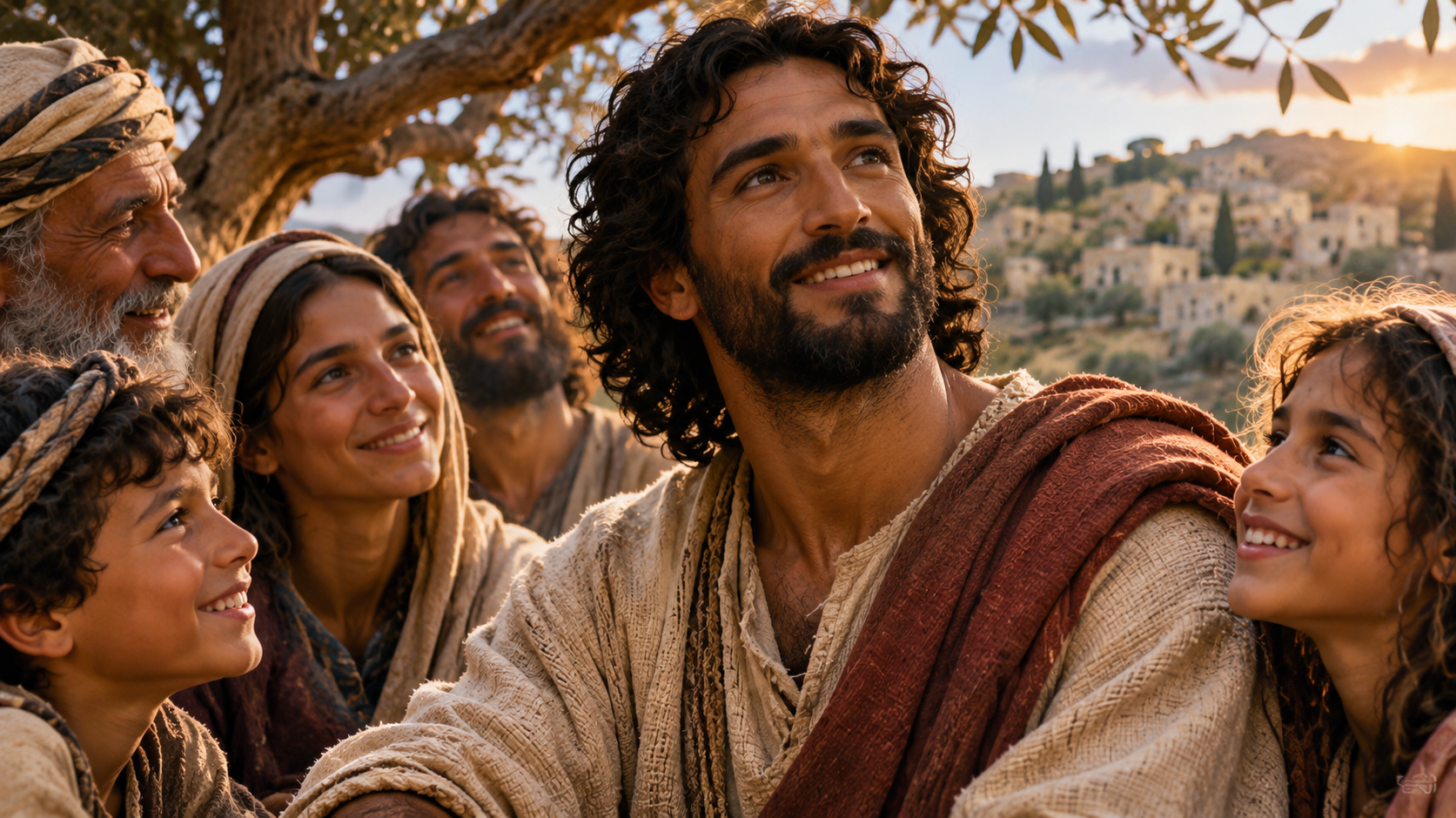
Jesus of Nazareth — The Extraordinary Life Behind the Familiar Name
Reading path: The Jesus Story · Introduction. This is a separate story from the seven-stage Cosmic Adventure.
Imagine a village in Galilee, nearly two thousand years ago.
No television cameras. No cathedral bells. No portraits hanging in galleries. Just families, workshops, dusty roads, bread being prepared for dinner, and ordinary people trying to get through another day.
And among them, a boy named Jesus.
If you arrived expecting an immediate tour of heaven, you might be surprised by how much of The Urantia Book's account begins on the ground: with childhood, parents, siblings, responsibilities, friendship, work, loss, and the slow unfolding of a human life.
That is where our invitation begins.
Before we ask what the universe says about Jesus, let's meet the person the book asks us not to overlook.
Looking for something particular? Meet the human Jesus · Explore his teachings · Discover the Michael of Nebadon connection
Begin the first Jesus story — The Boy Who Asked Questions →
Start With the Human Jesus
The Jesus of Part IV isn't presented only through sermons and miraculous moments. The narrative lingers over the texture of his days and the people around him.
It describes a young person learning, working, asking questions, and carrying family responsibilities. Later it follows his travels, his relationships, and the widening circle of those who listened to him.
Some details overlap with the New Testament's broad historical setting; many additional scenes, conversations, and biographical assertions are distinctive claims of The Urantia Book and cannot be independently verified simply because the story is vivid.
Still, there is a beautiful question beneath them:
What might we discover by paying attention not only to what Jesus taught, but to how he treated people?
📖 Follow the original account — Childhood and everyday life
Part IV begins with Paper 120 — The Bestowal of Michael on Urantia. The childhood narrative begins in Paper 122 — Birth and Infancy of Jesus and continues through Paper 128 — Jesus' Early Manhood.
These links lead to the book itself. They are not endorsements of the historicity of every scene.
What Did Jesus Want People to Understand?
The portrait of Jesus in The Urantia Book repeatedly returns to ideas that are both simple and demanding: God's fatherly love, our spiritual kinship, forgiveness, sincere faith, compassion, and the transforming power of service.
Not just grand beliefs to admire from a distance.
Questions for an ordinary Tuesday.
What does loving your neighbour look like when that neighbour is difficult?
What does forgiveness ask of someone who has been hurt?
What does it mean to treat a person as worthy of dignity before they have earned your approval?
The book's final paper, Paper 196 — The Faith of Jesus, emphasizes the faith and living example of the human Jesus, not just theories about his divine identity. That makes a wonderful doorway for readers interested in practice as much as theology.
📖 Follow the original account — Teaching and ministry
Explore Paper 140 — The Ordination of the Twelve, Paper 149 — The Second Preaching Tour, and Paper 196 — The Faith of Jesus.
These chapters are invitations to read the primary text, not substitutes for a completed historical or propositional study.
The Cosmic Question: Who Was Michael of Nebadon?
Readers arriving from our cosmic adventure have already encountered Nebadon, a local universe in The Urantia Book's proposed cosmology.
Now comes a connection that changes the scale of the story.
According to Part IV, Jesus of Nazareth was Michael of Nebadon, the Creator Son of that local universe, living an authentic human life on Urantia.
Paper 120 presents this incarnation as part of Michael's experiential understanding of the creatures he governs.
It is a remarkable theological claim. It is not an independently established historical fact, and readers are free to examine, question, or reject it.
But as a narrative idea it raises a compelling question:
If the ruler of a universe wanted to understand human beings, what would it mean to learn their lives from the inside?
Visit Nebadon — The Universe Where a Creator Learned to Understand →
📖 Follow the original account — The book's portrayal of identity
Read Paper 120 — The Bestowal of Michael on Urantia and Paper 196 — The Faith of Jesus.
The claimed identity of Jesus with Michael of Nebadon belongs to the text's religious cosmology. Different Christian traditions and historical scholars approach Jesus' identity in other ways.
Choose the Door That Interests You
You don't have to read all 77 papers of Part IV before one question can change the way you look at the story.
If you want the person: Begin with the childhood and early-life accounts in Papers 122–128.
If you want the teachings: Explore the public ministry and teachings, then finish with Paper 196.
If you want the cosmic story: Begin with Paper 120 and follow the connection between Jesus and Michael of Nebadon.
Or simply stay with this thought for a moment:
The story of Jesus may be extraordinary because of what it claims about heaven. But it can also be compelling because of what it asks us to notice on Earth.
A tired person. A lonely neighbour. A difficult choice. An opportunity to forgive.
Perhaps that is a fitting place to begin.
An Invitation, Not a Verdict
This gateway is an editorial introduction to Part IV of The Urantia Book.
Our formal proposition-by-proposition research has not yet reached Papers 120–196. We will not pretend that it has, or confuse vivid literary detail with independent historical evidence. Nor does the Atlas ask readers to accept the book's celestial authorship in order to explore its portrayal of Jesus.
What we can offer is an open door: a captivating narrative, direct access to the original passages, honest distinctions between evidence and belief, and room for your own questions.
The great cosmic adventure remains available. So does the serious research.
But if you came here looking for Jesus, welcome. This door is for you.