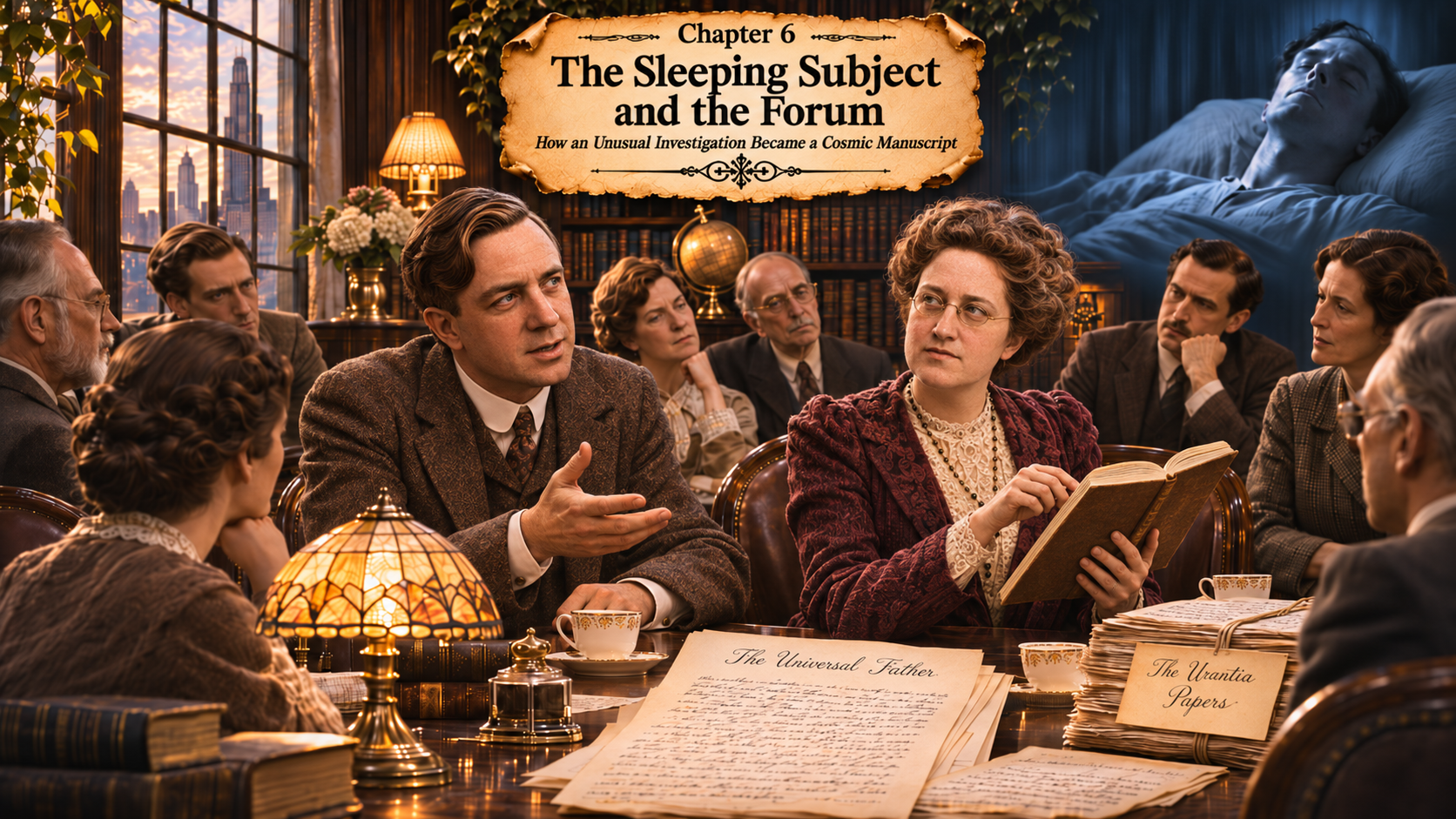
The Sleeping Subject and the Forum
How an Unusual Investigation Became a Cosmic Manuscript
Historical Specials · Chapter 6 · Return to the historical introduction
It began with a sleeping man whose name was never revealed.
Then came a physician who couldn't explain what he was observing.
Then a room full of people who wouldn't stop asking questions.
And eventually, according to those who participated, the answers began arriving in writing.
The Sunday Afternoon That Changed Everything
Chicago. The early 1920s.
It was supposed to be a pleasant Sunday afternoon.
A gathering of friends.
A little conversation.
Perhaps some discussion about health.
A cup of tea.
Nothing particularly extraordinary.
Certainly nothing requiring an explanation of the organization of the universe.
At the Chicago home of Drs. William and Lena Sadler, visitors began assembling for an informal discussion.
Some were professionals. Others came from different occupations and walks of life.
They shared something more important than their educational backgrounds.
Curiosity.
And curiosity, as history repeatedly demonstrates, has a remarkable tendency to interfere with perfectly respectable afternoon plans.
According to William Sadler's later recollection, he had suggested that the couple invite former patients and friends to regular Sunday gatherings.
Lena took the initiative.
When William returned from a trip, she had already organized the meeting.
Three o'clock.
The programme seemed straightforward.
Begin with a practical health discussion.
Perhaps the common cold.
Perhaps worry.
Then tea.
Then questions.
It was a sensible plan.
An entirely reasonable way for two physicians to maintain contact with people they knew.
But one afternoon, the conversation turned toward psychic phenomena.
Sadler had been investigating extraordinary claims for years.
He had exposed questionable mediums.
He had studied unconscious psychological processes.
He had become convinced that most remarkable psychic performances possessed decidedly ordinary explanations.
And he said so.
Then someone asked an inconvenient question.
Were there any cases he hadn't been able to explain?
Well.
As it happened...
There was one.
And at that moment, according to the later historical account, a Sunday discussion group began moving toward something none of its participants had originally planned.
The history of The Urantia Book was about to acquire an audience.
Historical note: This opening is an atmospheric reconstruction based on Sadler's retrospective account. The dialogue is paraphrased, not a verbatim record of an individually documented Sunday meeting.
The Man Who Slept Through His Own Mystery
We met him in Chapter 5.
Or, more accurately, we met the mystery surrounding him.
The unidentified sleeping subject.
A man whose unusual nighttime experiences had attracted the attention of William and Lena Sadler.
According to William Sadler's published account, the man entered an exceptionally deep state of sleep during which remarkable communications were reported.
Sadler claimed that ordinary efforts failed to awaken him.
He described the individual as generally unaware of what took place during these episodes.
And he reported that some communications appeared to involve personalities claiming origins beyond Earth.
Not the ghosts of departed relatives.
Not the familiar séance personalities associated with nineteenth-century Spiritualism.
Something different.
At least, that was Sadler's interpretation.
In the appendix to his 1929 book The Mind at Mischief, he reported attending approximately 250 nighttime sessions and stated that stenographic notes had been taken during many of them.
After years of investigation, he remained unable to provide an explanation he considered satisfactory.
That statement deserves attention.
But it also deserves precision.
Sadler reported an unexplained phenomenon. He did not independently demonstrate that the alleged communicators existed.
Nor does his published description enable us to reconstruct the man's medical condition, interview him, or examine the original proceedings under modern investigative standards.
There is another important limitation.
The 1929 appendix does not identify the subject or explicitly present itself as a complete history of the production of The Urantia Book.
That connection is developed more fully in later accounts from participants in the Urantia movement.
We must distinguish those accounts rather than quietly treating them as a single uninterrupted record.
But our Sunday visitors had something rather more immediate on their minds.
They wanted to hear about the case.
And Lena had notes.
Lena Brings Out the Notebook
This is one of the most revealing moments in the story.
In Sadler's retrospective account, when the visitors expressed interest in his unexplained case, he asked Lena to retrieve notes from a recent reported contact.
She read them to the gathering.
Consider what this tells us.
Lena was not merely a spectator.
She was a physician, an investigator, and an active participant in the early proceedings.
She also helped create the social setting in which the Forum developed.
The woman who arranged an afternoon gathering now found herself helping introduce its members to an extraordinary investigation.
We cannot establish every conversation that followed.
We do not possess a complete contemporary transcript of that first discussion.
But the participants' later accounts describe a striking transformation.
The visitors became fascinated.
They returned.
They asked more questions.
The medical discussions gradually gave way to philosophy, theology, cosmology, and the possibility of communication with intelligences beyond ordinary human experience.
According to Sadler, the planned series of health lectures never materialized.
One can almost sympathize with the Doctor.
He had intended to explain how to avoid catching a cold.
His audience wanted to know who created the universe.
A rather ambitious expansion of the syllabus.
And so the gathering acquired a name.
The Forum.
It was an appropriate choice.
A forum is a place for discussion.
Questions.
Disagreement.
Exploration.
And, occasionally, the discovery that the answer to one question produces another seventeen.
For the people gathering in the Sadlers' home, this was becoming more than an intellectual diversion.
They believed they might be participating in something extraordinary.
But what?
That remained to be determined.
A Mystery With Two Beginning Dates
Before following the Forum further, we must address something Chapter 5 introduced.
Our historical calendar has developed a disagreement.
Two dates appear in accounts of the beginning of the sleeping-subject investigation.
1906.
1911.
And the difference matters.
In 1929, Sadler stated that he first encountered the case in the summer of 1911.
That is an identifiable, published statement made by the investigator himself.
Later historical accounts associated with the Urantia movement place the beginning in 1906.
Some attribute the earlier date to Emma Christensen, affectionately known as Christy, who became an important participant in the movement.
Those later sources even suggest that Sadler acknowledged an error in his published chronology.
But that assertion is retrospective.
We do not possess sufficiently strong independent evidence to establish precisely when the first encounter occurred.
Could an initial consultation have happened in 1906, followed by more sustained observations beginning in 1911?
Possibly.
Could an investigator have misremembered or misstated a date?
Certainly.
Could later recollections have become confused?
That is also possible.
What we cannot responsibly do is select a convenient explanation and present it as a documented fact.
The same caution applies to the Forum.
Historical timelines place the earliest gatherings around 1922–1923, while a Fellowship institutional history begins its account of the regular Sunday meetings in 1924.
The Forum's formal organization as a closed group is dated to September 1925 in Sadler's later history.
These may reflect different stages in the group's development, but not every discrepancy is resolved.
Fortunately, the broader sequence is clear enough for our journey.
An investigation preceded an informal gathering. The gathering became an organized group. The group began submitting questions. And those questions became central to the participants' account of the Urantia Papers.
History does not always provide a perfectly synchronized calendar.
Sometimes it leaves us with several clocks and the responsibility to notice that they disagree.
The Question That Changed the Questions
Now we return to the sleeping subject.
According to Sadler's 1960 history, the investigators had been conducting reported communications for many years.
Much of the material involved unusual descriptions of the universe.
Different orders of beings.
Inhabited worlds.
Celestial administration.
Concepts that would eventually become familiar to readers of The Urantia Book.
Then, during one of the reported nighttime encounters, something unexpected happened.
An alleged communicator challenged the investigators.
They had been asking comparatively trivial questions, the participant account says.
Why not ask questions that might genuinely benefit humanity?
Not merely questions about unusual visitors.
Not questions intended to satisfy passing curiosity.
Questions of enduring significance.
Questions about reality itself.
Sadler described the challenge as a turning point.
The investigators responded by deciding to ask questions they believed human beings could not adequately answer.
Where did the universe come from?
What is the nature of God?
What is the purpose of creation?
How are personality, mind, and spirit related?
What happens after death?
And why does human life exist at all?
Imagine the difference between the questions.
One day:
Who are you, and where do you come from?
Another day:
What is the ultimate destiny of an evolving human personality in an inhabited universe?
We have moved rather far from the common cold.
But another transformation was taking place.
The investigators were no longer simply observing unusual experiences.
They were becoming participants in a process of organized questioning.
And the Forum would soon join them.
When the Living Room Became a Question Factory
According to the later movement history, Forum members were invited to prepare substantial questions about the universe, deity, creation, and human existence.
The response was enthusiastic.
Sadler recalled that the participants produced several hundred questions at an early stage.
The questions were sorted.
Repeated questions were removed.
Subjects were organized.
And the investigators reported that written material subsequently appeared in response.
This became a recurring pattern.
A paper would be presented.
The Forum would examine its contents.
Members would formulate additional questions.
And further material would reportedly follow.
Here is an important feature of the story.
The Forum was not described merely as an audience receiving a finished manuscript.
Its questions reportedly influenced the unfolding organization and expansion of the work.
The participants were readers.
Discussants.
Questioners.
And, at least in this procedural sense, contributors to the process by which the manuscript took shape.
That does not establish who composed its answers.
But it tells us something important about the human organization surrounding them.
Even on the movement's own account, the production of The Urantia Book involved sustained human activity.
People had to read.
Compare.
Organize.
Clarify.
Ask further questions.
Preserve documents.
Eventually, prepare a book for publication.
Whatever one believes about the alleged source of the material, the historical participation of human beings cannot simply disappear from the story.
And this leads us to an especially interesting question.
What exactly did the participants mean when they said a paper had appeared?
The Papers That Nobody Claimed to Write
This is where the mystery becomes more complicated.
The early reported communications connected with the sleeping subject included spoken messages and written communications.
But the later Urantia Papers were described differently.
In his 1962 recorded remarks, William S. Sadler Jr. described papers appearing in handwriting associated with the unidentified subject.
He claimed that the witnesses never observed the man physically writing them.
That is a remarkable statement.
It is also testimony.
Not independently established proof of materialization.
The distinction is critical.
Sadler Jr. offered his own speculative explanation involving several levels of celestial communication and translation.
He explicitly acknowledged that his proposed mechanism was a theory.
His account should therefore not be mistaken for an independently verified description of how the papers were produced.
William Sadler's 1960 history was similarly cautious about the actual mechanism.
He maintained that the investigators did not understand how the material was reduced to written English.
He described the Contact Commissioners comparing handwritten material with typewritten copies.
He also described manuscript preservation and subsequent preparation for publication.
These accounts leave significant questions unanswered.
Who physically composed the text?
What processes of composition, editing, and transcription occurred?
Which original documents survived?
How were alterations handled?
And how much of the complete production history can now be reconstructed?
The published testimony does not settle these questions.
The central difficulty is not that we have no historical accounts.
We have several.
The difficulty is that the most extraordinary parts of those accounts are not supported by the kind of independently inspectable evidence that would establish their proposed supernatural explanation.
A witness may sincerely report that a document appeared under circumstances the witness could not explain.
That testimony matters.
But the absence of an observed ordinary mechanism does not demonstrate that an extraordinary mechanism was responsible.
We have encountered this distinction before.
In the Fox sisters' farmhouse.
In Victorian séances.
In investigations of trance communications.
And now, in a Chicago household where an increasingly elaborate manuscript was reportedly taking shape.
The historical setting has changed.
The investigative challenge has not.
The Thirty People Who Promised Not to Tell
As the Forum became more formally organized, its structure changed.
According to Sadler's later history, the Forum was established as a closed group in September 1925.
Its charter membership numbered thirty.
Members were required to maintain confidentiality concerning the reported revelations.
They were not to discuss the material outside the group.
Nor were they permitted to make unauthorized copies or notes of the papers.
This is an important development.
The gatherings were no longer simply informal Sunday conversations.
They had become part of a structured undertaking with rules, responsibilities, and restrictions.
Over time, the membership included people from many occupations.
Doctors.
Lawyers.
Teachers.
Ministers.
Office workers.
Homemakers.
And others.
The Forum became a community organized around a growing body of unusual writings.
But not everyone had the same role.
A smaller circle became known as the Contact Commission.
It included members of the Sadler family and close associates, including William and Lena, their son William Jr., and members of the Kellogg family. Emma Christensen also became part of the inner group.
The commissioners were responsible for handling questions and written material and preserving the developing manuscript.
According to the historical accounts, Forum members generally encountered the papers through readings and discussion.
The Contact Commissioners occupied the more restricted position associated with the reported contacts.
This distinction matters.
Participation in the Forum did not necessarily make someone an eyewitness to the sleeping-subject phenomenon or to the alleged appearance of manuscripts.
Many participants could testify to what they read, discussed, and experienced as members.
A much smaller number claimed direct knowledge of the unusual contact proceedings.
And even their testimony must be evaluated according to what they actually observed.
Not what subsequent generations imagined they must have seen.
The Manuscript That Kept Growing
The participants' accounts describe an extended process rather than the arrival of a complete book in a single extraordinary event.
According to Sadler's 1960 history, the first substantial series contained fifty-seven papers.
Further questions led to an expansion and reworking of the material.
Over time, the collection developed into the 196 papers familiar to readers of the published book.
And the subject matter was extraordinary in scope.
The nature of God.
The structure of the universe.
The administration of celestial creation.
The evolution of life.
Human origins.
The history of civilization.
The development of religion.
The survival of personality after death.
And, eventually, an extensive account of the life and teachings of Jesus.
An enormous intellectual undertaking had developed around the Forum's questioning.
Sadler's later history states that the first three parts of the manuscript were completed in 1934.
The fourth part, devoted to Jesus, was reportedly delivered in 1935.
He attributed the separate timing of the Jesus material to developments involving the alleged celestial authors.
Those alleged causes belong to the movement's religious explanation, not to independently verified historical events.
But the reported manuscript sequence is important.
It suggests that the book passed through successive stages of preparation.
The process also did not end with the initial arrival of the papers.
Sadler described further clarification and revision.
Material could be added.
Material could be removed.
Passages could be adjusted.
Later historical research has raised additional questions about the manuscript's textual development and the dates of some source material.
This should not surprise anyone who has ever participated in the preparation of a large book.
Manuscripts develop.
Readers ask questions.
Editors discover ambiguities.
Revisions occur.
But the existence of revision raises a consequential historical question.
How much did the final published text owe to its alleged extraordinary source, and how much to the ordinary intellectual work of the people handling it?
Those possibilities need not be framed as mutually exclusive within a believer's interpretation.
A religious reader might believe human preparation was part of the revelatory process.
A secular historian might interpret the same activity as evidence of human literary production.
The task of historical investigation is not to decide the answer in advance.
It is to determine what the evidence supports.
The Strange Problem of Human Sources
There is another development worth mentioning.
Decades after publication, researchers began identifying similarities between passages in The Urantia Book and earlier books written by human scholars.
One researcher, Matthew Block, documented extensive textual parallels involving works published in the nineteenth and early twentieth centuries.
Some parallels concern ideas.
Others involve wording, organization, or sequences of explanation.
These comparisons are significant because they concern actual texts that can be examined.
But what do they establish?
A close textual resemblance can support a conclusion that one work drew upon another, directly or indirectly.
It does not automatically identify the individual responsible for the borrowing.
Nor does it independently settle the theological question of whether revelation, as believers understand it, can incorporate pre-existing human knowledge.
Indeed, The Urantia Book itself contains statements acknowledging the use of human concepts and expressions.
Different readers interpret the implications differently.
For the historian, however, the investigation becomes more concrete.
We can compare books.
Publication dates.
Phrases.
Paragraph structures.
Bibliographies.
And the intellectual environment of the people involved.
The mystery is no longer confined to inaccessible nighttime experiences.
It has entered the much more accessible world of documents.
And documents have a wonderful quality.
They can be examined without requiring anyone to fall asleep first.
Tyrion Requests an Author's Identification
An entirely fictional Atlas interlude.
Tyrion entered the Forum's imagined records office.
He was carrying a clipboard.
His single eye was narrowed in professional concentration.
His two ears were alert.
The glowing T on his collar illuminated a small desk covered with manuscripts.
He had been assigned a straightforward task.
Determine the author.
He found a paper labelled The Universal Father.
He examined its contents.
He checked the title.
He searched for a signature.
Nothing.
He examined another paper.
No ordinary human author.
Another.
Still nothing.
Finally, Tyrion opened a new file.
AUTHOR IDENTIFICATION — INVESTIGATION PENDING
Under Evidence collected, he wrote:
One large manuscript.
Numerous extraordinary claims.
Several conflicting historical accounts.
An impressive number of unanswered questions.
Under Final conclusion, he wrote:
Further biscuits required.
Then he reconsidered.
He crossed out the sentence.
Further evidence required.
That looked considerably more professional.
Although he remained convinced the two procedures were not mutually exclusive.
End fictional interlude.
What Secrecy Protected—and What It Cost
Secrecy is often treated as evidence of wrongdoing.
That is too simple.
People have legitimate reasons for protecting private medical information.
Religious groups sometimes restrict access to sacred or preliminary material.
Researchers may preserve confidentiality.
And individuals associated with unusual experiences may wish to avoid publicity.
In Sadler's 1929 account, the sleeping subject's privacy was an explicit concern.
In later movement histories, another explanation appears.
The participants said they had been instructed not to reveal the contact personality's identity because the revelation was not supposed to become associated with a particular human individual.
They wanted readers to evaluate the teachings rather than develop a cult of personality around the alleged intermediary.
That reasoning is understandable as a religious intention.
But it has historical consequences.
The subject cannot be independently interviewed.
His background cannot be securely established.
His relationship to the investigators cannot be reconstructed in full.
The circumstances of the claimed contacts remain only partially documented.
And the surviving accounts were written or recorded from within a relatively small circle of committed participants.
There were also restrictions concerning notes, copies, and related communications.
Sadler's later history describes instructions to destroy certain preliminary communications rather than preserve them indefinitely.
For participants who regarded the material as sacred revelation, these restrictions may have seemed essential.
For later historians, they present a formidable obstacle.
Secrecy may protect a person's privacy while simultaneously limiting the possibility of independent verification.
Both propositions can be true.
The question is not whether every act of secrecy was suspicious.
The question is what we can know when crucial evidence is inaccessible, missing, or deliberately withheld.
And the answer is less than we might wish.
Could the Whole Thing Have Had an Ordinary Explanation?
We should consider the possibilities without declaring victory for any of them.
One interpretation is the religious explanation offered by Urantia participants.
On this view, the papers were communicated through an extraordinary revelatory process involving celestial intelligences.
Many readers continue to understand The Urantia Book in this way.
The historical problem is that the alleged supernatural source has not been independently demonstrated.
Another interpretation involves unusual psychological experiences.
Sleep-related phenomena, dissociation, unconscious mental activity, and other altered states have all been studied in connection with extraordinary reports.
Sadler himself investigated several such possibilities and maintained that they failed to explain his case.
But his inability to identify an ordinary explanation does not establish that no ordinary explanation existed.
Nor can modern researchers diagnose the unidentified subject retrospectively from the limited published description.
A third interpretation emphasizes the social development of the movement.
The Forum provided a structured environment in which a group of people repeatedly discussed shared questions.
Participants developed a common vocabulary.
They examined written material.
They expanded interpretations.
They formed an increasingly coherent intellectual community.
Such processes can help explain how complex bodies of religious and philosophical literature develop.
But social development alone does not identify the original author.
A fourth interpretation focuses on literary construction.
The Urantia Papers may have resulted from human authorship, editorial collaboration, adaptation of existing sources, or some combination of these activities.
Textual parallels and the documented preparation of the manuscript provide legitimate grounds for exploring such possibilities.
But a convincing historical explanation must go beyond simply observing that human beings were involved.
It must account for the relevant documents, the production chronology, the testimony, and the evidence of textual composition.
There is also the possibility that participants were sincere but mistaken about the origins of experiences they believed were extraordinary.
And there is the more skeptical possibility of conscious fabrication.
Neither possibility should be asserted without supporting evidence.
We must resist the temptation to turn uncertainty into certainty merely because one explanation appeals to us.
An unexplained report is not proof of revelation.
And a report of revelation is not proof of fraud.
Those are different conclusions, requiring different evidence.
The Community Behind the Mystery
It would be easy to tell this story as though only the sleeping subject mattered.
An anonymous man.
An extraordinary phenomenon.
A mysterious manuscript.
End of investigation.
But that would overlook something important.
For years, human beings committed themselves to reading, discussing, questioning, and preserving these writings.
Lena Sadler continued participating despite personal hardships and serious illness.
William Sadler combined his medical and literary career with his growing commitment to the Urantia project.
Their son became a prominent figure in the emerging movement.
Emma Christensen and the Kellogg associates played significant roles in its administration and preservation.
And many Forum members devoted countless hours to material they believed might possess profound spiritual significance.
According to Sadler's 1960 history, the Forum eventually recorded a cumulative membership of 486 people during its formal existence.
Not all were present at once.
Not all possessed the same responsibilities.
And not all witnessed the same things.
But their participation was real.
These were people with ordinary lives.
Work.
Families.
Responsibilities.
Disagreements.
Hopes.
And questions.
They were not merely characters in an extraordinary origin story.
They were the community through which the manuscript eventually reached the world.
A historian can recognize that dedication without accepting every claim made by the participants.
A reader can respect their sincerity without surrendering critical judgment.
And a believer can acknowledge unanswered historical questions without necessarily abandoning the spiritual meaning they find in the text.
These are not contradictions.
They are different dimensions of a complicated human story.
The Manuscript Outlives Its First Readers
By the late 1930s, the Urantia project had developed beyond the original Forum conversations.
In 1939, a more systematic study group was organized.
Seventy people initially joined.
It became known simply as the Seventy.
The purpose was to study the papers carefully and prepare participants to understand and teach their contents.
The formal Forum phase concluded in 1942, according to Sadler's later history, although study activity continued.
The eventual book had not yet appeared in bookstores.
Its manuscript had developed over years.
Its supporters had organized themselves.
Its teachings had been read and discussed.
But the general public remained largely unaware of what was happening.
And the world beyond Chicago was changing dramatically.
Economic depression.
Political upheaval.
World war.
Scientific transformation.
New questions about humanity's future.
Meanwhile, in a relatively small religious circle, a manuscript describing an immense universe was being prepared for eventual publication.
Whatever its true authorship, the work represented an extraordinary intellectual and organizational commitment.
But there was still one crucial problem.
The manuscript had to become a book.
And a book required money.
Printing.
Distribution.
Legal organization.
And a decision that its time had finally arrived.
A Book Without a Human Author
The surviving account describes a deliberate effort to prevent the published work from becoming associated with a single human personality.
That intention shaped the movement.
No identified sleeping subject would appear on the title page.
William Sadler would not be named as the book's author.
Nor would Lena.
Nor William Jr.
Nor the Forum.
Instead, the work would present its own extraordinary claims concerning authorship.
The published papers would attribute themselves to many different celestial personalities.
For those who accepted the revelation, this was appropriate.
The message, they believed, mattered more than the earthly circumstances through which it arrived.
For historians, the absence of an identified human author created an enduring problem.
The manuscript could be studied.
Its contents could be compared with earlier literature.
Its publication could be documented.
But its complete chain of composition remained uncertain.
Perhaps that uncertainty explains why the story continues to fascinate people.
It sits at an unusual intersection.
Medicine and religion.
Psychology and revelation.
Literature and testimony.
Secrecy and public teaching.
Human questions and purportedly celestial answers.
And beneath all of it remains the one individual whose name was never publicly disclosed by the principal participants.
The sleeping subject.
We should not pretend to know his identity.
Nor should we attach a famous name to him merely because a theory makes for an exciting story.
The suggestion involving Edgar Cayce, for example, deserves its own careful investigation.
Dates, locations, surviving records, and competing testimony must be compared before any historical conclusion can be justified.
For now, the identity remains unestablished.
And the manuscript is about to step into the light.
The Door to 1955
Think about how far we've travelled.
A farmhouse in 1848.
A movement of spiritualist mediums.
An era of books claiming revelations from invisible realms.
A great religious gathering in Chicago in 1893.
A physician investigating the mysterious workings of the human mind.
A sleeping man whose identity remained concealed.
A Sunday afternoon discussion.
A notebook.
A question.
Then hundreds of questions.
And eventually, a manuscript containing nearly two thousand pages.
It is quite a journey.
But there is something especially moving about the people in this story.
They were searching for answers to questions that human beings have asked for thousands of years.
Why are we here?
Are we alone?
Does personality survive death?
Is there a purpose to the universe?
Can human beings know anything meaningful about God?
The historical evidence does not establish that the Forum received answers from celestial intelligences.
But it does establish that a community formed around its conviction that such answers might have been received.
And that conviction helped bring an unusual book into existence.
We can examine the historical claims without pretending to settle the religious questions.
We can appreciate the intellectual ambition without accepting every conclusion.
We can recognize sincere belief without confusing sincerity with proof.
And we can continue asking questions.
Because now the mystery is about to change.
The Sunday discussions will become a publishing enterprise.
The private manuscript will become a public book.
And the extraordinary claims that had circulated within a relatively small group will finally become available to anyone willing to open its pages.
Chicago. October 12, 1955.
After decades of preparation, The Urantia Book is published.
But that is the beginning of another story.
Who paid to bring it into print?
Why did publication take so long?
What did the first readers encounter?
And what happened when an enormous book claiming celestial authorship entered a world already crowded with competing ideas about religion, science, and the human future?
The door to 1955 is opening.
And this time, the mystery will have a publisher.
🔎 Factoid — What the Historical Evidence Actually Establishes
The sleeping subject: William S. Sadler publicly described an unidentified male subject in the 1929 appendix to The Mind at Mischief. The case was reported as unexplained by Sadler, but the alleged extraordinary source of the communications was not independently established.
1906 versus 1911: Sadler's 1929 publication gives 1911. Later movement histories give 1906. The precise beginning remains disputed.
The Forum: Informal gatherings developed in the early 1920s. Sadler's 1960 history gives September 1925 as the formal organization of a closed group of thirty charter members.
Lena Kellogg Sadler: A physician and active participant in the investigation, she helped organize the Sunday gatherings and read notes associated with reported contacts to the group.
The Contact Commission: A smaller circle of participants responsible for handling questions, manuscripts, and restricted communications. Forum membership alone did not confer direct access to the reported contact proceedings.
The first papers: Sadler's 1960 history describes an initial series of fifty-seven papers, subsequently expanded and revised into the 196 papers found in the published book.
1934–1935: The movement's retrospective history places the completion of the first three parts in 1934 and the delivery of the Jesus papers in 1935. These are participant-reported milestones, not independent verification of celestial transmission.
1939: The Seventy began systematic study of the papers.
1942: The Forum's original formal phase concluded. Study activity continued afterward.
1955: The Urantia Book was published on October 12, 1955.
The historical boundary: Documentation establishes the existence of Sadler's published testimony, the movement, its organizations, the manuscript tradition, and the eventual book. It does not independently establish the celestial origin of the writings or the precise mechanism by which the original papers were produced.
📚 Sources for Further Investigation
Primary and participant sources
- William S. Sadler, The Mind at Mischief, Appendix (1929) — An early published description of the sleeping-subject case.
- William S. Sadler, A History of the Urantia Movement (1960) — A participant's retrospective account of the Forum, questions, manuscript, secrecy, and publication.
- William S. Sadler Jr., How The Urantia Book Came into Existence (1962) — A recorded retrospective account by a Contact Commission participant.
- Marian Rowley, History of the Urantia Movement, draft — A further movement-associated historical account.
Historical archives and independent research
- The Urantia Book Fellowship — Historical Timeline — Early chronology, documentary references, and areas of disagreement.
- The Urantia Book Fellowship — A Brief History — Institutional account of the Forum's development.
- University of California, Santa Barbara — Urantia Book Historical Society Archive — Archival collection describing the movement's history and surviving materials.
- Sarah Lewis, The Peculiar Sleep: Receiving The Urantia Book — Academic analysis published in The Invention of Sacred Tradition (2007).
- Matthew Block — Urantia Book Source Studies — Textual comparisons between the Urantia Papers and earlier human literature.
Editorial note: Participant recollections are evidence of what participants reported, not independent corroboration of the supernatural explanations they offered. The opening atmosphere is a literary reconstruction; Tyrion's interlude is fictional. No sleeping-subject identity has been asserted.
🧭 Continue the Historical Journey
- Previous — Chapter 5: The Doctor, the Mind, and the Unexplained
- Next — Chapter 7: Chicago, October 1955: When the Mystery Became a Book
- Return to Historical Specials — Before the Book
Continue to Chapter 7 for the publication of the book in 1955. The wider historical investigation remains open.