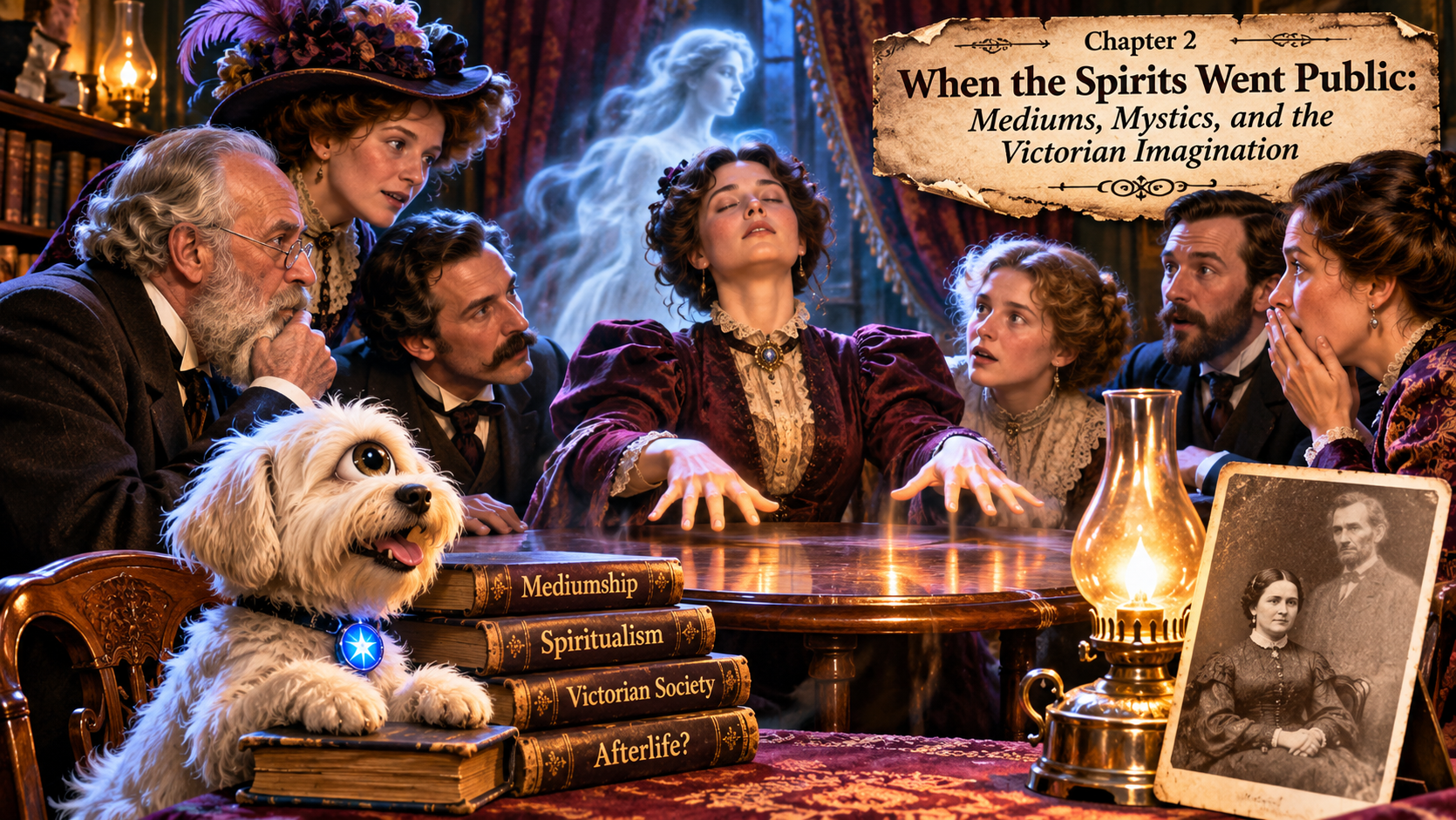
When the Spirits Went Public: Mediums, Mystics, and the Victorian Imagination
Historical Specials · Chapter 2 · Return to the historical introduction
The farmhouse was behind us. The mysterious knocks had escaped into the newspapers. And suddenly, the dead—if the Spiritualists were right—had apparently discovered public speaking.
The Evening the Invisible Sold Tickets
Rochester, New York.
November 14, 1849.
The audience gathered at Corinthian Hall.
Some were curious.
Some were skeptical.
Some had already become convinced that something extraordinary was happening.
Others probably considered the entire affair a splendid opportunity to witness humanity making a public fool of itself.
Admission cost twenty-five cents.
Approximately four hundred people attended.
The attraction?
Reports that two young sisters had been communicating with the dead.
Only a year earlier, Maggie and Kate Fox had become associated with mysterious knocking sounds in a farmhouse near Hydesville.
Now the claims had reached a public auditorium.
Consider the transformation.
A family hears strange sounds.
Neighbours become interested.
Religious reformers investigate.
Newspapers spread the story.
And before long, someone has organized a public event.
Human civilization had achieved another remarkable milestone.
The supernatural had entered show business.
Of course, that isn't how everyone present understood the occasion.
To believers, the proceedings might demonstrate that human personality survived death.
To critics, they offered an opportunity to expose deception.
To investigators, the challenge seemed straightforward.
If mysterious sounds occurred, could anyone establish where they came from?
The demonstrations attracted scrutiny.
Committees examined the proceedings, searched for possible tricks, and attempted to determine the source of the noises.
Some examinations failed to identify how the sounds were produced.
But the absence of an explanation during a particular demonstration did not prove that departed spirits were responsible.
That distinction mattered then.
It matters now.
Nevertheless, the public fascination was unmistakable.
Something had changed.
The claims no longer belonged to one farmhouse.
They had become a movement.
And that movement was about to acquire a rather surprising number of living representatives.
The Victorian Parlour Gets Crowded
Imagine entering a comfortable middle-class home in the 1850s.
The furniture is polished.
Curtains frame the windows.
Family portraits decorate the walls.
A clock ticks above the mantelpiece.
The atmosphere suggests respectable domestic life.
Then the hostess announces that everyone will be attempting to communicate with the dead.
Suddenly, the evening takes an unexpected turn.
Across Britain, America, and parts of Europe, gatherings devoted to purported spirit communication became increasingly fashionable.
Some participants sat around tables.
Others waited for knocks.
Certain mediums entered trances.
There were claims of automatic writing, messages attributed to deceased relatives, and furniture moving through forces nobody could identify.
The séances attracted believers, skeptics, wealthy enthusiasts, religious reformers, writers, and people who were simply curious.
And the parlour became a kind of experimental theatre.
A table stood in the centre.
Several people placed their hands upon it.
Everyone waited.
Perhaps the furniture would move.
Perhaps someone would report an unusual sensation.
Perhaps a participant would ask a question.
Or perhaps nothing would happen, leaving everyone to enjoy refreshments while quietly reconsidering the evening's entertainment.
But beneath the sometimes theatrical proceedings lay a serious question.
What if consciousness survived bodily death?
For many Spiritualists, the question was not merely whether an invisible hand could move a table.
It was whether human life possessed a dimension that death could not destroy.
That possibility had profound emotional appeal.
It also raised a problem.
How could anyone distinguish a genuine communication from imagination, suggestion, misinterpretation, or deliberate fraud?
The more extraordinary the alleged phenomena became, the more important that question grew.
Tyrion Investigates the Furniture
An entirely fictional Atlas time-travel interlude.
Tyrion stood beside a Victorian table.
A medium had invited the participants to rest their fingertips upon its surface.
The room became quiet.
Someone requested a sign from the spirit world.
The table moved.
Tyrion tilted his enormous single eye.
He inspected the legs.
He examined the floor.
He sniffed beneath the tablecloth.
Then he sat down.
His preliminary conclusion?
The furniture appeared suspiciously well behaved for something allegedly receiving instructions from another dimension.
He offered no final verdict.
But he requested that someone investigate the possibility of biscuits before proceeding to the next experiment.
End fictional interlude.
When Scientists Joined the Conversation
By the early 1850s, table-turning had attracted enough attention to interest serious scientific investigators.
One of them was Michael Faraday.
Yes.
That Michael Faraday.
The physicist and chemist whose investigations of electricity and magnetism helped transform modern science.
Apparently, discovering electromagnetic induction wasn't sufficient to guarantee a quiet retirement from unusual questions.
People wanted to know why tables moved.
So Faraday investigated.
In 1853, he examined reports of table-turning using a relatively simple experimental arrangement.
He introduced materials that made it possible to detect slight movements between the participants' hands and the table.
The results indicated that the participants were unconsciously exerting the forces that moved the furniture.
Their hands moved first.
The table followed.
The effect could occur without deliberate deception.
That was crucial.
A sincere participant might genuinely believe an external force was moving the table.
But unconscious muscular activity could produce the observed motion.
Faraday's investigation offered an important natural explanation for the particular movements he tested.
It did not establish the cause of every alleged paranormal event, and Spiritualists continued to dispute whether his experiments accounted for their more extraordinary reports.
But the methodological lesson was significant.
An experience can feel mysterious without requiring a supernatural explanation.
And a person can report an experience honestly while misunderstanding its cause.
That principle would become increasingly important as psychical research developed into a more organized field of investigation.
The Women Who Found Their Voices
Something else was happening within Spiritualism.
Something considerably more consequential than moving furniture.
Women were gaining opportunities to speak publicly.
In much of nineteenth-century society, women faced substantial restrictions on religious leadership, education, political participation, and public authority.
But Spiritualist gatherings introduced an unusual possibility.
If a woman claimed to speak under the influence of an invisible intelligence, audiences might listen to her in circumstances where they otherwise would not have welcomed a female religious lecturer.
The reasoning was peculiar.
A woman might be discouraged from speaking with authority in her own name.
But if she claimed that a departed personality was speaking through her, the rules sometimes changed.
One might reasonably wonder whether the alleged spirits had discovered an unexpectedly effective loophole in Victorian social conventions.
Yet the consequences were real.
Women became prominent mediums, speakers, organizers, authors, and religious reformers.
Some connected Spiritualist beliefs to movements for women's rights, abolition, and wider social change.
Historian Ann Braude has examined these connections in Radical Spirits: Spiritualism and Women's Rights in Nineteenth-Century America.
And the history becomes especially interesting when we meet Emma Hardinge Britten.
Emma Takes the Stage
Emma Hardinge Britten was born in London in 1823.
She developed a career in music and theatre before becoming one of the nineteenth century's influential Spiritualist lecturers and writers.
Her life took her across the Atlantic and into a world of trance communication, religious experimentation, and public controversy.
But she did not simply begin as an enthusiastic believer.
Her own later account described an initially hostile reaction to Spiritualist claims.
She found aspects of the movement deeply troubling.
Yet her curiosity persisted.
And she eventually became one of its prominent advocates.
Emma's career reveals something important about the period.
Spiritualism wasn't confined to darkened rooms.
Its practitioners delivered public lectures.
They organized meetings.
They debated theology.
They published books and periodicals.
They developed networks across national boundaries.
And some women used those platforms to challenge assumptions about gender, religion, and authority.
Whatever one concludes about their supernatural claims, their public activity belongs to documented social history.
Emma wasn't merely a curious figure from an age of strange beliefs.
She was participating in a broader transformation of public religious culture.
And she would eventually become connected with yet another movement in the expanding nineteenth-century world of esoteric ideas.
Theosophy.
But we're getting ahead of ourselves.
Our historical time machine has several stops remaining before that particular gathering begins.
Then Came the Civil War
In 1861, the United States entered a devastating civil war.
Over the following four years, enormous numbers of soldiers and civilians experienced death, separation, displacement, and grief.
Families waited for news.
Letters stopped arriving.
Men disappeared into distant battlefields.
Some bodies were never identified.
And countless people struggled with the possibility that they would never see someone they loved again.
In such an atmosphere, the promise of communication with the dead acquired a particularly powerful emotional significance.
Spiritualism had already been growing before the war.
The war did not create it.
But widespread bereavement gave the movement new urgency.
What would you give to hear from someone you had lost?
What if a medium claimed to carry a message from your son?
Your husband?
Your brother?
What if someone could assure you that the person you loved still existed somewhere?
The longing is profoundly human.
And it helps explain why people might attend séances even when they possessed doubts.
We should be careful here.
Grief does not make someone foolish.
Nor does the sincerity of grief establish the authenticity of a purported spirit message.
Both observations can be true.
The suffering was real.
The hope was real.
The claims still required evidence.
Even the White House Wasn't Immune
Among those affected by Spiritualism was Mary Todd Lincoln.
Her life was marked by extraordinary loss.
In 1862, while Abraham Lincoln occupied the presidency, their young son Willie died.
Three years later, the president himself was assassinated.
Mary's grief became part of an already difficult life.
She participated in séances and sought what she believed might be contact with deceased loved ones.
But one of the strangest episodes associated with her interest in Spiritualism involved a photographer.
His name was William Mumler.
And he claimed to possess an extraordinary photographic ability.
He could, he suggested, produce pictures containing images of the dead.
Imagine what that meant in an era when photography itself still seemed astonishing.
A machine could capture a person's likeness.
A permanent image could preserve a face long after its owner had disappeared.
And now someone claimed that the camera could photograph spirits.
It was almost irresistible.
If photographs could preserve the living, why couldn't they reveal the dead?
There was, of course, a rather substantial problem.
Photographic equipment did not become a detector of supernatural beings merely because someone claimed that it had.
The Ghost in the Photograph
Mumler produced photographs that appeared to show translucent figures near living sitters.
Sometimes the apparent spirit resembled a deceased relative.
Sometimes the image seemed strangely familiar.
One of his most famous photographs depicted Mary Todd Lincoln seated while a ghostly figure resembling Abraham Lincoln appeared behind her.
To a grieving widow, such an image could carry enormous emotional significance.
To a skeptical observer, it raised an immediate question.
Could the effect have been produced through photographic manipulation?
Nineteenth-century photography involved complex processes.
Multiple exposures and other techniques could create images that seemed astonishing to people unfamiliar with their production.
Mumler faced accusations of fraud.
His photographic claims became a public controversy.
He was eventually acquitted in a criminal case, but acquittal did not establish that his photographs depicted actual spirits.
The famous Lincoln image is now regarded by historians as a photographic deception.
Still, the historical significance of spirit photography extends beyond the question of one photographer's honesty.
It reveals how a developing technology can acquire an almost magical reputation.
Photography seemed objective.
The camera appeared to record reality.
But photographs could mislead.
The machine could produce an image.
That did not mean the image's apparent explanation was true.
And here, once again, the Victorian world was discovering a lesson that remains surprisingly relevant.
Seeing something is not the same as understanding how it came to be seen.
A Movement Larger Than Its Mysteries
By the later nineteenth century, Spiritualism had developed into much more than a collection of sensational incidents.
It included religious congregations.
Public speakers.
Periodicals.
Associations.
Networks of investigators.
And communities united by various beliefs about the survival of personality after death.
But the movement was never intellectually uniform.
Some Spiritualists embraced Christian language and teachings.
Others questioned traditional doctrines concerning judgment and the afterlife.
Some were interested in social reform.
Others focused almost entirely on personal communications with departed relatives.
Some treated mediumship as religious experience.
Others hoped it might become a scientifically demonstrable phenomenon.
And still others approached the movement as entertainment or a source of income.
There were sincere seekers.
There were capable organizers.
There were imaginative thinkers.
There were professional performers.
And there were individuals accused of exploiting the vulnerable.
The history resists being compressed into a single verdict about everyone involved.
That complexity makes it fascinating.
Because Spiritualism was never only a story about the dead.
It was also a story about the living.
About authority.
About grief.
About women's voices.
About religious freedom.
About emerging technologies.
And about the uneasy relationship between the things people believed and the things they could demonstrate.
The Victorian Imagination Had No Speed Limit
Think of the nineteenth century for a moment.
Railroads transformed distances.
Telegraphs carried messages.
Electricity revealed remarkable possibilities.
Photography preserved appearances.
New scientific discoveries challenged familiar explanations of nature.
Meanwhile, religious thinkers questioned traditional doctrines and investigated spiritual possibilities.
The intellectual atmosphere was restless.
And within this atmosphere, the idea of communicating with unseen intelligences seemed to some people not entirely unreasonable.
If a telegraph could deliver a message across hundreds of kilometres, perhaps, enthusiasts wondered, some unknown process might transmit a message across an even greater boundary.
The boundary between life and death.
That was an analogy, not evidence.
But it captured the imagination.
And it helps explain why Spiritualism appealed to some individuals who considered themselves modern, educated, and scientifically curious.
Not everyone regarded supernatural claims as opposed to science.
Some believed science might eventually explain them.
Others believed the paranormal was already revealing the limitations of established scientific knowledge.
And skeptics continued insisting that extraordinary claims required adequate evidence.
The argument had become international.
And it was about to grow more sophisticated.
Tyrion Requests a Laboratory
Another entirely fictional Atlas interlude.
After reviewing the available nineteenth-century evidence, Tyrion reached an important conclusion.
The investigators had a problem.
Some people wanted to believe.
Some wanted to disprove.
Others wanted to sell tickets.
And several were extremely interested in the behaviour of household furniture.
Tyrion believed the next experiment required three things:
A properly controlled room.
An independent observer.
And a reliable supply of biscuits.
His proposal encountered immediate resistance when someone pointed out that biscuits were not considered standard scientific equipment.
Tyrion disagreed.
He maintained that any investigation lasting longer than twenty minutes without refreshments risked becoming a test of human endurance rather than paranormal activity.
He also wondered why so much effort had been devoted to making tables move when nobody had yet demonstrated that the tables wanted to go anywhere.
End fictional interlude.
The Problem Nobody Had Solved
As our time machine approaches the 1870s, consider what the previous decades had established.
People had reported remarkable experiences.
Spiritualist organizations had developed.
Women had found opportunities for public religious leadership.
Scientists had investigated purported paranormal phenomena.
Skeptics had exposed or proposed ordinary explanations for various claims.
And grieving families had continued searching for reassurance that their loved ones survived.
But the underlying philosophical problem remained.
If someone delivered a message allegedly originating from an invisible intelligence, how could the listener establish its source?
A message might contain interesting ideas.
It might be emotionally moving.
It might include information unfamiliar to its immediate audience.
It might even appear to answer questions.
But none of those features alone would identify its author.
An extraordinary message does not automatically establish an extraordinary messenger.
And that insight will become central when we eventually examine The Urantia Book.
Because the book contains extraordinary claims concerning its authorship.
Its early human participants reported unusual circumstances surrounding the appearance of its papers.
And some later readers would associate those circumstances with other reported cases of altered consciousness, trance communication, and sleeping subjects.
Including Edgar Cayce.
But to understand that controversy, we need to investigate something first.
The growing nineteenth-century belief that alleged messages from invisible personalities could be collected, compared, organized, and presented as systematic knowledge.
Not merely isolated knocks.
Not simply a private séance.
But books.
Teachings.
Entire philosophies.
Religious systems claiming to draw upon communications from unseen sources.
And several remarkable individuals were about to enter our story.
One was a French educator who would become known as Allan Kardec.
Another was a controversial spiritual teacher named Helena Blavatsky.
And eventually, serious investigators would establish organizations devoted specifically to studying claims that seemed to challenge conventional explanations.
The conversation was changing.
It was becoming more ambitious.
And considerably more complicated.
When the Spirits Left the Parlour
We began this chapter in a crowded auditorium in Rochester.
People had paid admission to hear mysterious sounds.
Some wanted proof.
Some wanted entertainment.
Some wanted hope.
Decades later, Spiritualism had become an international subject of religious, scientific, and cultural debate.
The supposed voices of the dead had travelled far beyond the farmhouse.
They had entered newspapers.
Lecture halls.
Churches.
Photographic studios.
Private homes.
And the intellectual conversations of an increasingly modern world.
Yet beneath all the controversies remained a deeply human desire.
The hope that personality mattered.
That love might endure.
That death might not erase everything we hold dear.
The historical record does not allow us to conclude that the Spiritualists had demonstrated communication with the dead.
But it does allow us to understand why so many people found the possibility meaningful.
And it invites another question.
When the extraordinary is claimed, what matters more: the beauty of the message, or the evidence for where it came from?
Perhaps the answer is that these are different questions.
A message may possess beauty or moral value without its asserted origin being established.
And an unusual origin claim may remain unverified even when the ideas deserve serious consideration.
That distinction will accompany us all the way to Chicago.
For now, the Victorian parlour is closing.
The lamps are being extinguished.
The audience has gone home.
And somewhere in the intellectual landscape of nineteenth-century Europe, a new possibility is taking shape.
What if spirit communications could be assembled into an entire philosophy of the universe?
Somebody is about to try.
And, naturally, Tyrion wants to know whether the proposed universe includes a designated department for dogs.
Next historical chapter: The Books That Claimed to Speak for the Invisible — Allan Kardec, Theosophy, and the Search for New Revelation.
Our journey continues toward Chicago, William S. Sadler, the unidentified sleeping subject, Edgar Cayce, and October 1955.
🔎 Factoid — Where History Ends and Interpretation Begins
The public demonstrations: The Fox family's purported spirit communications were demonstrated publicly at Rochester's Corinthian Hall in November 1849. Contemporary investigations did not provide independently conclusive evidence of spirit communication.
The moving tables: Michael Faraday's 1853 experiments supplied evidence that unconscious muscular actions could explain the table movements he investigated. His results did not investigate every paranormal claim made by Spiritualists.
Women and Spiritualism: Historians Ann Braude and Alex Owen have documented women's prominent roles in the movement, including its relationships with social reform, religious authority, and changing gender expectations.
Mary Todd Lincoln and spirit photography: Her involvement with Spiritualism is historically documented. William Mumler produced a famous purported spirit photograph featuring Lincoln and an image resembling her deceased husband. The supernatural interpretation lacks credible evidentiary support.
Historical boundaries: No direct historical relationship has been established between the people described in this chapter and the production of The Urantia Book. The literary settings, imagined transitions, jokes, and Tyrion's time-travel interludes are original storytelling, not historical testimony.
Sources for further investigation
- Smithsonian Magazine — The Fox Sisters and Spiritualism
- Oxford University Museum of Natural History — Victorian Spiritualism
- Michael Faraday's 1853 letter concerning table-turning
- Ann Braude — Radical Spirits, Indiana University Press
- Alex Owen — The Darkened Room, University of Chicago Press
- National Park Service — Mary Todd Lincoln
- Smithsonian Magazine — William Mumler and spirit photography