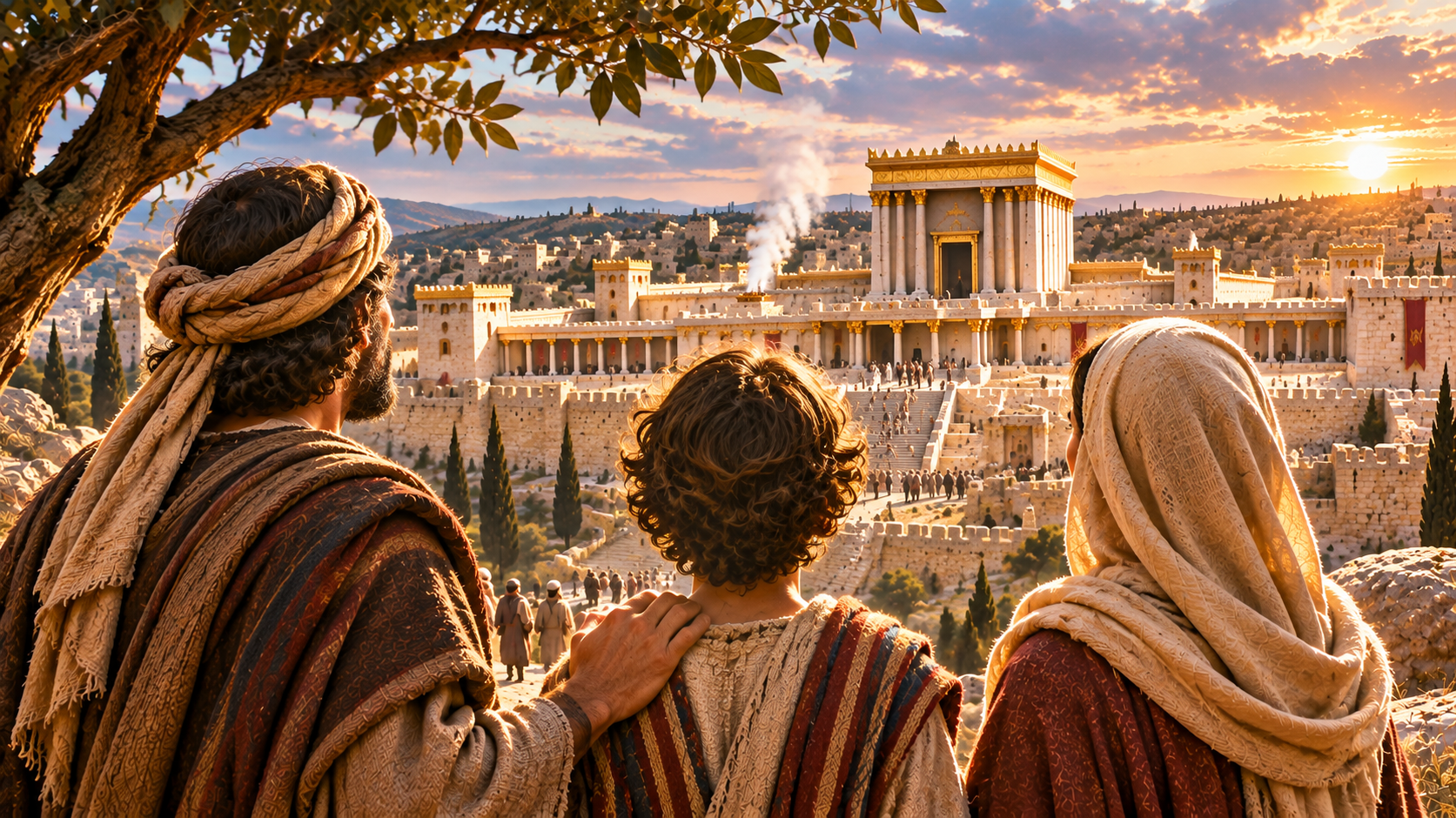
Jesus Goes to Jerusalem
The Jesus Story · Chapter 6 of 7. Return to the story introduction.
He had survived religious disagreements, a village meeting about a charcoal drawing, and an unsuccessful attempt to introduce Greek athletics to Nazareth. Now, at twelve years old, Jesus was about to visit Jerusalem.
His parents expected a memorable religious pilgrimage.
They were right.
Just not quite in the way they imagined.
The Boy Who Graduated With Questions
On March 20, A.D. 7, according to The Urantia Book, something rather important happened in Nazareth.
Jesus graduated from the school connected with the village synagogue.
His teachers were proud.
His parents were proud.
Even the elders who had occasionally found his questions rather troublesome were proud.
And somewhere in the village, one imagines, a few adults were quietly relieved.
The boy had completed his schooling.
At last.
He had studied the Hebrew scriptures, learned his father's trade, explored the countryside, helped raise his younger siblings, and developed the remarkable habit of asking questions that were considerably larger than the person asking them.
He was still twelve years old.
His voice was changing.
His responsibilities were growing.
And a new baby brother, Amos, had recently joined the family.
If the household had ever been quiet, the memory was becoming increasingly difficult to verify.
But Jesus was approaching another milestone.
He had been recognized as a son of the commandment, and he was now eligible to accompany his parents to Jerusalem for Passover.
Jerusalem!
The city he had heard about since childhood.
The home of the great temple.
The centre of so much of his people's religious history.
And the place where, according to his teachers, he might someday continue his education among renowned scholars.
For a young man who loved learning, this was an extraordinary opportunity.
His teachers hoped the journey would inspire him toward advanced religious studies.
Joseph hoped it would deepen his son's appreciation for Jewish worship and tradition.
Mary had expectations of her own.
Jesus?
He wanted to see everything.
Which, as his father had discovered on previous outings, could be a demanding arrangement.
One Hundred and Three Pilgrims
On the morning of April 4, the Nazareth pilgrims set out.
The Urantia Book gives their number as 103.
A sizeable travelling company.
Families, relatives, neighbours, friends, and fellow worshippers making their way south toward the Holy City.
Imagine the preparations.
Food and supplies.
Travelling arrangements.
Children who needed looking after.
Adults trying to remember whether everything had been packed.
And the inevitable questions from younger travellers concerning how much farther they had to go.
Some experiences transcend historical periods.
The journey would take four days.
Rather than travel directly through Samaria, the company followed a route through the Jordan valley.
The narrator describes fields of grain, flowering oleanders, the winding river, and mountains rising above the landscape.
For Jesus, the journey offered far more than transportation.
Every hill carried history.
Every village invited another question.
Joseph and Mary recounted stories of Israel's past as the company travelled.
These were not merely strange places on a map.
They were landscapes associated with prophets, kings, struggles, victories, failures, and the long history of a people seeking to understand their relationship with God.
Jesus listened.
And watched.
And learned.
Then the travellers approached a familiar sight.
Scythopolis.
The Greek city where, the previous year, Jesus had enthusiastically admired athletic competitions and suggested that Nazareth might benefit from an amphitheatre of its own.
Joseph had reacted with an enthusiasm best described as considerably less than overwhelming.
Now father and son could see the city from a distance.
Neither raised the subject.
Mary, who had never learned about the disagreement, noticed their silence without understanding its significance.
It was probably just as well.
The Nazareth Municipal Stadium Committee had suffered enough.
A Village Called Bethany
As the pilgrims approached Jerusalem, they climbed from the Jordan valley toward the hills.
The air and landscape changed.
The long-awaited destination was drawing closer.
Near the eastern slopes of the Mount of Olives, they stopped at Bethany.
And there, according to the narrative, something happened that would matter deeply in the years ahead.
The family met a man named Simon.
He had three children: Mary, Martha, and Lazarus.
The children were approximately Jesus' age.
The families shared refreshments, and a friendship began.
It would endure.
For anyone familiar with the later life of Jesus, these names possess extraordinary significance.
But not yet.
Not to the young people meeting one another that day.
To them, this was simply a pleasant encounter during a religious pilgrimage.
New acquaintances.
New conversations.
The beginning of friendship.
There is something beautiful about that.
We rarely know, when meeting someone for the first time, how important that person may become.
A chance encounter can grow into one of the defining relationships of a lifetime.
And some of life's greatest stories begin without anybody realizing that a story has begun.
The City Beyond the Hill
Then came the moment Jesus had been waiting for.
The travellers reached the crest of the Mount of Olives.
And Jerusalem appeared.
The temple.
The palaces.
The surrounding city.
The extraordinary sight of a place he had imagined throughout his childhood.
According to Paper 124, Jesus experienced one of the most intense moments of purely human wonder in his life.
Think about that.
This young person, whom the book identifies with Michael of Nebadon, stood on a hillside experiencing the excitement of seeing something magnificent for the first time.
He had heard about Jerusalem.
He had studied its history.
He had formed ideas about its significance.
Now it stood before him.
Real.
Immense.
Alive with people.
And more impressive than anything he had imagined.
For a moment, there were no difficult questions.
No disagreements.
No complicated explanations.
Only wonder.
That is a precious human experience.
The moment when imagination finally meets reality.
The moment when something long anticipated becomes something actually seen.
And perhaps most beautifully, the moment when a person discovers that the world is even larger than expected.
But this particular discovery would not remain entirely comfortable.
The Temple of His Dreams
Jerusalem was crowded with pilgrims.
People had travelled from distant communities to celebrate Passover, commemorating Israel's deliverance from slavery.
For Jewish families, the festival carried profound religious and historical meaning.
Jesus was entering the spiritual heart of a tradition that had shaped his entire childhood.
He was deeply impressed.
The temple's scale astonished him.
Its architecture moved him.
Its religious significance stirred his imagination.
But admiration did not prevent disappointment.
The first difficulty arose when Mary was directed away from Joseph and Jesus during the ceremonies associated with his new religious standing.
According to Paper 125, Jesus had expected his mother to accompany him.
Instead, she was separated from them.
He was indignant.
Why should the woman who had raised him, taught him, cared for him, and brought him on this pilgrimage be excluded from that part of his religious experience?
He protested briefly to Joseph.
But the arrangements remained unchanged.
His mother went elsewhere.
And Jesus continued with the ceremony.
Something important had happened.
The boy who had learned to respect authority was discovering that an established religious custom could still leave him profoundly uncomfortable.
He did not simply abandon his respect for the temple.
He did not reject his people.
He began asking whether every inherited arrangement truly reflected the highest ideals of the faith he loved.
That is a difficult question.
Especially when the arrangements have existed for generations.
When Worship Became Difficult
Another experience disturbed him even more.
Joseph took Jesus through the temple precincts.
There were crowds.
Merchants.
Money-changers.
Animals intended for sacrifice.
The activity associated with one of the most important pilgrimage festivals in Jewish religious life.
Much of what Jesus encountered belonged to the established worship practices of the period.
These ceremonies carried meanings deeply rooted in scripture, covenant, remembrance, and religious obligation.
But the narrator describes Jesus reacting intensely to particular aspects of what he witnessed.
The commercial activity seemed inconsistent with the sacred purpose of the temple.
And the slaughter of sacrificial animals affected him profoundly.
He saw blood.
He heard suffering animals.
He watched the priests carrying out their appointed duties.
And the experience overwhelmed him.
According to Paper 125, he grasped Joseph's arm and begged to leave.
Here we should resist the temptation to make the scene simplistic.
The priests were not cartoon villains.
The worshippers were not foolish people.
They were participating in a religious world that carried genuine meaning for them.
But Jesus, as portrayed by The Urantia Book, was struggling with something he could not reconcile.
He believed deeply in the goodness and mercy of the heavenly Father.
How, then, should he understand the suffering he saw associated with worship?
The question troubled him.
And it would not go away.
A Father's Love
There is a remarkable moment in Paper 125.
Joseph attempts to explain certain religious teachings and practices.
Jesus listens.
But he cannot accept an understanding of God that portrays the heavenly Father as less merciful than a loving human parent.
He appeals to Joseph's own kindness.
He knows that Joseph loves him.
He knows that his father can correct him without ceasing to care for him.
And he reasons that divine love should not be imagined as inferior to the love of a good human father.
It's a striking reversal.
Until now, Joseph has frequently helped Jesus understand the world.
Now Jesus is asking Joseph to reconsider something about God.
The religious disagreement matters.
But so does the tenderness underneath it.
A son appeals to the goodness he has personally experienced in his father's care.
And Joseph, for all his perplexity, does not argue further.
Sometimes the deepest religious questions begin with the simplest human experiences.
The love of a parent.
The suffering of a vulnerable creature.
The feeling that genuine goodness must be greater, not smaller, than our finest human understanding of it.
Jesus carried those questions with him throughout the Passover celebrations.
An Unexpected Message
According to Paper 124, another extraordinary event occurred during this Jerusalem visit.
On the night before the Passover Sabbath, the narrator reports that a celestial messenger commissioned by Immanuel communicated to Jesus.
The message concerned the beginning of his Father's work.
For readers of The Urantia Book, this represents a significant moment in the developing self-awareness of the young Jesus.
The cosmic dimension of his identity was beginning to emerge more explicitly within his human experience.
But we should not overlook the contrast.
He was not yet thirteen.
He had younger brothers and sisters at home.
He still lived under the guidance of Joseph and Mary.
He was a Jewish boy on his first remembered visit to Jerusalem.
And the narrator was now describing him as beginning to confront responsibilities associated with an entire universe.
That's quite a lot to contemplate between family obligations and religious ceremonies.
The theological claim is extraordinary.
The human situation is strangely familiar.
A young person begins sensing that life may be asking something important of him.
He cannot yet see the whole path.
He does not possess every answer.
He simply begins recognizing that his future may be larger and more demanding than he once imagined.
The People Behind the Questions
During Passover week, Jesus met young people who had travelled from many different places.
The narrator says he spoke with more than 150 of them.
He wanted to know how they lived.
What their families did.
What their communities were like.
How people earned their livelihoods.
He had already learned much from travellers passing through Nazareth.
Now he was meeting young people from the wider world.
And he was fascinated.
Not merely by the differences between them.
But by their lives.
Their work.
Their families.
Their experiences.
The young carpenter's son was beginning to discover humanity beyond his own village.
Meanwhile, his parents were making plans.
They hoped Jesus might return to Jerusalem at fifteen to pursue advanced study under respected religious teachers.
His Nazareth teacher enthusiastically supported the prospect.
Joseph recognized the opportunity.
Mary hoped for a future worthy of the remarkable destiny she believed awaited her son.
But Jesus appeared strangely uninterested in the proposed educational arrangements.
This puzzled them.
He admired learning.
He respected sincere teachers.
Yet the future others were planning for him did not seem to fit the path gradually taking shape within his own mind.
There were no easy explanations.
Not yet.
The Most Dangerous Thing About a Good Discussion
As the festival continued, Jesus discovered something that excited him enormously.
Within the temple precincts, religious teachers held discussions in which questions could be raised and examined.
Here was an environment that appealed directly to his inquisitive nature.
Scripture.
Theology.
Moral questions.
Religious interpretation.
Ideas debated by people who had devoted years to studying them.
For a boy who had spent much of his childhood trying to get satisfactory answers from adults, this must have seemed an extraordinary discovery.
An entire gathering of knowledgeable people.
And they were actually discussing questions.
Voluntarily.
Without requiring the intervention of the Nazareth village elders.
What could possibly go wrong?
During the festival, Jesus largely respected the restrictions associated with his age and newly acquired religious standing.
He listened.
He observed.
He thought.
But the questions were accumulating.
About God.
About mercy.
About worship.
About religious authority.
About the treatment of other people.
And about the difference between the meaning of a sacred tradition and the way people sometimes practiced it.
For Jesus, Jerusalem had become more than the city of his dreams.
It had become a place where profound questions could finally be explored.
And he was not quite ready to leave.
The Caravan That Went Home Without Him
Eventually, Passover week ended.
The Nazareth pilgrims prepared for their return journey.
Families gathered.
Travelling companions organized themselves.
The company began moving out of Jerusalem toward Bethany and the road home.
Joseph believed Jesus was travelling with the women.
Mary believed he was travelling with the men.
Both assumptions seemed reasonable within the arrangements described by the narrator.
After all, Jesus had recently received recognition as a young man.
And he had travelled to Jerusalem with Mary and the women's company.
Surely he was somewhere among the pilgrims.
There was just one small problem.
He wasn't.
Jesus was still in the temple.
Listening to a discussion about angels.
According to Paper 125, he became so absorbed in the conversation that he completely lost track of the departure arrangements.
He did not realize that the caravan had gone until the discussions paused around midday.
And by then, his parents were already on their way home.
No messenger had reached them.
No one had checked that Jesus was with the correct travelling group.
And nobody possessed the faintest idea that an event destined to become one of the most memorable episodes of his youth was already unfolding.
It is difficult not to appreciate the irony.
The young man who had been contemplating the responsibilities of a universe had overlooked a fairly basic responsibility of family travel.
Make sure your parents know where you are.
The Empty Place in the Caravan
By evening, the Nazareth travellers reached Jericho.
Joseph and Mary expected to find their son.
Perhaps with relatives.
Perhaps among friends.
Perhaps travelling with another part of the company.
But he wasn't there.
They began asking questions.
Had anyone seen Jesus?
When had they last seen him?
Was he with another family?
Had he fallen behind?
The answers were not reassuring.
Nobody knew where he was.
The boy who had caused more than a few anxious moments during his childhood had now disappeared in a city crowded with strangers.
And Jerusalem lay behind them.
Imagine what that discovery must have felt like.
The sudden fear.
The urgent conversations.
The dreadful possibility that something terrible had happened.
There was no reason to suppose that Mary and Joseph could simply brush this aside as another of their son's unusual adventures.
They loved him.
They had been responsible for him throughout his life.
And now they did not know where he was.
According to the narrator, they spent a sleepless night in Jericho.
Wondering.
Worrying.
Reconsidering every assumption that had led to this moment.
Back in Jerusalem, however, Jesus was safe.
He had found hospitality with Simon's family in Bethany.
And his thoughts remained occupied with the questions that had so deeply stirred him.
He did not yet appreciate the distress his absence was causing.
The difference between his understanding of events and his parents' experience could hardly have been greater.
For Jesus, Jerusalem had become a place of discovery.
For Joseph and Mary, it had suddenly become the place where their son was lost.
And neither side yet understood what the other was experiencing.
Somewhere in Jerusalem, a young man was preparing to ask questions that would astonish learned teachers.
Somewhere along the road home, two frightened parents were preparing to search for their missing son.
And neither the teachers nor the parents were quite prepared for what would happen next.
To be continued in Chapter 7 — our final chapter of the introductory Jesus Story.
🔎 Factoid — The original sources
Primary sources
Paper 124 — The Later Childhood of Jesus, especially 124:5.1–5.6 and 124:6.1–6.18, provides the graduation, journey to Jerusalem, meeting at Bethany, first sight of the city, and the claimed celestial message.
Paper 125 — Jesus at Jerusalem, especially 125:0.1–125:3.2, describes the temple experiences, Passover observances, young Jesus' questions, the pilgrimage company's departure, and his parents' discovery that he was missing.
An interesting biblical connection
The Gospel of Luke also recounts the twelve-year-old Jesus travelling to Jerusalem for Passover, remaining behind, and being found among religious teachers. See Luke 2:41–52. The Urantia Book supplies extensive additional biographical, psychological, chronological, and theological details not contained in Luke.
Historical and storytelling boundaries
The specific dates, number of pilgrims, meeting with Simon's family, and celestial messenger episode are claims from The Urantia Book, not independently verified historical facts. The account's portrayal of Jesus' response to temple practices should not be generalized into a claim that Jewish worship lacked genuine spiritual meaning. The humour, scene-setting, and emotional transitions are original literary narration rather than invented quotations from historical figures.