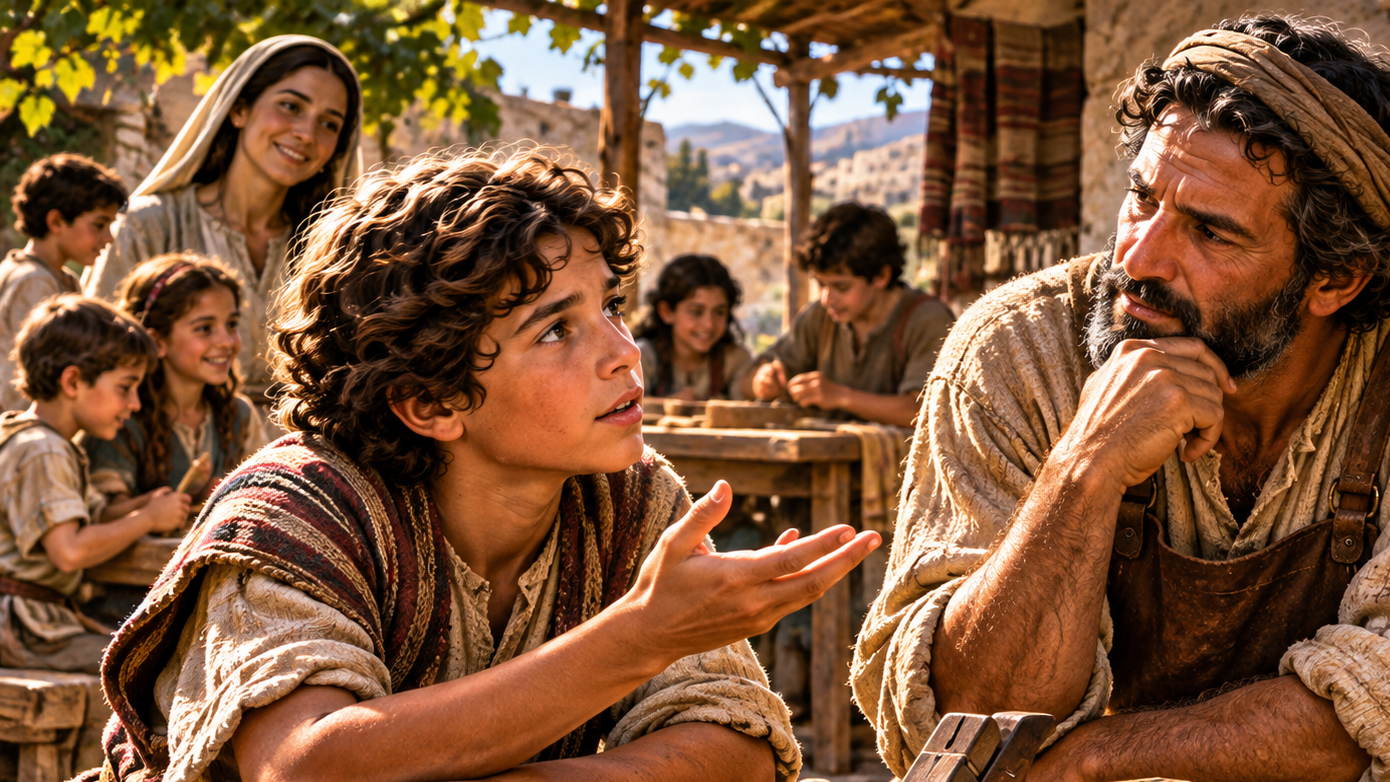
The Carpenter's Son and the Question at the Door
The Jesus Story · Chapter 5. Return to the story introduction.
He was learning to earn his own money, teach his younger siblings, and keep peace in a crowded household. Then he noticed something beside the front door. Naturally, there would be questions.
The Workshop Had a New Employee
Somewhere in Nazareth, during A.D. 6, Joseph's carpenter shop acquired a young worker with an unusually inquisitive mind.
This was not necessarily an advantage.
Carpentry requires patience, concentration, steady hands, and a willingness to follow instructions.
Jesus possessed all of these qualities.
He also possessed an extraordinary ability to notice things that other people had stopped noticing.
Which can complicate an otherwise peaceful afternoon.
According to The Urantia Book, Jesus had begun doing regular work in the family workshop. His father even allowed him to manage his own earnings.
For a boy of his age, the narrator describes this as an unusual privilege.
Imagine the satisfaction.
He was no longer merely learning how to work.
He was beginning to experience something of the responsibility and independence that came with earning money.
Of course, independent earnings in a household with six younger children probably did not mean unlimited opportunities for extravagant spending.
The Nazareth luxury-goods market would have to endure the disappointment.
But the arrangement mattered.
Joseph was trusting his son.
And Jesus was discovering that growing independence came with new obligations.
The previous summer had taught him that a family sometimes needed help urgently.
Now he was learning that helping could become part of the ordinary rhythm of life.
Work. Study. Family. Friends.
And questions.
Always questions.
A Young Man Learning When to Speak
Jesus had already developed something of a reputation in Nazareth.
He was bright, energetic, unusually thoughtful, and occasionally capable of producing religious questions that made experienced adults wish they had scheduled an appointment elsewhere.
His parents loved him.
His teachers admired him.
And some of the villagers undoubtedly preferred their philosophical discussions to remain safely theoretical.
But something was changing.
According to Paper 124, Jesus had begun recognizing how his questions and behaviour sometimes created difficulties for his family.
He became more discreet.
Not less curious.
Not less thoughtful.
Simply more aware of the effect his words could have on others.
That distinction is important.
There is a difference between abandoning an idea and learning when, where, and how to express it.
A person can possess a perfectly reasonable argument and still choose a spectacularly unfortunate moment to deliver it.
Anyone who has ever attempted to settle a family disagreement during supper knows this.
Jesus was learning that wisdom involves more than recognizing what might be true.
It also requires understanding the people who must hear it.
And within his own household, those people had rather different expectations.
Two Parents, Two Understandings
Joseph and Mary shared a deep concern for their eldest son.
But The Urantia Book portrays them as increasingly divided over the nature of his future.
Mary continued to cherish expectations about the extraordinary destiny she believed awaited him.
Joseph gradually favoured an understanding of his son's mission that emphasized its spiritual character.
The difference mattered.
Both parents wanted what they believed was best for Jesus.
Both loved him.
Both carried responsibilities and hopes shaped by their religious world.
Yet they did not always imagine the same future.
And Jesus was becoming aware of it.
The book describes him hearing his parents discussing these matters when they believed he was asleep.
Think about that for a moment.
A child lying quietly in bed, hearing the people he loves most discussing what he might become.
Perhaps he understands some of their hopes.
Perhaps he struggles with others.
He knows they care about him.
But he is beginning to realize that loving parents can misunderstand the person their child is becoming.
There's a sadness in that discovery.
Not because anyone has necessarily behaved badly.
But because growing up involves realizing that other people—even those closest to us—cannot always see the world through our eyes.
And Jesus had a rather large world beginning to unfold within his.
The narrator tells us that he himself experienced uncertainty about his mission.
He had not yet fully understood the extraordinary identity the book attributes to him.
He was still developing a human understanding of himself.
That detail deserves our attention.
In this account, Jesus was not pretending to grow up.
He was growing up.
And no amount of cosmic significance could eliminate the difficult human work of becoming a mature person.
The Little Classroom at Home
Meanwhile, life carried on.
There were younger children to look after, work to complete, lessons to learn, and household responsibilities that had no intention of disappearing merely because someone was contemplating the meaning of existence.
Jesus continued helping educate his brothers and sisters.
He also developed a growing interest in music.
The book gives us a delightful glimpse of a household in which learning did not stop at the synagogue door.
Imagine the family atmosphere.
One child trying to understand a lesson.
Another needing assistance.
Someone interrupting.
Someone else deciding that the most important question in the entire universe concerns when supper will be ready.
And Jesus, the eldest brother, trying to maintain an educational environment among people who have known him since they were born.
A difficult audience.
You can earn the admiration of respected teachers, but explaining something to a younger sibling who insists you are wrong carries its own special challenges.
The book tells us that Jesus became increasingly tactful in dealing with his family.
He learned to make adjustments.
He learned to consider their feelings.
He learned that being correct did not automatically make a disagreement worth pursuing.
And yet there remained certain questions he could not simply put aside.
One of them was waiting beside the doorway.
The Question at the Door
In the Jewish religious tradition, a mezuzah contains passages from the Torah associated with the commandment to remember God's teachings upon the doorposts of the home.
For generations, the practice has expressed religious identity, devotion, and remembrance.
It is not simply a decorative object.
It carries sacred meaning.
According to The Urantia Book, Joseph's household observed a custom involving a parchment fastened beside the door. Family members touched it when entering or leaving, then kissed the finger that had touched it.
To Joseph, such practices formed part of the religious life he was teaching his children.
But Jesus noticed a difficulty.
Remember the charcoal drawing?
Some years earlier, he had been told that making certain images was religiously unacceptable because they might encourage idolatry.
Joseph had upheld that interpretation.
Jesus had obeyed, despite disagreeing.
Now he was considering another question.
If making a likeness could be forbidden because people might treat it with excessive religious devotion, how should one understand the gestures of reverence directed toward an object beside the door?
The questions are not identical, of course.
A mezuzah contains sacred words rather than a likeness of a person or deity.
And within Jewish tradition, honouring the Torah's words does not mean worshipping the physical parchment.
But the narrator portrays Jesus as challenging what he considered an inconsistency in the family's reasoning.
And so, once again, Joseph found himself facing a question from his eldest son.
Fortunately, no village committee appears to have been summoned.
Nazareth had apparently survived enough administrative excitement involving this particular child.
This Time, Joseph Listened
Here is the remarkable part of the episode.
Joseph reconsidered.
According to Paper 124, after hearing Jesus' objection, he removed the parchment.
It is a small detail, easily overlooked.
But think about what it means within the story.
This is the same father who had previously forbidden his son to continue drawing likenesses.
The same father who had reacted angrily when Jesus proposed building a Greek-style amphitheatre in Nazareth.
Joseph was not a man without convictions.
His religious commitments mattered deeply to him.
And yet, on this occasion, he listened to his son and changed a household practice.
We should be careful not to turn this into a story about Judaism being defeated by superior reasoning.
The Jewish tradition of the mezuzah has a rich theological meaning, and the particular episode belongs to The Urantia Book's distinctive narrative, not to independently established history.
The more interesting human story concerns Joseph and Jesus themselves.
A father can possess authority without being incapable of reconsideration.
A son can ask a difficult question without seeking to humiliate his father.
A disagreement can produce understanding rather than resentment.
And a household can change without anyone needing to declare victory.
There is something profoundly encouraging about that possibility.
Joseph did not have to agree with every thought his son expressed.
Jesus did not have to abandon his conscience to demonstrate respect.
For one moment, the two found a way forward together.
Perhaps the finest expression of parental authority is not always having the final word, but being willing to recognize a good argument—even when it comes from your own child.
Especially when it comes from your own child.
That requires considerable courage.
And occasionally a rather substantial adjustment to one's parental ego.
The Two Loyalties
But the doorpost was only one episode in a much larger struggle.
The narrator tells us that Jesus experienced prolonged mental distress as he tried to reconcile two powerful obligations.
One involved fidelity to his deepest convictions about truth and righteousness.
The other involved honouring his father and mother.
Both mattered.
Neither could simply be dismissed.
And that made the problem difficult.
It would have been easy to rebel whenever he disagreed.
It would have been equally easy to surrender his private judgment and obey without reflection.
But Jesus was searching for something more demanding.
A way to remain sincere without becoming cruel.
A way to respect his parents without ceasing to think independently.
A way to belong to a family without losing his emerging sense of personal responsibility.
This may be one of the most recognizable struggles of adolescence.
The world begins to grow larger than the household in which we were raised.
We encounter new ideas.
We recognize differences between what we have been taught and what we are beginning to believe.
Sometimes our parents understand.
Sometimes they do not.
Sometimes we discover that we were mistaken.
And sometimes, to our astonishment, they discover that they were.
The difficult part is learning how to live together through all of it.
According to the book, Jesus increasingly found his way toward an understanding grounded in fairness, tolerance, loyalty, and love.
Not a formula that eliminated disagreements.
A way of living that made disagreements bearable.
And perhaps even fruitful.
A Different Kind of Carpenter
During this same period, Jesus continued learning his father's trade.
Wood had to be measured.
Tools had to be handled properly.
Useful objects had to be made.
A carpenter who ignored practical realities would not remain a carpenter for very long.
Wood does not become straighter merely because you possess excellent intentions.
And a poorly made joint will not hold together because its maker has developed an impressive philosophy of craftsmanship.
There is a lesson here.
In the workshop, Jesus encountered a world in which actions had consequences.
A mistake required correction.
A task required patience.
A finished object had to serve someone else's needs.
Outside the workshop, he was learning similar lessons about human relationships.
Words could wound.
Pride could interfere with understanding.
Good intentions did not guarantee good results.
And loving someone required attention to how one's actions affected that person.
We should not pretend that Joseph consciously taught all these philosophical lessons with every piece of timber.
The book doesn't say that.
But the parallels are difficult to miss.
A boy was learning to build useful things with his hands.
And, at the same time, learning to build something far more delicate.
Trust.
The Boy and the Future
By the end of this period, Jesus was approaching a new threshold.
His schooling was nearing completion.
His understanding of the world was growing.
His responsibilities were multiplying.
And the questions surrounding his future were becoming more urgent.
Would he pursue advanced religious education?
Would he remain involved in the family trade?
What did his parents expect?
What did he himself believe?
And what was this mysterious sense of mission that continued to trouble and inspire him?
The answers had not yet fully emerged.
But the boy was becoming someone capable of facing them.
He had learned that independence did not mean isolation.
That conviction did not require contempt.
That respect did not forbid disagreement.
And that the people closest to us sometimes have as much to learn from us as we have to learn from them.
There is something quietly beautiful about the image.
A young carpenter's apprentice in Nazareth.
A family trying to understand him.
A teacher who recognized his promise.
A mother and father whose hopes were not always the same.
And a growing boy discovering how to live honourably among people who did not always share his understanding.
No crowds.
No miracles.
No declarations from the heavens.
Just the difficult, wonderful business of becoming human.
Soon, however, the world beyond Nazareth would call to him again.
There would be a graduation.
An extraordinary journey.
A first encounter with Jerusalem that would leave a profound impression upon him.
And questions that even the most learned religious teachers would find difficult to answer.
But those adventures were still ahead.
For now, leave Jesus in Joseph's workshop.
Perhaps the day's work has ended.
Perhaps the tools have been put away.
Perhaps the family is gathering for the evening.
We do not know.
What we do know, according to this narrative, is that the boy was learning something much greater than how to work with wood.
He was learning that truth and love need not become enemies—and that wisdom sometimes begins when one person is willing to listen to another.
Even when the other person happens to be twelve years old.
And even when the question concerns the front door.
🔎 Factoid — The original source and historical boundaries
Primary source: Paper 124 — The Later Childhood of Jesus, particularly 124:4.1–4.9.
This section describes Jesus' work in the carpenter shop, his earnings, his growing discretion, his interest in music, his relationships with his siblings, his parents' differing expectations, the doorpost incident, and his attempts to reconcile personal convictions with family obligations.
Jewish religious context: The mezuzah represents a continuing and meaningful Jewish religious practice. Its Torah passages include Deuteronomy 6:4–9 and 11:13–21.
An important historical qualification: Archaeological and textual evidence supports the existence of mezuzah practices in the first century CE. However, the specific practice of kissing one's finger after touching the mezuzah lacks secure attestation from that period; historical discussions associate its later documentation with much later Jewish sources. Consequently, the exact gesture depicted in The Urantia Book should not be treated as historically verified.
Storytelling boundary: The workshop atmosphere, imagined domestic moments, humour, and emotional interpretations are original narrative commentary. No invented dialogue has been attributed to Jesus, Joseph, or Mary.