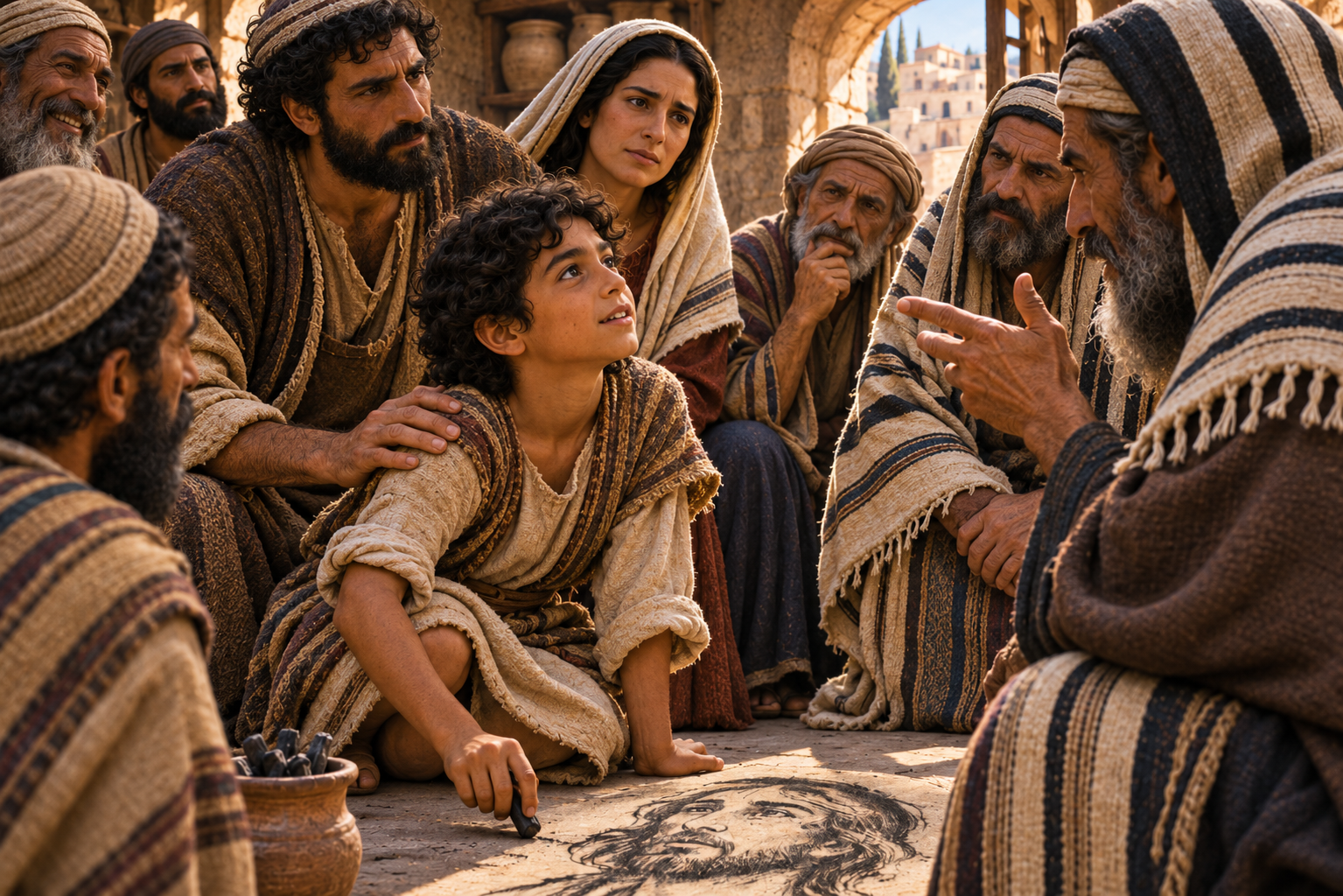
The Drawing That Started a Village Meeting
The Jesus Story · Chapter 2. Return to the story introduction.
One boy. One piece of charcoal. Several concerned adults. And an artistic controversy that Nazareth would not soon forget.
Imagine being summoned to a meeting because your child has done something so troubling that several respected members of the community have decided to intervene.
Was there a fight?
No.
Was something stolen?
No.
Had the boy threatened somebody?
Not at all.
He had drawn a picture.
Of his teacher.
On the classroom floor.
And apparently, this was serious enough to require adult supervision of the highest available order.
Welcome back to Nazareth.
A Boy With a Dangerous Piece of Charcoal
When we last visited Jesus, we met an inquisitive child who seemed determined to understand everything around him.
According to The Urantia Book, by his ninth year, his curiosity had developed another outlet: art.
He enjoyed drawing landscapes and shaping objects from clay.
Nothing particularly revolutionary about that, you might think.
But in the religious community in which he was growing up, the creation of images raised serious questions about obedience to God's commandments.
And Jesus, being Jesus, had questions of his own.
One day, he drew a likeness of his teacher on the schoolroom floor.
We aren't told whether the likeness was flattering.
We aren't told whether the teacher had an unusually prominent nose.
And we certainly aren't told whether the drawing deserved a place in the Nazareth Municipal Art Gallery.
What we do know is that somebody noticed.
And things escalated.
The Committee Arrives
In Paper 124, the narrator describes a delegation of elders approaching Joseph to complain about his son's behaviour.
Jesus initially listened from outside the house, sitting on a stone.
Some members of the delegation apparently found the episode amusing. Others regarded it as a serious religious offence.
It is a wonderfully human detail.
Even among people who shared religious traditions, reactions differed.
And then something happened.
The complaints began falling upon Joseph.
Jesus had been willing to listen while the adults discussed his drawing. But when his father became the target of their criticism, he entered the room.
He wanted to speak for himself.
Now imagine the situation.
A group of respected adults, already convinced that something improper has happened, suddenly finds itself confronted by the nine-year-old responsible.
And the boy intends to explain his position.
This must have been quite a meeting.
Unfortunately, the ancient world had not yet invented the administrative phrase "We'll take your concerns under advisement."
When Obedience and Understanding Disagree
Here's where the story becomes more interesting than a childhood anecdote.
Jesus did not simply rebel.
According to the account, he defended his position with composure, then accepted that Joseph would make the final decision.
Mary hoped for a compromise. Perhaps the boy could continue modelling clay at home, away from the school.
Joseph decided otherwise.
He upheld the restrictive interpretation of the commandment governing images.
And Jesus complied.
For the remainder of his life in his father's household, the book tells us, he abandoned drawing and modelling likenesses.
But it adds an important qualification.
He had not become convinced that his artistic activities were wrong.
Think about that distinction.
A person can respect an authority without surrendering every private judgment.
A child can obey a parent while continuing to think.
And a disagreement does not necessarily have to become a declaration of war.
That is a surprisingly mature lesson for a story involving charcoal and a classroom floor.
The Price of Growing Up
There is something rather touching about this episode.
The boy loses an activity he genuinely loves.
He accepts the family decision, but acceptance does not make the disappointment disappear.
And that matters.
Sometimes we picture spiritual greatness as a life untouched by ordinary frustrations.
Yet The Urantia Book repeatedly portrays Jesus experiencing the difficulties of growing up: misunderstandings, conflicting expectations, family obligations, and the discovery that other people do not always see the world as we do.
The narrator eventually identifies this young person with Michael of Nebadon, a Creator Son.
That remains the book's theological claim, not an independently established historical fact.
But within the story, consider the extraordinary contrast.
A being described as the creator of an entire local universe is learning what it means to be told by his earthly father that he may no longer draw pictures.
One can almost hear the celestial administration requesting clarification.
Surely this regulation does not apply to the Creator himself?
Apparently, in Joseph's household, it did.
And perhaps that is precisely what makes the story meaningful.
Not privilege.
Not special exemption.
But the willingness to experience ordinary human limitations.
The Courage to Think Kindly
There's another lesson worth considering.
The religious elders need not become villains in our retelling.
They were responding to a question they understood through the traditions and obligations of their community.
Joseph was navigating his responsibilities as a Jewish father.
Mary was trying to protect and guide her son.
And Jesus was discovering that sincerity and obedience sometimes pull in different directions.
Each person occupied a different position in the same difficult conversation.
Perhaps genuine understanding begins when we can recognize that possibility.
We can disagree with a person's interpretation without dismissing the person.
We can value traditions without treating every interpretation as beyond question.
And we can ask difficult questions without making humiliation our objective.
These aren't conclusions that require accepting the book's celestial cosmology.
They are practical questions about living together.
Beyond the Schoolroom
Of course, one lost artistic pastime was hardly going to extinguish this boy's curiosity.
The world was growing larger around him.
There were travellers, languages, workshops, farms, and cities beyond the familiar hills of Nazareth.
And there was Joseph, doing his best to educate a son who sometimes regarded an innocent family outing as an opportunity to reconsider the assumptions of an entire civilization.
Another adventure was approaching.
One involving a Greek city, athletic competitions, and an idea that would thoroughly alarm his father.
If a charcoal drawing could generate a village controversy, imagine what might happen when Jesus encountered an entire culture with different customs.
But that's our next story.
For now, leave the boy in Nazareth.
He has put away the charcoal.
He has not put away his curiosity.
🔎 Factoid — The original source and historical boundary
Primary text: Paper 124 — The Later Childhood of Jesus, Section 1, especially 124:1.3–1.5, recounts the picture, the elders' reaction, Joseph's ruling, and Jesus' disappointment.
Where the next story comes from: The account of the trip to Scythopolis and the Greek athletic games appears later, in Paper 124:3.6–3.9.
Context: Interpretations of the prohibition on images varied within Jewish history. This chapter describes the restrictions as The Urantia Book presents them in Jesus' family and school, not as a universal claim about every Jewish community.
Evidence boundary: The particular childhood confrontation is an assertion of The Urantia Book, not an independently documented episode in the historical life of Jesus. The narration, humorous asides, and imagined celestial reactions are original literary commentary, not quotations from the source.