The Summer Childhood Grew Up
The Jesus Story · Chapter 4. Return to the story introduction.
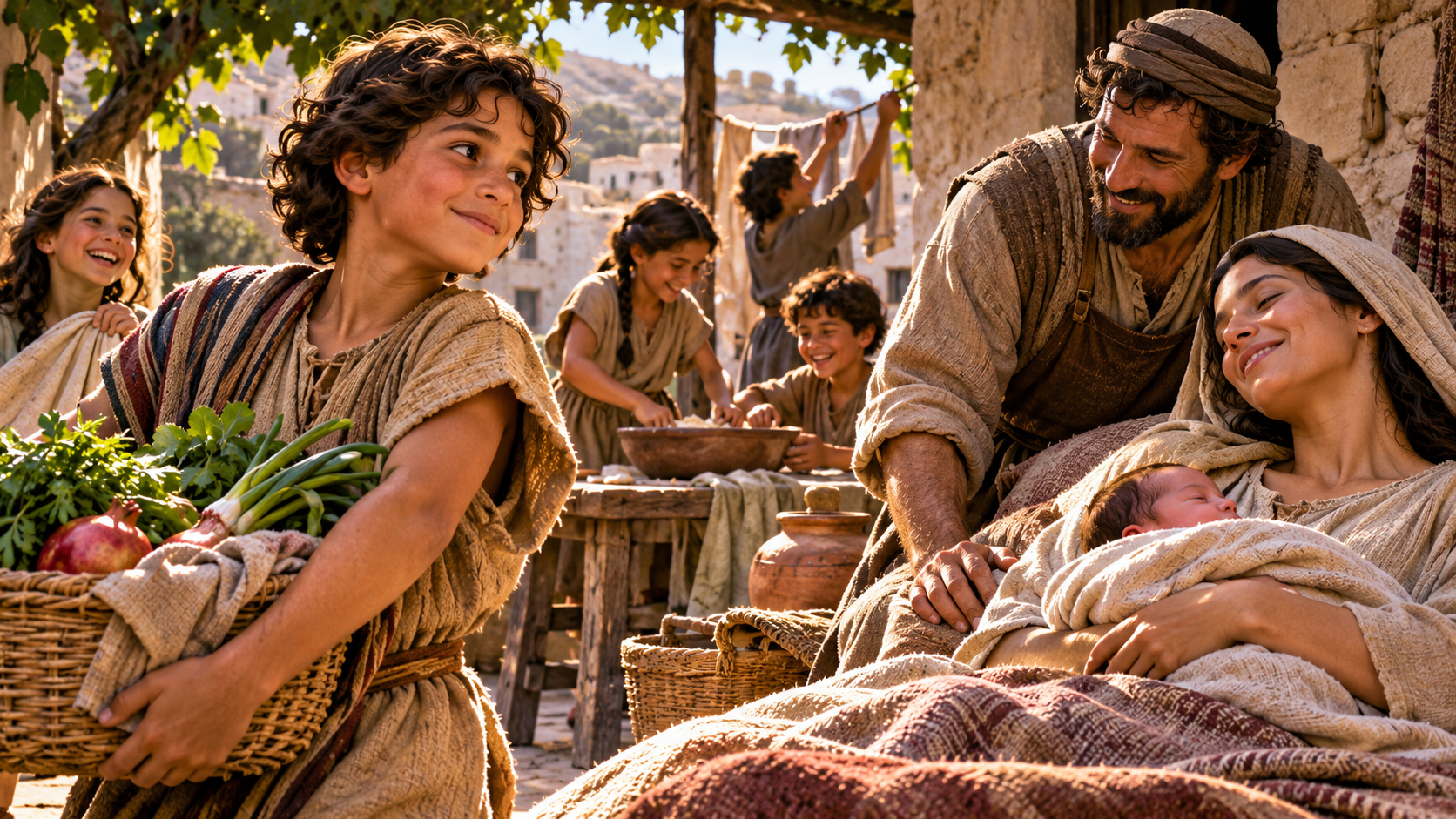
One baby. One seriously ill mother. One worried father. And a boy who was about to discover that growing up doesn't always wait for your permission.
The Household That Never Slept
There are few things more impressive than the arrival of a newborn baby.
A tiny human being enters the world, weighs considerably less than a sack of grain, possesses no useful employment skills, and immediately assumes control of an entire household.
Remarkable management potential.
In Nazareth, during the summer of A.D. 5, the family of Joseph and Mary was about to experience another expansion.
And Jesus, their eldest son, was about to learn that some of life's most important lessons happen nowhere near a classroom.
When we last met him, he had returned from Scythopolis with a head full of fascinating ideas about Greek athletic competitions.
His father had been less enthusiastic.
The proposed Nazareth stadium had been abandoned.
The boy's curiosity had survived.
And life, for the moment, had returned to normal.
But normal was about to become a rather distant memory.
June 24 — A New Brother Arrives
According to The Urantia Book, on the evening of June 24, A.D. 5, Mary gave birth to her seventh child.
His name was Jude.
Another son.
Another brother.
Another member of a household that already had considerably more children than available moments of peace and quiet.
Jesus had grown accustomed to the arrival of younger siblings. James, Miriam, Joseph, Simon, and Martha had already joined the family.
He understood something about babies.
They needed feeding.
They needed holding.
They needed attention.
And they possessed an extraordinary ability to announce their dissatisfaction with arrangements that everyone else had considered perfectly reasonable.
But Jude's arrival was different.
Something went wrong.
The birth was complicated, and Mary became seriously ill.
The book doesn't tell us precisely what medical difficulties she experienced.
It tells us that her illness lasted several weeks.
And that was serious enough to change the daily life of the entire family.
Joseph remained at home.
Jesus began undertaking additional errands and responsibilities.
Suddenly, the concerns of everyday childhood had to share space with something much more urgent.
His mother needed help.
His father needed help.
His brothers and sisters needed care.
And the family's eldest child was needed in ways he had never been needed before.
When the Strongest Person in the Room Needs Help
Imagine the change.
Not as a scene of magnificent celestial drama.
Not with trumpets announcing that the Creator of Nebadon had been assigned an important new mission.
Just a house in Nazareth.
A newborn baby.
A mother recovering from a dangerous childbirth.
A father trying to keep everything together.
And several young children who still needed meals, reassurance, attention, and all the ordinary things that make a family a family.
Somebody had to look after the everyday necessities.
Somebody had to help Joseph.
Somebody had to notice what needed doing.
The source doesn't provide a detailed inventory of Jesus' chores. We shouldn't pretend to know exactly which errands he performed.
But we can picture the ordinary possibilities: carrying a message, bringing something home, helping a younger sibling, or setting aside a personal pleasure because another person needed attention.
None of these activities would make an especially impressive entry in a biography of a universe creator.
Yet there is something extraordinary about them.
Because love, when you think about it, often looks suspiciously like work.
Not the glamorous kind.
Not the sort that earns applause.
The quiet kind.
The kind that continues when everyone is tired.
The kind that asks nothing more dramatic than:
What needs doing?
And then does it.
The Boy Who Had to Grow Up Early
Paper 124 describes this period as a decisive turning point.
Jesus had enjoyed a childhood filled with exploration, learning, physical activity, fishing excursions, conversations with travellers, and questions that occasionally made the adults of Nazareth reconsider their career choices.
He had friends.
He had interests.
He had ambitions.
He had recently discovered an entire Greek city and managed to alarm his father with a proposal for recreational infrastructure.
He had been, in many recognizable ways, a boy.
But now he faced responsibilities that the narrator says ordinarily would not have fallen upon him for another year or two.
He was not yet eleven.
And childhood had begun asking something different of him.
There is a temptation, when telling stories about remarkable individuals, to make every hardship appear effortless.
Of course Jesus helped.
Of course he understood.
Of course he behaved with perfect maturity.
But that interpretation risks missing something important about the portrait The Urantia Book offers.
The text presents a genuine human development, not a childhood in which every challenge came with a convenient supernatural exemption.
Jesus had to grow.
He had to learn.
He had to adjust to circumstances he had not chosen.
And the obligations of being the eldest child were no less real because the narrator also attributed an extraordinary cosmic identity to him.
Perhaps that is one of the most moving contrasts in the entire story.
A being whom the book describes as the creator of a universe was learning how to serve within a single human household.
No throne.
No celestial procession.
No special exemption from family obligations.
Just a boy who was needed.
Joseph's Quiet Burden
We should remember Joseph.
In the preceding chapter, we watched him struggle with his son's enthusiasm for Greek athletics.
Now that disagreement must have seemed rather small.
His wife was seriously ill.
There was a newborn child.
There were other children to care for.
And the ordinary demands of earning a living had not magically disappeared.
The book specifically tells us that Joseph remained at home during Mary's illness.
It doesn't reveal all his private concerns.
We needn't invent them to understand the weight of the situation.
Anyone who has watched someone they love become seriously ill knows how quickly the world can contract.
The questions that occupied your thoughts yesterday suddenly lose their importance.
Your plans change.
Your priorities change.
The future becomes less certain.
And sometimes the greatest achievement of the day is simply getting everyone safely through it.
Joseph had spent years teaching Jesus.
Now the two were navigating a new kind of responsibility together.
The relationship between father and son was changing.
Not because Joseph had ceased to be the father.
Not because Jesus had suddenly become an adult.
But because families sometimes discover that responsibility cannot remain neatly divided by age.
When difficulty arrives, everyone contributes what they can.
And sometimes a child contributes more than anyone expected.
Mary's Place in the Story
It would be easy to concentrate entirely on Jesus and overlook Mary.
That would be a mistake.
She had brought another child into the world and endured a serious illness in the process.
The book gives us no detailed account of her recovery.
But its description of those difficult weeks invites us to remember something fundamental.
Mary was not merely a supporting character in the story of a famous son.
She was a woman with a life, a family, responsibilities, hopes, and vulnerabilities of her own.
She was also a mother whose children depended upon her.
And during these weeks, she was the one who needed care.
There is something deeply human about that reversal.
The person who usually provides comfort becomes the person others must comfort.
The person who usually manages the household must allow others to help.
And those who receive love every day have an opportunity to discover what it means to give some of it back.
The book does not record a touching conversation between Mary and Jesus during this illness.
We won't manufacture one.
Sometimes the most respectful way to tell a story is to leave room for the reader's imagination.
Picture a mother recovering.
A family quietly adjusting around her.
And an eldest son beginning to understand that compassion is not simply something we feel.
It is something we practice.
What About His Own Dreams?
There is another detail worth remembering.
Jesus had not stopped being curious.
He was still learning from travellers who passed through Nazareth.
He was still interested in the wider world.
And, according to Paper 124, his teacher continued meeting with him weekly to help him study the Hebrew scriptures.
The chazan recognized the boy's intellectual promise and hoped he might eventually pursue advanced religious education in Jerusalem.
An ambitious future seemed possible.
Yet the realities of home life were beginning to place competing demands upon his attention.
The world was calling him outward.
His family needed him nearby.
Neither claim was meaningless.
And neither could simply be ignored.
The narrator tells us that Jesus increasingly contemplated the relationship between his obligations to his family and his larger mission.
For now, that mission remained mysterious.
No public ministry had begun.
No apostles had been gathered.
No crowds followed him through Galilee.
There was simply a growing young person trying to understand his place in the world.
And perhaps that is precisely where the great questions of human life begin.
Not with an announcement about one's destiny.
But with the discovery that other people matter.
That our decisions affect them.
That loving someone sometimes requires postponing something we desperately want.
And that freedom becomes more meaningful, not less, when it learns to make room for responsibility.
The Courage Nobody Applauds
We often admire courage when it looks dramatic.
A soldier standing against an army.
A traveller crossing a dangerous sea.
A reformer confronting powerful institutions.
These are stories people remember.
But there is another kind of courage.
It rarely attracts an audience.
It doesn't usually inspire monuments.
And it almost never receives a commemorative plaque.
The courage to get up and help when you're tired.
The courage to be patient with someone who needs more of you than you expected.
The courage to accept that life has changed—and to keep loving the people whose needs have changed it.
In this account, Jesus' growing maturity did not begin with a grand declaration.
It emerged through ordinary family duties.
The boy who had wanted to build a stadium was learning how to help sustain a household.
One ambition would have impressed an entire village.
The other mattered profoundly to the people who lived under his roof.
And perhaps the second achievement was greater.
A Different Kind of Greatness
There's a curious irony here.
According to The Urantia Book, this young person possessed an identity far beyond what his neighbours could have imagined.
But nobody in Nazareth needed a cosmic explanation of his existence to benefit from his kindness.
His younger siblings needed a dependable brother.
Joseph needed a helpful son.
Mary needed care and recovery.
And Jesus needed the ordinary human experiences through which character develops.
Whether a reader accepts the book's extraordinary theological claims or approaches them as spiritual literature, the human insight remains compelling.
Greatness does not always announce itself by rising above ordinary responsibilities. Sometimes it reveals itself by accepting them.
That is a lesson available to all of us.
Not just religious teachers.
Not just future leaders.
Not just people who believe they have a special calling.
Anyone who has ever rearranged a day to help someone else has encountered a little of this truth.
Anyone who has cared for an ill family member knows that love can require more endurance than enthusiasm.
And anyone who has grown up faster than expected understands that maturity sometimes arrives without asking whether we feel ready.
The Summer That Changed Everything
We do not know the exact day when Mary's health improved.
We do not know when Joseph resumed his normal routines.
We do not know which particular task made Jesus first realize that something about his childhood had changed.
But the narrator makes the larger significance unmistakable.
He had entered a new stage of life.
There would still be laughter.
There would still be discoveries.
There would still be friendship, learning, and occasions for youthful delight.
Jesus had not suddenly become a solemn little adult incapable of enjoying anything.
Thank goodness.
The world has quite enough unnecessarily solemn adults already.
But something within his daily experience had changed.
His family was no longer merely the place where he was cared for.
It was increasingly a community in which he was expected to help care for others.
And that distinction matters.
Because growing up is not simply becoming stronger, taller, or more knowledgeable.
Sometimes it means realizing that your strength, your knowledge, and your time can make life better for somebody else.
The summer would pass.
Mary would recover.
Jude would grow.
The familiar rhythms of Nazareth would continue.
But Jesus would not return entirely to the childhood he had known before.
A new kind of life was beginning.
And while the demands of that life would grow more complicated, so would the remarkable young person learning to meet them.
For now, leave him at home.
Not standing before a crowd.
Not delivering a sermon.
Not demonstrating supernatural power.
Just helping his family.
Sometimes the first great work of a remarkable life is simply being there for the people who need you.
And that may be a far greater accomplishment than building a stadium.
🔎 Factoid — What The Urantia Book Actually Says
Primary source: Paper 124 — The Later Childhood of Jesus, particularly 124:3.3–3.5 and 124:3.10.
The book dates Jude's birth to June 24, A.D. 5, describes Mary's serious illness and Joseph's remaining at home, and states that Jesus assumed unusually early firstborn responsibilities. It also describes his weekly scriptural instruction and his increasingly serious thoughts about family obligations.
Historical distinction: These details form part of The Urantia Book's account. The specific illness, dates, and childhood experiences are not independently verified historical events.
Literary distinction: The imagined household atmosphere, descriptions of emotional experiences, and humorous observations belong to our storytelling, not to quotations from the original source.