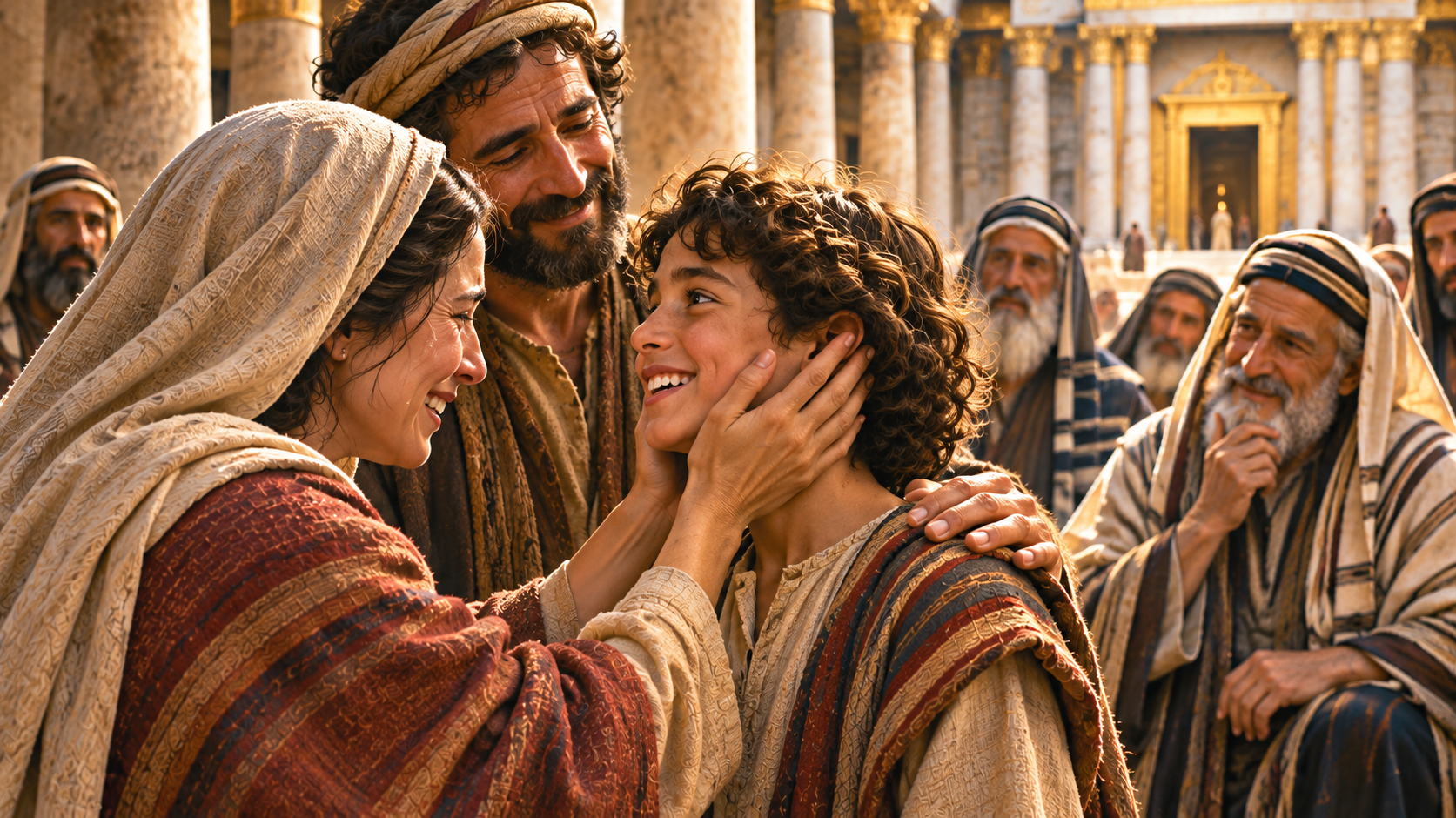
The Boy Who Stayed Behind
The Jesus Story · Chapter 7 of 7. Return to the story introduction.
One missing son. Two terrified parents. An entire temple full of religious scholars. And a twelve-year-old who had finally found people willing to discuss his questions.
The Longest Night in Jericho
Somewhere in Jericho, Mary was experiencing the kind of fear that makes sleep impossible.
Her son was missing.
Not a misplaced sandal.
Not a forgotten parcel.
Her son.
Twelve-year-old Jesus had disappeared somewhere between Jerusalem and the returning Nazareth caravan.
Mary had assumed he was travelling with Joseph.
Joseph had assumed he was travelling with Mary.
Both assumptions had seemed perfectly reasonable.
Until neither could find him.
There is a lesson here for parents travelling with exceptionally intelligent children.
Never assume the other parent has checked the passenger manifest.
Especially when the passenger in question has a documented history of becoming intensely interested in religious discussions.
But there was nothing amusing about the situation now.
According to The Urantia Book, Joseph and Mary spent that night anxiously discussing what might have happened.
They recalled the unusual behaviour Jesus had displayed during Passover.
His troubled thoughts.
His unexpected questions.
His increasing independence.
And they gently reproached one another for failing to make certain he was with the caravan.
Neither knew where he was.
Neither knew whether he was safe.
And neither could do anything useful until morning.
Imagine that.
Two parents who had devoted their lives to raising their eldest son, lying awake in a strange town, wondering whether they would ever see him again.
The hours must have felt unbearable.
And all the while, their missing son was experiencing something entirely different.
Meanwhile, Back in Jerusalem...
Jesus had spent the afternoon listening to religious discussions in the temple.
He had become so absorbed in the exchange of ideas that he hadn't noticed the caravan leaving.
By the time he realized what had happened, his parents were long gone.
Now, in a situation that might have caused another twelve-year-old to panic, the narrator describes Jesus calmly continuing his activities.
When the discussions ended, he went to Bethany.
Simon and his family welcomed him.
Lazarus, Martha, and Mary were delighted to see their young friend again.
Jesus stayed for supper and spent much of the evening alone in the garden, thinking.
Here is one of the most remarkable contrasts in this entire episode.
His parents were frightened.
Jesus was safe.
His parents were searching their memories for clues.
Jesus was considering theological questions.
They were beginning to imagine the worst.
He was enjoying an unprecedented opportunity for independent thought.
Nobody had explained the situation to all three of them.
And until somebody did, the emotional distance between parent and child was considerably greater than the physical distance between Jericho and Jerusalem.
The boy was discovering freedom.
His parents were discovering what freedom can feel like from the other side.
A Young Man With Something to Say
The next morning, Jesus returned to the temple.
On his way, he paused on the Mount of Olives.
Below him lay Jerusalem.
The magnificent city that had filled him with wonder only days earlier.
But his feelings had changed.
The narrator describes him weeping as he contemplated the spiritual condition of his people and their subjection to Roman political power.
He had admired the temple.
He had been deeply moved by aspects of its worship.
He had also encountered practices that disturbed him.
These experiences were difficult to reconcile.
But he had discovered something else.
The temple was a place where people could discuss serious religious questions.
And now he intended to participate.
Not merely listen.
Not simply observe.
He wanted answers.
The discussions were conducted by learned Jewish teachers, men accustomed to examining scripture, religious law, and the great questions of their tradition.
Jesus was young.
Very young.
But he had studied the scriptures.
He knew how to frame a question.
And, perhaps most importantly, he was genuinely interested in the answers.
According to Paper 125, he began participating during the day's second discussion session.
His questions impressed many of the teachers.
Not everyone, naturally.
One particularly impatient scholar challenged his right to participate because of his age.
Jesus explained that he had completed his education and undergone the religious consecration associated with his new standing.
Some of the teachers reacted dismissively when they learned he came from Nazareth.
Apparently, a young person from an obscure Galilean village was not everyone's preferred source of religious inquiry.
But the discussion leader allowed him to remain.
And the boy continued asking questions.
This is important.
The book does not portray all the Jewish teachers as hostile or foolish.
Most treated Jesus with consideration.
They recognized his sincerity.
They were willing to engage with him.
And some were beginning to realize that this particular pupil possessed an extraordinary mind.
They had no reason to know what the book would later claim about his identity.
To them, he was an unusually thoughtful Jewish boy from Galilee.
And that was already interesting enough.
The Search Nobody Wanted to Make
While Jesus was exploring theological questions, Joseph and Mary were retracing their steps.
They returned from Jericho to Jerusalem.
They visited the place where they had stayed during Passover.
Nobody had seen him.
They searched through the city.
They asked questions.
They checked places where he might reasonably have gone.
But the day ended without success.
Their son remained missing.
Think about the difference between a city seen through the eyes of an excited traveller and the same city seen through the eyes of a frightened parent.
The grand buildings no longer matter.
The crowded streets become obstacles.
Every unfamiliar face offers a momentary possibility.
Every unanswered question deepens the fear.
Jerusalem had been the destination of a memorable family pilgrimage.
Now it was a maze.
And somewhere inside it was their child.
The book tells us that Joseph and Mary returned to their relatives for the night.
Still without him.
Their search would continue.
The Questions That Changed the Room
By Jesus' third day of temple discussions after the caravan departed, something extraordinary had happened.
People were coming specifically to hear him.
The narrator reports that spectators gathered to watch this young Galilean engage the learned teachers.
Simon travelled from Bethany to see what was happening.
And the discussions increasingly centred on the boy's questions.
These were not ordinary questions about dates, names, and religious vocabulary.
Jesus was probing the meaning behind established practices.
He wanted to understand what lay behind the veil of the temple's most sacred sanctuary.
He questioned why mothers were separated from male worshippers.
He wondered how animal sacrifice could be reconciled with the love of a heavenly Father.
He challenged the presence of commercial activity in a place devoted to worship.
And he raised a particularly consequential question:
Was the expected Messiah destined to become a political ruler, or might his mission concern an entirely different kind of kingdom?
Consider the implications.
Here was a boy who had spent years listening to adults explain the world.
Now he was asking them to reconsider some of their own explanations.
But there was something unusual about his manner.
He did not simply announce that everyone else was wrong.
He asked questions that invited examination.
He could challenge an argument without deliberately humiliating the person making it.
He could disagree while remaining respectful.
And, according to the narrator, he possessed a sense of humour that made his questions more engaging even to people who did not appreciate being challenged.
Now that sounds familiar.
Truth. Beauty. Goodness. HUMOUR.
Apparently, the combination has an impressive pedigree within The Urantia Book's narrative.
The discussions continued for more than four hours.
And the most remarkable thing was not that Jesus had defeated anyone.
It was that he had inspired people to think.
He was not collecting victories.
He was pursuing understanding.
There is a difference.
A debate can produce a winner.
A good question can change the thinking of everyone in the room.
And sometimes the most important person in a discussion is not the one who knows the most.
It's the one who asks what nobody else has thought to ask.
So Close, and Yet...
Meanwhile, Joseph and Mary continued searching.
The narrator describes them entering the temple precincts several times.
On one occasion, they came remarkably close to hearing Jesus' voice.
But they did not recognize that the young man attracting so much attention was their missing son.
Imagine the irony.
A boy had become the subject of growing interest among the temple teachers.
People were gathering to hear his questions.
His reputation was spreading.
And his parents were wandering through Jerusalem wondering where on Earth he had gone.
It sounds almost like a comedy.
Until we remember what the experience must have felt like to Mary and Joseph.
They were exhausted.
Frightened.
And increasingly desperate.
They did not need news of a remarkable young scholar.
They needed their son.
The storyteller's temptation is to make this a tale of a child triumphing over adults.
But that would miss its most important human truth.
Three people loved one another.
All three believed they were acting reasonably.
And all three were about to discover that their understanding of the situation differed dramatically.
The Fourth Day
The next day, Jesus returned to the temple again.
His knowledge of the Hebrew scriptures impressed the scholars.
So did his familiarity with Greek-language scripture.
But it was not simply his learning that interested them.
His questions seemed unusually mature.
His reasoning was thoughtful.
His confidence did not depend upon arrogance.
During an afternoon discussion, the subject turned toward prayer.
The leading teacher invited Jesus to come forward and sit beside him.
He wanted to hear the young man's own understanding of prayer and worship.
Think about that moment.
A twelve-year-old carpenter's son from Nazareth was being invited to explain his religious understanding before experienced scholars.
Not because he possessed official authority.
Not because he had demanded special recognition.
But because his questions and reasoning had earned their attention.
Here was an opportunity that might have shaped his future.
Perhaps it would confirm his teachers' hopes that he should pursue advanced religious education in Jerusalem.
Perhaps it would open doors nobody in Nazareth had imagined.
Or perhaps something even more significant was unfolding within him.
But just as the discussion approached another important moment—
His parents arrived.
The Voice They Had Been Searching For
According to Paper 125, Joseph and Mary had heard reports of an unusual young scholar who had been astonishing the temple teachers.
They had not imagined the scholar was Jesus.
They were considering a journey to visit Zacharias and his family, wondering whether their son might have gone there.
On their way, they stopped at the temple.
And then they heard him.
A familiar voice.
A voice Mary had known since infancy.
The voice that had asked countless questions in Nazareth.
The voice she had feared she might never hear again.
There he was.
Alive.
Safe.
Sitting among the teachers.
For one astonishing moment, the search was over.
And then came the emotional consequences.
Mary rushed toward him.
Her relief was mixed with the fear and exhaustion of the preceding days.
She demanded to know why he had put them through such suffering.
Joseph stood silent, visibly reproving.
The scholars watched.
Jesus stood to greet his parents.
And suddenly, the entire situation was no longer about theology.
It was about a mother and father who had been terrified.
And a son who had not understood the distress his absence would cause.
There is a powerful human lesson here.
Being intellectually right about something does not mean you have fully understood how your behaviour affects the people who love you.
Jesus had been absorbed in what he considered his Father's work.
Mary and Joseph had been absorbed in finding their child.
Neither experience cancelled the other.
Both mattered.
Two Fathers, One Difficult Question
Jesus' reply puzzled his parents.
He wondered why they had searched so long when they might have expected to find him in his heavenly Father's house, occupied with his Father's work.
To the teachers, the response must have seemed extraordinary.
To Mary and Joseph, it was profoundly difficult to understand.
Their eldest son was speaking about a responsibility that seemed to reach beyond the ordinary expectations of family life.
But he was still their son.
He still belonged to the household in Nazareth.
And they had just spent days wondering whether he was dead or alive.
The narrator does not portray Jesus as delivering a triumphant speech and walking away.
Instead, he recognizes the tension.
After a moment, he reassures his parents.
Each had acted according to what seemed right.
Now it was time to go home.
It is a beautifully understated resolution.
No dramatic argument.
No public declaration of victory.
No need for the temple teachers to select a winner.
A family had been reunited.
And the next responsibility was simple.
Leave together.
This time, preferably with everyone accounted for.
One Last Look at Jerusalem
As the three began their journey home, they crossed the Mount of Olives.
They stopped.
Behind them lay Jerusalem.
The temple.
The streets.
The religious discussions.
The extraordinary experience that had changed something within Jesus.
According to Paper 125, the young man raised his staff and spoke with intense emotion about the suffering and bondage of his people.
He was troubled by Roman domination.
He was troubled by religious traditions that, in his understanding, obscured the loving character of God.
And he declared his intention to return.
Here was a hint of the remarkable future the book attributes to him.
Yet nothing had suddenly become simple.
His parents did not fully understand him.
He did not possess a complete plan for his life's mission.
The road ahead remained uncertain.
And the caravan journey back to Nazareth was considerably quieter than the journey to Jerusalem had been.
The narrator tells us that Jesus spoke little during the three-day return.
His parents also remained unusually silent.
Perhaps each was considering what had happened.
Perhaps each was trying to understand the others.
The source does not tell us their private thoughts in detail.
But we know that something significant had occurred.
The boy who left Nazareth was not entirely the same young man who returned.
Neither were his parents.
The Promise
When they finally reached home, Jesus spoke with Joseph and Mary.
He reassured them of his affection.
He indicated that they need not fear another experience like the one they had just endured.
And he affirmed something deeply important.
His developing sense of responsibility to the heavenly Father would not cause him to abandon the obligations of his earthly family.
He would continue to respect his father.
He would continue serving those who depended upon him.
He would not demand that his future begin immediately simply because he had glimpsed something of its significance.
The narrator records his concluding declaration:
“I will await my hour.”
Six words.
But consider their meaning.
There are moments when a person feels ready to change the world.
To begin something extraordinary.
To leave familiar obligations behind and follow an exciting possibility.
Yet life sometimes asks something harder.
Wait.
Learn.
Grow.
Serve.
Become ready.
Jesus had experienced an extraordinary week in Jerusalem.
He had glimpsed a larger purpose.
He had asked questions that surprised learned teachers.
He had felt the exhilaration of independence.
But he had also encountered the fear his unexpected absence caused his parents.
And now he was choosing to return to ordinary life.
Not because his larger aspirations had disappeared.
Because they would have to coexist with love, patience, and responsibility.
Perhaps that is a more difficult form of greatness than making a spectacular announcement.
Knowing when to act matters. Knowing when to wait matters too.
The Boy Who Came Home
And so our first journey through the human childhood of Jesus comes to an end.
Not in the temple.
Not before a gathering of religious scholars.
Not with a miraculous display.
But at home.
In Nazareth.
With Joseph and Mary.
With younger brothers and sisters.
With work to do.
With people to love.
And with a future that remained largely unwritten from the perspective of his developing human experience.
Think of the young person we have followed through these seven chapters.
The boy who asked questions.
The child whose charcoal drawing caused a religious controversy.
The enthusiastic visitor who wanted to introduce Greek athletic competitions to Nazareth.
The eldest son who began carrying greater responsibilities during his mother's illness.
The young carpenter who learned that conscience and family loyalty need not become enemies.
The astonished pilgrim who first saw Jerusalem from the Mount of Olives.
And finally, the twelve-year-old who stayed behind in the temple, discovered the power of a thoughtful question, and learned that even an extraordinary calling did not erase ordinary human obligations.
These are not the stories of a child pretending to be human.
Within The Urantia Book's theological account, they are the experiences of a genuinely developing human life.
And that may be one of the most beautiful ideas in the entire narrative.
The extraordinary does not always stand apart from the ordinary.
Sometimes it grows within it.
Through relationships.
Through disappointments.
Through patience.
Through laughter.
Through mistakes.
Through compassion.
And through the quiet courage of accepting responsibility for the people who need us.
The great adventures of Jesus' adult life still lay ahead.
There would be further loss.
Further growth.
Years of work.
Difficult choices.
Friendships.
Teaching.
And eventually, a public ministry that would change the lives of countless people.
But those stories belong to another part of the journey.
For now, our young traveller has returned safely to Nazareth.
The tools in Joseph's workshop await him.
His brothers and sisters still need their eldest sibling.
Mary still has hopes for his future.
Joseph still has much to teach him.
And the boy?
He still has questions.
Of course he does.
Some things never change.
Seven Chapters. One Extraordinary Beginning.
If you've travelled with us from Chapter 1 to Chapter 7, you've encountered only a small portion of the remarkable portrait of Jesus presented in The Urantia Book.
But perhaps you've discovered something worth carrying with you.
A meaningful life doesn't begin when the world finally notices you. It begins in the ordinary choices you make while nobody is watching.
And maybe, just maybe, the universe becomes a little more understandable when we remember the value of a good question, a compassionate response, and the willingness to keep learning.
Our introductory Jesus Story ends here.
The adventure does not.
Because there is still a universe waiting beyond Nazareth.
And another door in the Atlas remains open.
Explore the Universe. Ask the Questions. Experience and KEEP the Wonder.
Truth. Beauty. Goodness. HUMOUR.
🔎 Factoid — What The Urantia Book Actually Says
Primary source: Paper 125 — Jesus at Jerusalem, especially Sections 3–6 (125:3.1–125:6.13).
The original narrative describes Jesus remaining at the temple after the Nazareth caravan departed, his discussions with Jewish religious teachers, the search undertaken by Joseph and Mary, their discovery of him during the fourth day's proceedings, and the journey home. The episode emphasizes his questions, growing spiritual self-understanding, and ability to balance personal convictions with family responsibilities.
What happened afterward? Paper 126 — The Two Crucial Years continues Jesus' adolescence, including his increasing responsibilities and the death of Joseph in A.D. 8, as reported by the book. We have intentionally left these events for a future instalment rather than rushing through them in our introductory edition.
Biblical connection: Luke 2:41–52 records the story of the young Jesus remaining in Jerusalem, being found among religious teachers, and returning to Nazareth. The additional dates, discussions, named participants, and psychological details in our chapter come from The Urantia Book, not independently verified historical accounts.
Storytelling distinction: The imagined emotional atmosphere, modern humour, and reflective interpretations are original literary commentary. The short closing quotation about awaiting his hour comes from Paper 125:6.11.