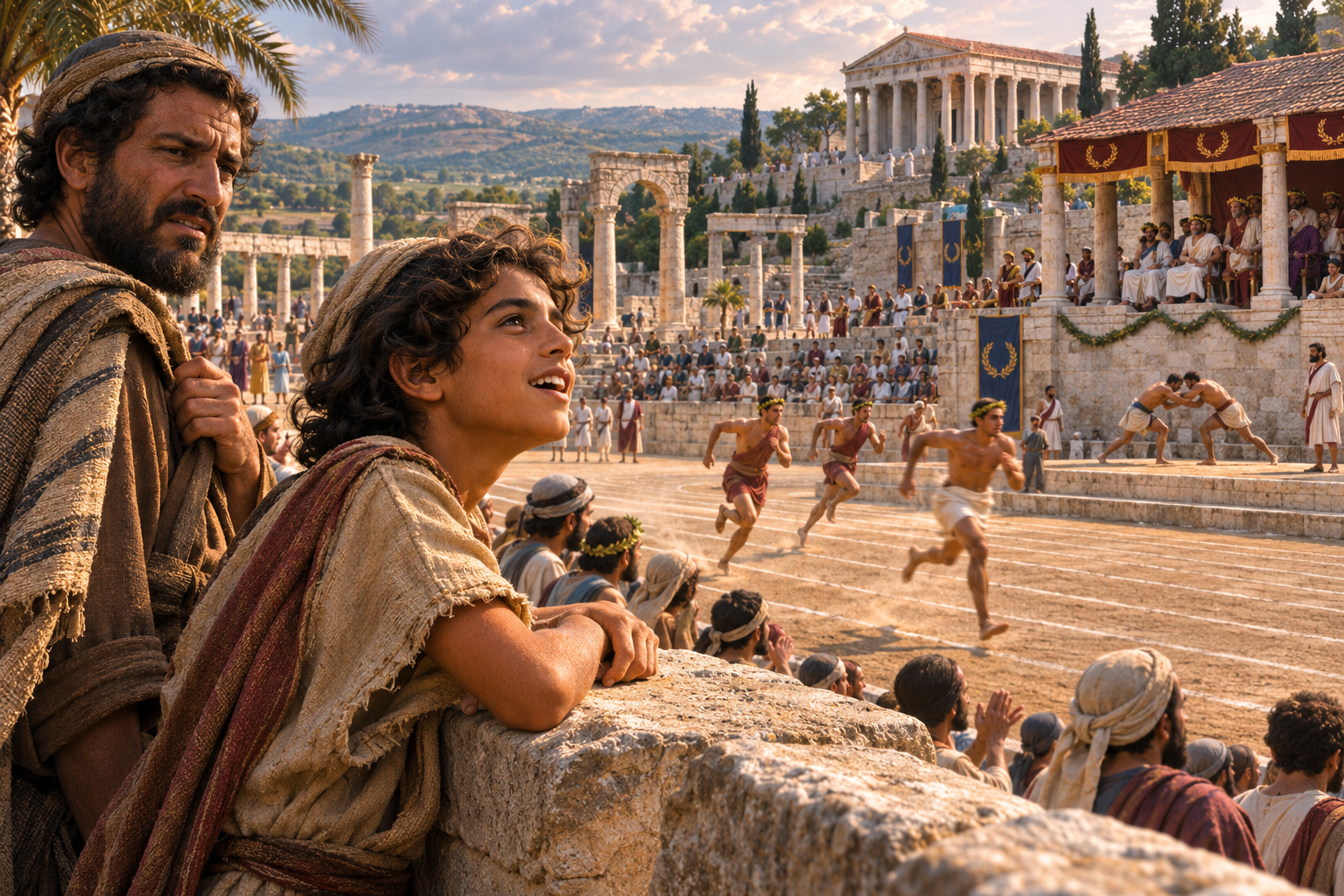
The Day Jesus Wanted to Build a Stadium
The Jesus Story · Chapter 3. Return to the story introduction.
An eleven-year-old boy discovers Greek athletics. His father discovers a headache. And Nazareth narrowly avoids acquiring its first municipal recreation department.
The trouble began with a business trip.
Joseph had business to conduct.
Jesus had questions to ask.
And neither of them had the slightest intention of returning home with a proposal for a major public construction project.
At least, Joseph didn't.
But we've met this boy before.
This was the child who had already managed to turn a charcoal drawing into a village controversy.
Now, two years later, he was about to discover something considerably more exciting than a classroom floor.
And Joseph was about to discover that parenthood occasionally requires the patience of Job, the diplomacy of Solomon, and a particularly comfortable place to sit down.
The City Beyond the Hills
According to The Urantia Book, during his eleventh year, Jesus accompanied Joseph on a business trip to Scythopolis, a predominantly Greek city in the region known as the Decapolis.
It was also the ancient city of Beth-shean, a place with deep connections to Israel's history.
On the journey, Joseph told his son stories about King Saul, the Philistines, and the turbulent history of their people.
It was an opportunity to pass along the traditions that helped define their identity.
And Jesus listened.
But something else was waiting beyond the hills.
Scythopolis.
A city whose buildings Jesus had admired from a distance and whose unusual features had long aroused his curiosity.
Now he could finally see it for himself.
The streets were orderly. Public buildings impressed him. An open-air theatre caught his attention.
And there was a beautiful marble temple dedicated to Greek gods.
Joseph was less enthusiastic.
You can almost imagine the father's thoughts:
We have a perfectly magnificent temple in Jerusalem, and my son has apparently decided to become the official architectural critic of Greek civilization.
Joseph tried to redirect his attention toward the grandeur of Jerusalem.
But Jesus continued asking questions.
That was becoming something of a family tradition.
And Then Came the Games
As fate—or, more precisely, the narrator of Paper 124—would have it, Scythopolis was hosting athletic competitions.
Young men from Greek cities were demonstrating their physical abilities.
Strength.
Skill.
Endurance.
Competition.
And the sort of organized outdoor recreation that tends to attract an enthusiastic audience.
Jesus wanted to watch.
Very much.
Joseph hesitated.
But his son persisted, and eventually they attended.
Now imagine the scene.
The crowd cheering.
Athletes competing.
The energy of the spectators.
And somewhere among them, an eleven-year-old Jewish boy watching with unmistakable delight.
For Jesus, the experience was exhilarating.
For Joseph, it was becoming a theological emergency.
The father saw practices associated with a culture whose religious customs conflicted with his own.
The son saw something valuable in physical development and wholesome recreation.
They were watching the same event.
They were not seeing the same thing.
And that difference would soon become painfully important.
A Modest Proposal
After the competitions, Jesus shared an idea with Joseph.
Wouldn't it be wonderful if the young men of Nazareth could enjoy similar opportunities for outdoor exercise?
Joseph was not impressed.
He explained his objections.
Jesus listened.
But the boy remained unconvinced.
At this point, a prudent child might have decided to change the subject.
Perhaps to carpentry.
Or fishing.
Or the weather.
Anything, really, except Greek athletics.
Unfortunately, prudence had not yet become the dominant feature of Jesus' municipal planning philosophy.
That evening, back at their lodging, he suggested something extraordinary.
Why not build an amphitheatre in Nazareth?
Yes.
An amphitheatre.
In Nazareth.
One can almost hear the collective gasp of the imaginary Nazareth Town Council.
We haven't even approved the drainage improvements, and now the carpenter's son wants a stadium?
The boy was thinking about the benefits of recreation.
Joseph was thinking about what the proposal represented.
And suddenly the conversation became much more serious.
The Night Joseph Lost His Temper
This is the moment when the humour gives way to something deeply human.
According to Paper 124, Joseph became genuinely angry with his son.
The narrator describes this as the only occasion on which Jesus witnessed his father's anger directed toward him.
Joseph seized the boy by the shoulder and sharply forbade him from expressing such an idea again.
Jesus was stunned.
Not simply because his father disagreed with him.
He was accustomed to disagreement.
But because the intensity of Joseph's reaction was something he had never experienced before.
The excitement of the afternoon disappeared.
In its place came an unfamiliar hurt.
The boy who had watched the athletes with such enthusiasm now faced a father whose disapproval had shaken him.
And Jesus submitted to his father's instruction.
He did not argue further.
He did not organize a protest.
He did not secretly establish the Nazareth Amateur Athletic Association.
He remained silent about the Greek games for the rest of Joseph's life.
But silence does not necessarily mean agreement.
Two Good People, Two Different Worlds
It's tempting to read this episode as a simple contest between an enlightened child and an unreasonable parent.
That would make the story easier.
It would also make it less interesting.
Joseph was a first-century Jewish father who understood his responsibilities through the religious and cultural traditions of his community.
He wanted to raise his son faithfully.
He had reasons to be concerned about practices associated with the worship and customs of other peoples.
Jesus, meanwhile, had noticed something worthwhile in a society different from his own.
He wasn't necessarily endorsing Greek religion.
He was recognizing the potential value of physical exercise, recreation, and community activity.
Those are different questions.
And that's where the story offers something worth carrying into our own lives.
Can we recognize something good in another culture without surrendering everything valuable in our own?
Can a parent protect a child while remaining open to what that child might discover?
Can a young person respect a parent's authority without abandoning the ability to think independently?
None of those questions has an effortless answer.
Joseph and Jesus were learning to live with that difficulty.
So, perhaps, are we.
An Idea That Would Not Disappear
The most revealing part of this episode comes later.
Paper 124 tells us that Jesus never again raised the subject of Greek athletics while Joseph lived.
But the narrator also explains that the experience influenced his later thinking.
As an adult, Jesus continued to appreciate wholesome recreation.
And, within the limitations of the customs surrounding him, he incorporated opportunities for recreation into the lives of his apostles.
The stadium never materialized.
The underlying insight survived.
That distinction matters.
An idea doesn't always need to win its first argument to possess enduring value.
Sometimes it must mature.
Sometimes circumstances change.
Sometimes the person carrying the idea must discover a different way to express it.
And sometimes the most meaningful victory isn't proving somebody wrong.
It's finding a way to preserve what is worthwhile without destroying a relationship.
The Journey Home
Imagine the return trip.
The buildings of Scythopolis growing smaller behind them.
The familiar hills of Galilee approaching.
Joseph walking beside his son.
Neither one particularly eager to revisit the subject of athletic facilities.
Perhaps the silence was uncomfortable.
Perhaps it was peaceful.
We don't know.
The book doesn't describe every moment of that journey, and we shouldn't pretend otherwise.
But we can recognize the emotional situation.
Two people who love one another have discovered a genuine difference between them.
They cannot erase it.
They cannot resolve it immediately.
And yet they must continue travelling together.
Perhaps that is the real story.
Not an argument about Greek games.
Not a proposed stadium.
But the delicate work of preserving love when understanding remains incomplete.
There is something quietly beautiful about that.
And rather inconvenient.
Because it means the people we love are occasionally permitted to have minds of their own.
An astonishing administrative oversight, really.
The Responsibilities Waiting at Home
There is one more thing the boy could not have known.
According to the narrative, before that summer was over, his family would face difficulties far more serious than a disagreement about recreation.
A new baby brother would arrive.
Mary would become seriously ill.
And Jesus would find himself accepting responsibilities that normally belonged to someone older.
The carefree adventures of childhood were beginning to give way to the demands of family life.
He had returned from Scythopolis with a wider understanding of the world.
Soon he would need a wider understanding of responsibility.
But that belongs to our next chapter.
For now, picture Joseph and Jesus making their way toward Nazareth.
The boy has learned that discovering something good does not guarantee that everyone will welcome it.
The father has learned that his son will not always see the world through his eyes.
And both still have much to learn about one another.
Sometimes growing up means discovering that the people we love can disagree with us—and learning how to keep loving them anyway.
🔎 Factoid — Original source and historical boundaries
Primary text: Paper 124 — The Later Childhood of Jesus, especially 124:3.6–3.9, describes the visit to Scythopolis, athletic competitions, Joseph's anger, Jesus' silence, and his later appreciation of recreation.
What comes next: The family's difficulties discussed near the end draw on 124:3.3–3.4.
Historical boundary: These specific childhood episodes are claims within The Urantia Book, not independently established historical events. Scythopolis and the broader Greco-Roman cultural environment can be studied historically without treating the book's account of Jesus' visit as verified.
Storytelling boundary: The imagined thoughts, municipal planning jokes, and reconstructed atmosphere are original literary illustrations. Joseph's concerns are presented within the book's religious context, not as proof that every Jewish community shared identical attitudes toward Greek culture.