The Boy Who Asked Questions
The Jesus Story · Chapter 1. Return to the story introduction.
An ordinary village. An extraordinary life. And rather a lot of questions.
Imagine a little town in Galilee.
There are no crowds waiting for a famous teacher. No stained-glass windows. No one is selling commemorative sandals.
There are workshops, neighbors, travelers, children who would rather play than finish their chores, and adults who are fairly certain they already know how the world works.
In the middle of all this, according to The Urantia Book, a boy named Jesus is growing up.
And he has questions.
Not Yet the Man on the Mountain
When people hear the name Jesus, they may picture a sermon, a healing, a gathering beside the sea, or the final days in Jerusalem.
Part IV invites us to start somewhere quieter.
Paper 123 — The Early Childhood of Jesus portrays a child returning with his parents to Nazareth after a period in Alexandria. It describes household routines, playmates, younger siblings, and a home in which questions about nature, custom, and religion become part of daily life.
These detailed childhood episodes are claims within the book's narrative. They are not independently documented scenes from the historical Jesus' childhood.
Still, the picture is absorbing.
Imagine his parents trying to explain the world to a boy who isn't satisfied with because that's how we do things.
Anyone who has ever raised a curious child will recognize the danger.
One innocent question can turn breakfast into a three-hour philosophical seminar.
The Village Was a Classroom
In the book's account, young Jesus learns from his family, from synagogue instruction, from the workshop, and from the people passing through Nazareth.
Joseph is described as a carpenter and builder. Mary looks after a growing household. The young Jesus befriends a boy named Jacob, watches work being done, and observes travelers from different places.
The point isn't that we can verify every described conversation or encounter. We cannot.
The interesting possibility is that an extraordinary moral imagination might grow through close attention to ordinary people.
A neighbor needs help carrying something heavy.
Two friends disagree.
A traveler brings news of another town.
A parent answers a question and realizes, halfway through, that the question is better than the answer.
The Urantia Book portrays Jesus not as a child floating above humanity, but as someone learning human life from inside it.
And this is where we should be careful: the text's portrait is far more detailed than the historical evidence available for Jesus' childhood. Narrative richness does not establish historical accuracy.
The Question Behind the Question
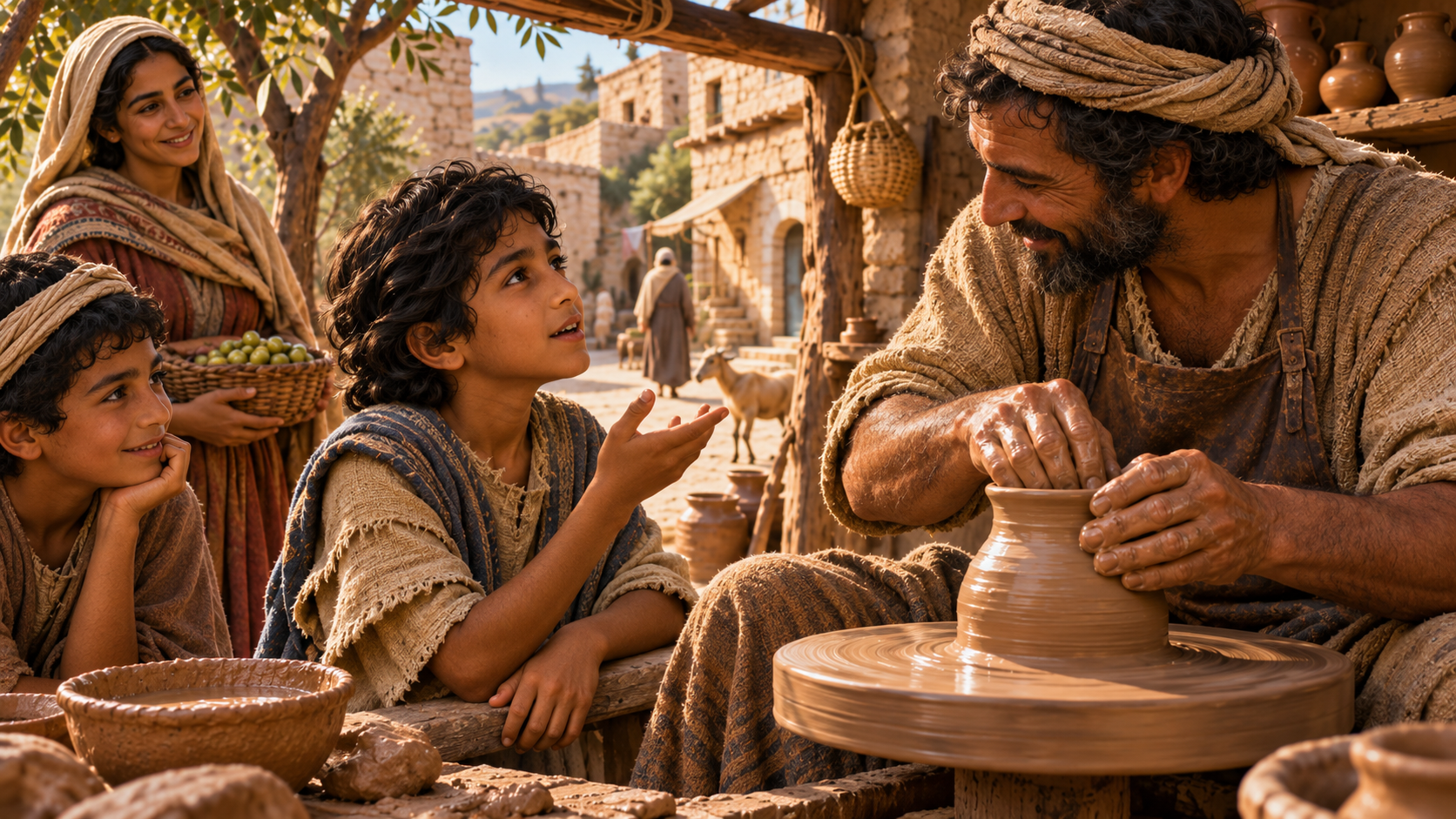
One scene in Paper 123 describes Jesus and other children spending time with a potter named Nathan, watching clay take shape on a wheel.
Imagine the moment.
A shapeless lump slowly becomes a vessel.
Most children might ask whether they can have a turn.
A particularly curious one might ask why one vessel turns out strong and another cracks.
And an adult who enjoys questions might reply, "What do you think?"
The potter episode belongs to the book's account. The imagined exchange above is our own reconstruction, not a quotation from Jesus or the text.
But it illustrates the theme we want to follow: an education in observation, patience, wonder, and human relationships.
The book describes a Jesus who learns languages and scripture, but who also learns about people by meeting them.
For an Atlas devoted to Truth, Beauty, Goodness, and Humour, there's something worth remembering here:
Knowledge can fill a mind. Understanding asks us to pay attention to another life.
A Small Life Isn't a Small Story
Consider the great claims Part IV will eventually make about Jesus.
It identifies him with Michael of Nebadon, a Creator Son who experiences a genuinely human life.
That is the book's theological account, not an independently verified identification.
But if we want to understand why Part IV gives so much attention to childhood, the idea becomes intelligible: the road toward the book's cosmic claims passes through a family, a home, a village, and the daily work of growing up.
The very ordinary details are not necessarily interruptions in the story.
They may be what the storyteller wants us to notice.
Before public ministry, there is learning.
Before teaching crowds, there is listening.
Before the adult who calls people to love one another, there is a child living among others.
A Question to Carry Forward
We can't know exactly what young Jesus said at a Nazareth workbench on a particular afternoon.
We can read what The Urantia Book imagines and asserts about those years, compare it with the limited independent historical record, and ask whether the portrait illuminates something about moral growth.
So here's our question for the next stage of the journey:
What would happen if we approached other people with the curiosity we usually reserve for the mysteries of the universe?
Perhaps we'd listen longer.
Perhaps we'd assume less.
Perhaps we'd discover that the person standing beside us has a universe of experiences we haven't begun to understand.
And perhaps, just occasionally, we'd discover that the most important question in the room wasn't ours.
🔎 Factoid — What comes from the book, and what doesn't?
Primary text: Paper 123 — The Early Childhood of Jesus, especially Sections 1, 3, and 5, describes the family's return to Nazareth, childhood friends, education, workshops, and encounters with others.
Historical boundary: Historians widely recognize Jesus of Nazareth as a first-century Jewish teacher, but the detailed scenes in this chapter cannot be confirmed as historical events merely by reading Part IV. This page is an introduction, not the Atlas's completed propositional analysis of Paper 123.
Storytelling boundary: The scene-setting, possible questions, and imagined dialogue are original literary illustrations. They should not be mistaken for recorded words of Jesus.