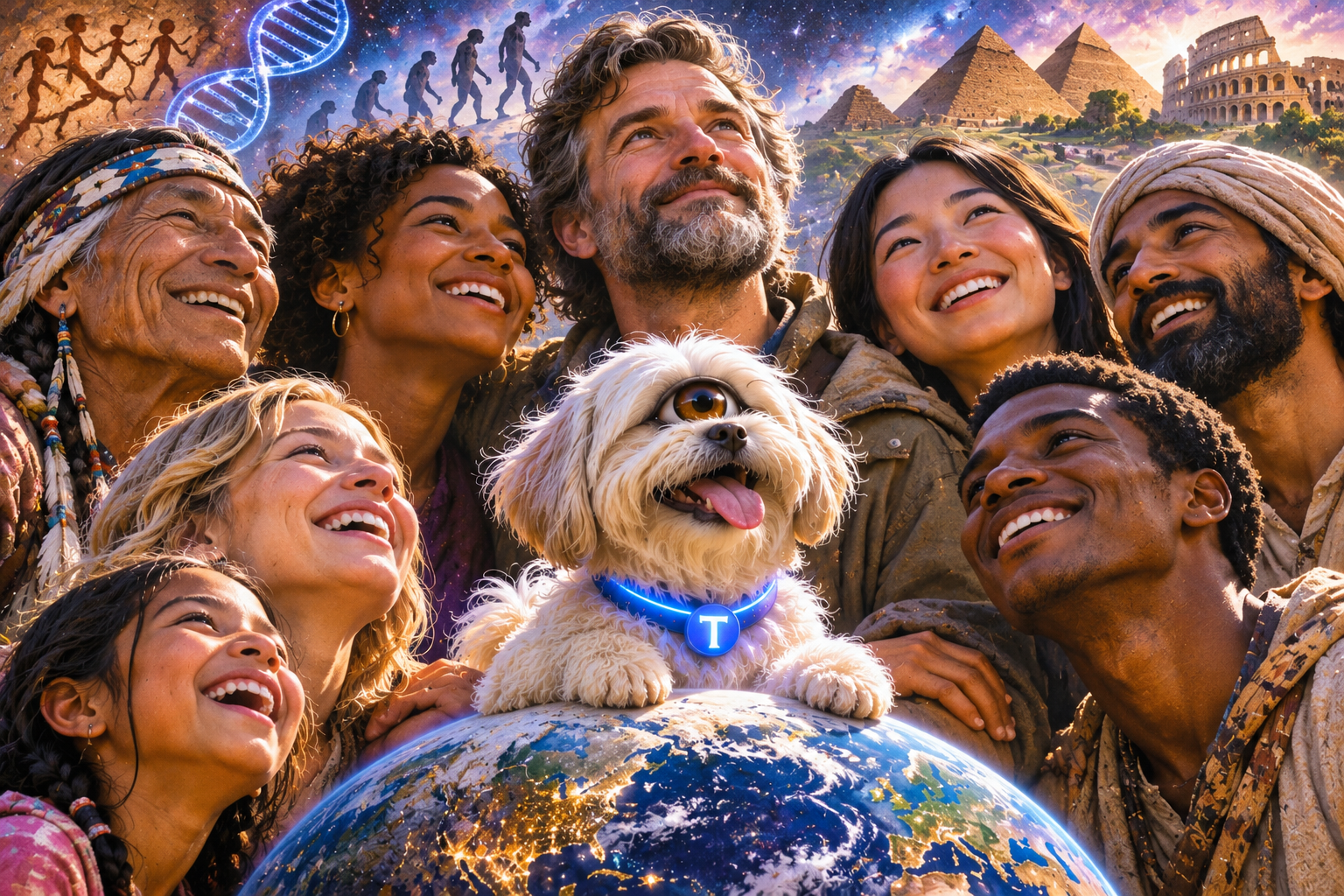
When Revelation Raises Difficult Questions
Race, human unity, and the courage to keep asking
Tyrion was still studying the map from our journey through the alleged Andite migrations.
We had travelled from Paradise to Havona, explored celestial capitals, encountered remarkable personalities, and returned to Earth's oldest stories.
Now we had found something neither of us particularly wanted to find.
"There's a problem," Tyrion said.
"I know."
"Your book talks about a loving Universal Father and the brotherhood of humanity."
"Yes."
"But then some of its passages rank human populations by inherited qualities."
"Yes, they do."
He watched the globe turning slowly in our observatory.
"How can both things belong in the same book?"
That was not a question to laugh away. And it wasn't a question I wanted to hide from anyone travelling with us.
In fact, it might be one of the most important questions we've encountered.
Can we take a purported revelation seriously without pretending every claim in it is beyond question?
The Difficulty Is Real
Some passages in The Urantia Book describe human populations through racial classifications and proposals for biological improvement. Certain statements imply inherited rankings of human capacities and reproduce ideas associated with eugenics.
Consider Paper 51:4–5, which discusses supposed racial strains, biological fitness, and controlled reproduction. These are not merely neutral names for ancient groups; some of the passage's claims raise serious scientific and ethical objections.
Those concerns deserve plain acknowledgement.
Modern anthropology and genetics do not substantiate the book's proposed celestial racial origins or fixed hierarchies of human worth. The American Association of Biological Anthropologists rejects treating socially recognized racial groups as discrete, biologically ranked human types.
Nor can we dismiss the harm that racial hierarchy and eugenic thinking have caused.
Tyrion listened without interrupting.
"So you're not going to tell me the difficult passages don't really say anything difficult?"
"No."
"Good. Because I can read."
He looked pleased with himself.
"And I only have one eye."
The Other Voice We Keep Hearing
But there is a reason the difficulty feels so unsettling.
Elsewhere, the book insists on spiritual kinship, loving service, divine regard for the individual, and an ever-widening fellowship of humanity.
Its moral imagination repeatedly asks people to look beyond tribe, nationality, status, and self-interest.
These teachings are part of what makes the journey meaningful to many readers.
So the difficulty isn't merely that the book contains an old-fashioned scientific classification. It is that some of its classifications appear to collide with its own deepest ethical aspirations.
Tyrion looked back toward the places we'd visited.
"All that talk about compassion on Uversa."
"Yes."
"And understanding others on Salvington."
"Yes."
"And welcoming strangers on Jerusem."
"Yes."
"Then surely we should apply those lessons here too."
I thought he had a point.
Admiration for a book should not require us to switch off the very moral judgment it encourages.
An Unexpected Admission Inside the Book
Here the story takes an intriguing turn.
In Paper 101, Section 4 — The Limitations of Revelation, the narrator says revelators are restricted in what they may disclose. It acknowledges that material presented as cosmology may later be outgrown by new discoveries, and it anticipates that readers might discard valuable religious insights after detecting errors in associated scientific accounts.
Tyrion sat upright.
"Wait. The book warns that some of its information may eventually need correcting?"
"Yes, specifically in its discussion of scientific and cosmological information."
"Then that sounds rather relevant."
"It is. But we need to be precise."
That passage does not explicitly say that the book's racial hierarchies were deliberately inserted as tests of our morality. Nor does it establish that every troubling ethical claim falls under the same allowance for provisional cosmology.
It offers a possible way to understand some limitations of the text.
It does not settle this particular problem.
And we cannot simply assume that an apparent mistake is a hidden lesson from celestial teachers.
"That's disappointing," Tyrion said.
"Sometimes an unanswered question really is unanswered."
"Then I suppose we'll have to live without inventing the answer."
A surprisingly good philosophical rule.
What Could Explain the Tension?
We considered several possibilities.
Perhaps a genuine revelatory message, if there is one, was constrained by the scientific language and assumptions available to its first readers.
Perhaps human authorship or cultural influence shaped more of the book's biological and moral claims than its account of celestial authorship would lead us to expect.
Perhaps a work can communicate genuinely valuable religious and philosophical insights while remaining mistaken on important matters of history, biology, or ethics.
Or perhaps some explanation has not yet been understood.
None of those possibilities is established simply because it would make us feel better.
The question of the book's claimed origin remains open to investigation, and different readers may reasonably reach different conclusions.
Tyrion looked puzzled.
"Does that mean we have to decide today whether the entire book is right or wrong?"
"No."
"Good. I was hoping to have breakfast before making a decision about the entire universe."
What We Can Know About Human Ancestry
Whatever the origin of the book, the scientific questions deserve independent answers.
Human populations have real evolutionary histories, shared ancestry, migrations, and patterns of genetic variation. But those histories do not divide humanity into neat, permanently separate, inherently superior or inferior biological races.
The Smithsonian Human Origins program offers introductions to the fossil, archaeological, and genetic evidence.
That evidence does not establish a celestial Adamic lineage, the so-called violet race, the Andites, or the book's proposed hierarchy of hereditary capacities.
We can investigate the text's claims without using them to classify real people.
And the equal dignity of human beings is not something we should place in suspense while waiting for a prehistoric genealogy to be verified.
"Even if someone's family tree looks different from mine?" Tyrion asked.
"Yes."
"Even if their ancestors were from somewhere else?"
"Yes."
"Even if they don't like dogs?"
"Yes, Tyrion."
He sighed.
"That last one really tests my commitment to universal fellowship."
Keeping Our Eyes Open—and Our Journey Open
Some readers will regard these passages as evidence against the book's claims to celestial authorship. Others will see them as limitations in the communication of revelation. Still others will remain undecided.
The Atlas should give all of them room to think.
It should not hide uncomfortable passages to preserve belief.
And it should not insist that readers discard every valuable idea they've encountered merely because one portion of the text is troubling.
A compelling spiritual insight is worth examining on its own merits. A claim of revelatory authority is also worth examining—not automatically accepting.
This isn't a loophole that rescues every assertion from criticism. If a claim is wrong or harmful, we should be willing to say so.
It's simply permission to keep learning.
Tyrion gazed at the observatory window. Beyond it, the familiar blue world waited.
"Suppose someone did make a mistake," he said.
"Yes?"
"Does that mean our entire journey was wasted?"
"Think of what we've explored."
"Paradise, Havona, Jerusem, Edentia, all those strange beings—and questions about love, personality, and what makes someone matter."
"Exactly."
He thought for a while.
"Then one difficult chapter doesn't mean we have to throw away the entire library."
"No. But neither should we pretend the difficult chapter isn't there."
"Good," he said. "Because I'm not finished asking questions."
Neither was I.
Another Door, Not a Dead End
When we began, the map seemed to promise an answer to every question.
Now it had taught us something more valuable: wonder and discernment can travel together.
We can be moved by beauty without confusing beauty with proof.
We can be drawn toward goodness without excusing statements that undermine human dignity.
And we can search for truth without demanding certainty before we're willing to take the next step.
Tyrion adjusted the glowing T on his collar.
"So where do we go now?"
"Wherever the next good question leads."
"Excellent," he said. "But perhaps first we should ask whether the kitchen has discovered any new biscuits."
Some mysteries remain remarkably persistent.
The journey doesn't end when a difficult question appears. Sometimes that is where deeper understanding begins.
Next Chapter — The Universe Has a Question for You →
🔎 Factoid — Read the Passages and Examine the Evidence
- The difficult biological claims: Paper 51 — The Planetary Adams, Sections 4–5. These passages deserve direct reading and critical scrutiny.
- The book's own account of limitations: Paper 101:4.1–4.5. Its discussion concerns restrictions upon revelation and the possible revision of scientific and cosmological claims. It does not explicitly explain away the racial passages.
- Human biological diversity: American Association of Biological Anthropologists — Statement on Race and Racism and Smithsonian Human Origins.
- Atlas evidence investigations: EVR-005 — The Six Sangik Races, EVR-008 — The First True Humans, and EVR-009 — Andon and Fonta. Each addresses a distinct claim; none verifies the book's racial hierarchy.
Evidence boundary: The imagined observatory conversation and Tyrion's remarks are original fiction. The book's supposed celestial authorship, biological programme, and racial origins have not been independently established. The idea that troubling passages were deliberately inserted as moral tests is speculative and is not presented as a conclusion.