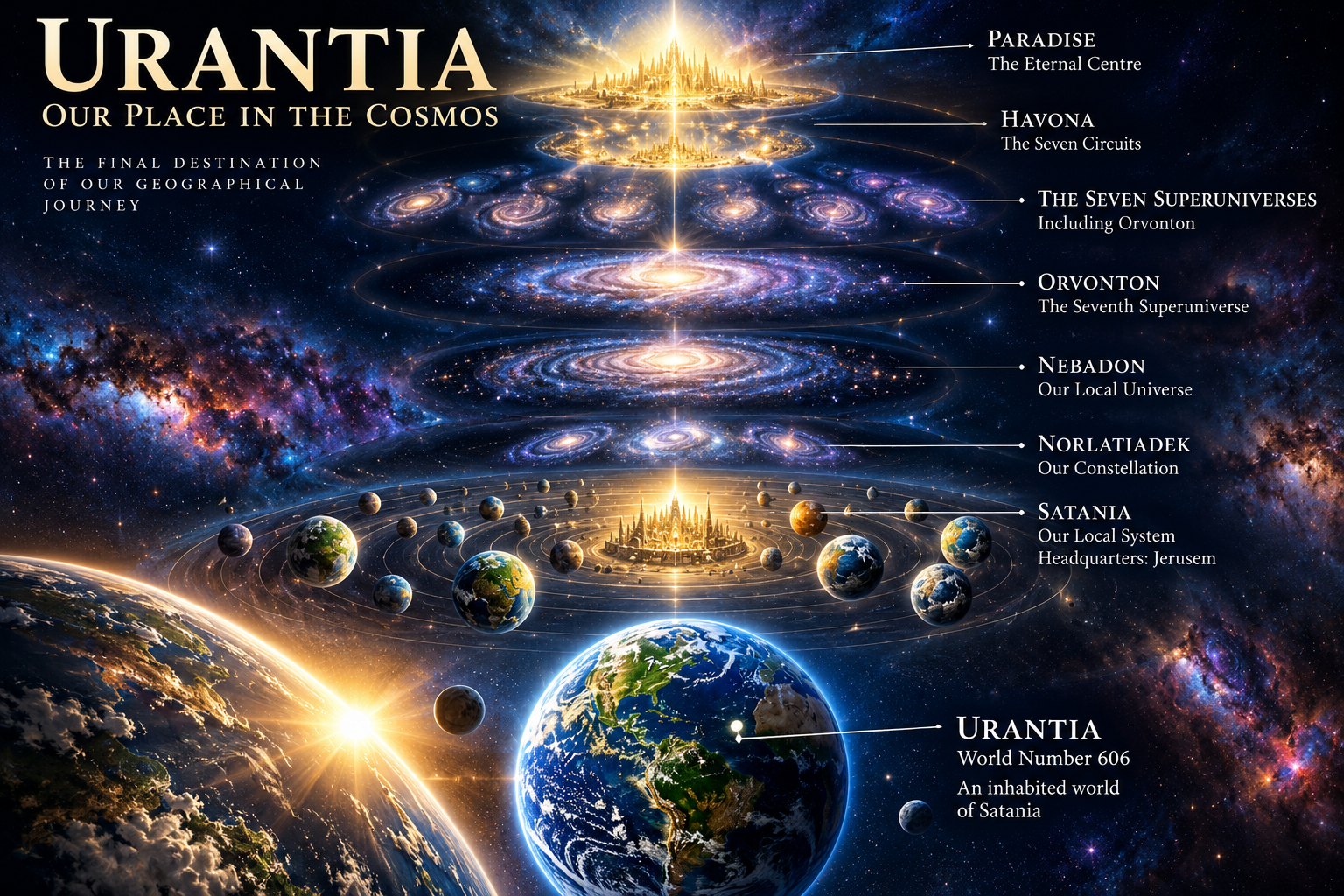
Urantia — Our Place in the Cosmos
The last light on the observatory map was very small.
Almost embarrassingly small.
We had travelled through an eternal central universe, seven enormous superuniverses, and more cosmic administrative departments than any mortal should reasonably encounter without a packed lunch.
We had visited Paradise, Havona, Orvonton, Nebadon, Norlatiadek, and Satania.
Now Tyrion stood beside the final glowing dot.
URANTIA.
"Well?" he asked.
"Well what?"
"Where's the enormous palace? The spectacular celestial capital? The welcome committee?"
I pointed toward the little blue world.
"That's it."
He stared at the map.
"That's Earth."
"Yes."
"We travelled across the universe to come back to Earth?"
"Yes."
He sat down, his little white paws planted firmly on the observatory table.
"I'd like to speak to whoever planned this holiday."
And then, beyond the observatory window, the real morning began.
The One World We Know for Certain
A faint light crept across the horizon.
There were rooftops. Trees. A road. Perhaps somebody was already walking to work, making breakfast, or looking for a car key that had been in their pocket the whole time.
No celestial transport arrived.
No crystal landing field appeared.
The ordinary world was doing what it always does: beginning another day.
We can investigate this planet directly. Its rocks record immense stretches of time. Its oceans and atmosphere sustain life. Its organisms share evolutionary histories that science continues to examine through fossils, genetics, geology, and observation.
And every one of us lives here.
The Urantia Book calls this planet Urantia.
But Earth does not require that name—or any proposed celestial registry—to exist. We can point to it, photograph it from space, measure its motions, and test claims about its physical history.
That's the wonderful difference between the destination and the journey we imagined to reach it.
Earth is established reality. The vast spiritual-administrative route described in the book is an extraordinary claim whose literal existence has not been independently established.
Tyrion studied the dawn.
"Well, at least we've found somewhere with reliable breakfasts."
"That depends on who's preparing them."
"Then our journey is not quite over."
Number 606 — Not a Performance Review
One last number blinked beside the blue planet.
606.
Tyrion narrowed his one eye.
"There it is again. Our planetary rating."
"It's not a rating."
"Are you sure?"
"Quite."
According to Paper 49:0.3, Urantia is the 606th world of Satania registered as inhabited by intelligent, choosing beings.
The same passage describes Satania as an unfinished system of 619 inhabited worlds, with others not yet inhabited.
The number refers to a supposed order of registration. It doesn't rank Earth's intelligence, morality, scenery, or customer service.
"That's a relief," said Tyrion. "I was drafting a strongly worded objection."
The book goes further. In 15:14.8, it supplies a spectacularly long grand-universe registry number:
5,342,482,337,666.
Tyrion sighed.
"Now they've given us an account number."
"That's how the book describes it."
"If anyone asks me to memorize that, I'm moving to Paradise."
None of these numbers comes from an independently verified census of extraterrestrial civilizations.
And still, the image of one little planet being named among an immense universe of worlds gives us something to think about.
Not because it proves that the cosmic directory is real.
Because it raises an unexpectedly personal question:
Can something be very small and still matter?
A Planet with a Complicated Childhood
The book certainly does not portray Urantia as a world that got everything right on the first attempt.
Quite the opposite.
We began this adventure with Lucifer's rebellion, a cosmic struggle over authority, freedom, and the consequences of pride. His rebellion reached Earth through Caligastia, its alleged Planetary Prince.
The narrative tells of the loyalty of Van and Amadon, the disruption of the planetary schools, and the eventual difficulties associated with the mission of Adam and Eve.
Even the book's story of life's origins on Urantia has its peculiarities.
It calls Earth a life-modification world—one of the planetary settings in which the Life Carriers, according to the narrator, were permitted to adapt the standard patterns of life in unusual ways.
That is a claim in Paper 58, not evidence that the Earth's organisms have been shown to originate from celestial intervention. Scientific claims about life's history require independent investigation; they cannot be inferred from the book merely because it describes an elaborate origin story.
Tyrion glanced at the blue dot.
"So our planet has a rather colourful history."
"According to the book."
"Rebellion, misplaced confidence, interrupted education..."
"Yes."
He considered this.
"And yet it turned out to be a fairly nice place for a dog."
It has its difficulties.
So do we.
But a world with a troubled history is not a world without a future.
The Extraordinary Visitor
Remember Michael of Nebadon?
Back in our local-universe chapter, we met a Creator Son who, according to the book, undertook seven bestowals to experience existence as various kinds of beings within his universe.
His last bestowal, the text says, took place here.
Not on Paradise.
Not on Uversa.
Not in the gardens of Edentia.
On Urantia.
The book identifies this Michael with Jesus of Nazareth, portraying his earthly life as the culminating experience through which the Creator Son came to understand mortal existence from the inside.
Paper 119:7.2–7.7 makes the point with striking simplicity: the Creator appears, in the narrative, as a human baby, raised within the ordinary circumstances of human life.
Tyrion seemed puzzled.
"The ruler of a vast universe chose this little planet?"
"That's what the book claims."
"And came as a baby?"
"Yes."
"Not as somebody with a magnificent office and a private celestial transport?"
"No."
He looked out at the streets beginning to fill with people.
"That's a rather unusual way to introduce yourself."
It is.
The identification of Jesus as Michael is a religious interpretation specific to the book, not an independently demonstrated historical identity.
But the ethical question woven through that story needs no cosmic registry:
What would happen if those who hold power genuinely tried to understand life as experienced by those without it?
It's a question worth asking on Earth, in ordinary human relationships and institutions, whether or not we accept the book's account of the bestowals.
Not the Centre of Everything
After such an extraordinary claim about Jesus, we might be tempted to conclude that Earth must somehow be the universe's favourite planet.
But the book's larger picture offers a more careful thought.
In 15:14.9, it portrays Urantia as one among an immense family of worlds, receiving loving attention as though it were the only inhabited world.
That's not the same as declaring every other world unimportant.
It's the difference between exclusive privilege and individual worth.
Think of a parent who has several children. To care deeply for one child does not require caring less for the others.
Think of a teacher with a crowded classroom. The existence of all those other students should not make any one learner invisible.
Or think of our small planet, full of billions of human beings who rarely appear in history books but whose lives still contain love, struggle, humour, courage, grief, and hope.
The scale of the universe does not automatically determine the worth of an individual.
Tyrion looked at his own small paw.
"I suppose being little doesn't make me unimportant."
"Not at all."
"Good. I'd hate to find out after all this travelling that size was the admission requirement."
What We Brought Home
The observatory was quiet now.
The enormous map still spread across the table, but its countless labels seemed less intimidating.
Paradise had introduced the idea of a centre.
Havona had asked whether perfection could contain endless discovery.
The superuniverses had reminded us that creation might be a story of becoming.
Orvonton had brought us face to face with justice and mercy.
Nebadon had asked whether understanding could matter more than authority.
Norlatiadek had offered gardens devoted, among other things, to learning how to live with others.
And Satania had reminded us that recovery is not the same as pretending nothing happened.
Now we were home.
Here, on Earth, those ideas no longer required luminous celestial headquarters.
They could begin in an ordinary kitchen, a school, a workplace, a quiet act of patience, or an unexpected kindness to a stranger.
Even the simplest moral questions remained wonderfully difficult.
Will I listen before I judge?
Will I learn something from someone unlike me?
Will I make room for another person to grow?
And perhaps most importantly:
Will I remember to love the world that is actually here, while I explore the universe that might be?
Tyrion looked toward the door.
"I have one question."
"Only one?"
"After an entire universe of sightseeing, are we finally allowed to go for a walk?"
I smiled.
"I think we've earned one."
He sprang down from the observatory bench, his glowing collar catching the first light of morning.
The map could wait.
The world outside could not.
Home Is Where the Next Adventure Begins
That completes our journey through the book's proposed cosmic geography—but the Atlas has much more to explore.
Now that we've arrived on a world with real people and real histories, the next question comes naturally:
How do civilizations begin, grow, stumble, and sometimes find the courage to begin again?
The book has stories to tell about Urantia, its early inhabitants, planetary teachers, the Garden of Eden, and the long unfolding of human societies. We can explore those stories with the same curiosity, humour, and care for evidence that brought us this far.
The map is only the beginning.
Continue the Adventure — The Lives Behind the Worlds →
🧭 Optional Detours — Before the Next Adventure
🎭 The Cosmic Help Desk
There was, of course, still one administrative problem.
After travelling all that way, someone in the Celestial Orientation Department had apparently forgotten to ask whether we remembered our house keys.
The original End of the Cosmic Road Trip sketch remains available as an optional comic detour.
The End of the Cosmic Road Trip
Bonus sketch:
An entirely fictional exchange involving an ascending mortal and a Reversion Director. This is satire, not a quotation from The Urantia Book.
ASCENDING MORTAL: "Paradise, Havona, seven superuniverses, Orvonton, Nebadon, Norlatiadek, Satania..."
REVERSION DIRECTOR: "And finally?"
ASCENDING MORTAL: "URANTIA! EARTH! HOME!"
REVERSION DIRECTOR: "Congratulations. Your cosmic navigation has been successful."
ASCENDING MORTAL: "Wonderful! After that enormous journey, I can't wait to get inside!"
REVERSION DIRECTOR: "Do you have your keys?"
The mortal searches his pockets.
ASCENDING MORTAL: "Oh, for the love of Paradise..."
REVERSION DIRECTOR: "Recalculating..."
🔎 Factoid — Urantia: The Source Trail
The Urantia Book is the primary textual source for the cosmic addresses, personalities, and spiritual history retold in this chapter. Our observatory, Tyrion's speech, and the imagined transitions are original fiction.
- Urantia as inhabited world number 606 of Satania; system of 619 inhabited worlds: 49:0.1–0.3
- The broader cosmic address and the book's registry number: 15:14.5–14.8
- A single world within a family of worlds, each regarded as worthy of care: 15:14.9
- The alleged Lucifer rebellion and Caligastia's participation: Paper 53, Paper 67
- The book's designation of Earth as a life-modification world: 58:0–4
- The seven bestowals of Michael and the asserted identity with Jesus: 119:7–8
Evidence boundary: Earth and its observable physical history are open to independent scientific investigation. Satania, the celestial registry, the book's accounts of planetary administration, supernatural intervention in life's history, and the identification of Jesus with Michael are claims within the text, not independently established discoveries.