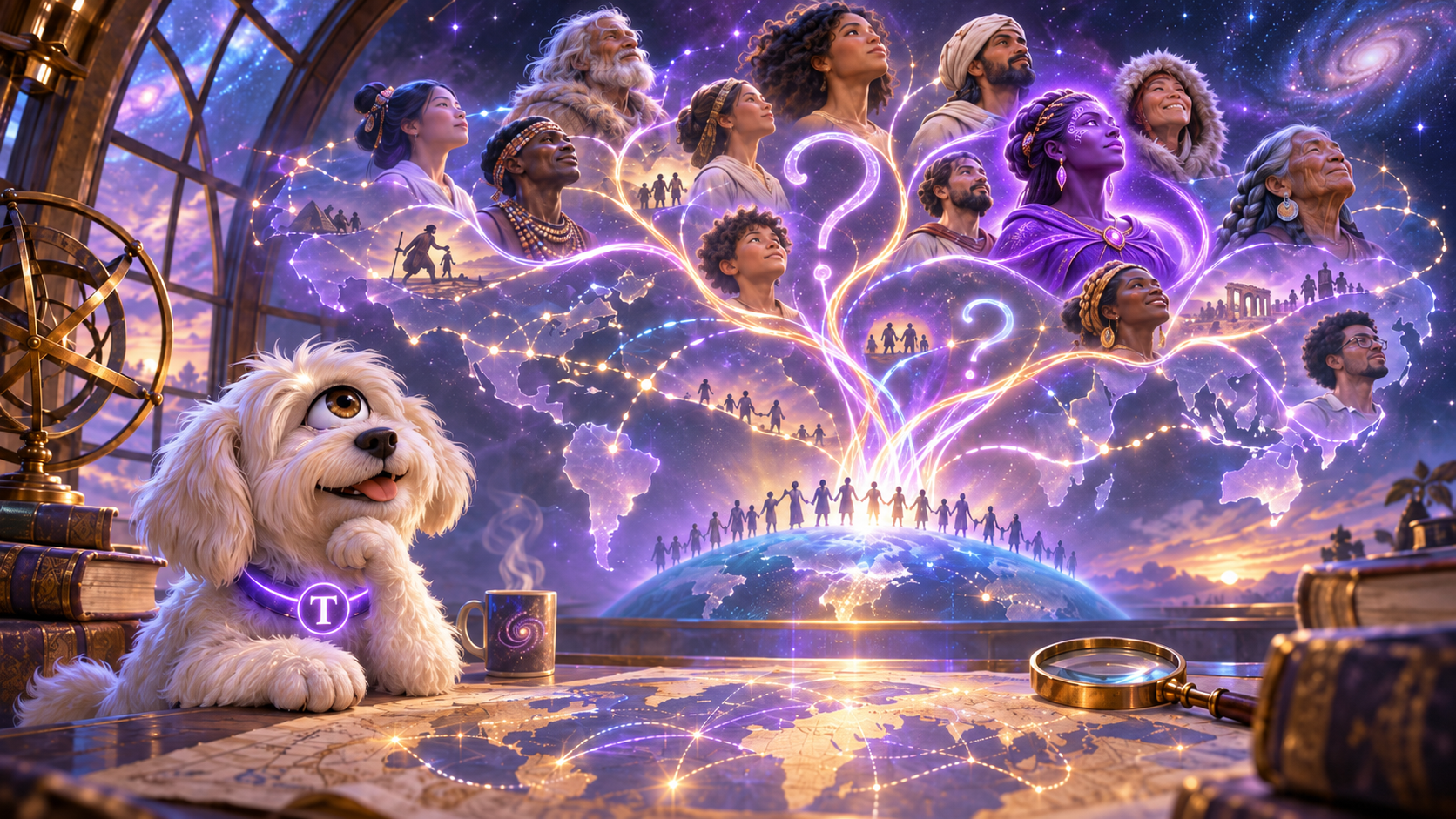
The Violet Race — The Family Tree That Became a Question
Tyrion had found an enormous family tree in our observatory.
It stretched across the wall, branching into rivers of names and arrows.
He stared at it with his one bright eye.
"Is this a map?"
"Of ancestry, according to The Urantia Book."
"Does it include my ancestors?"
"Not specifically."
"Then it's missing several highly distinguished dogs."
That might have been the end of the discussion.
But one of the labels on the map caught his attention.
THE VIOLET RACE.
He looked at me.
"Violet?"
"That's the book's term for a proposed lineage descended from Adam and Eve."
"So people were purple?"
"Not something we can establish from biology—and we must be careful about the book's use of colour labels."
Tyrion tilted his head.
"Then perhaps we'd better find out what the label actually means before anybody starts using it."
A very good idea.
A Story That Continues After Eden
We had left Adam and Eve rebuilding their lives in the Second Garden.
The book's narrative does not stop there. It claims their descendants carried an Adamic inheritance outward through generations, eventually mixing with other populations and influencing later civilizations.
In Paper 76 and Paper 78, these descendants become central characters in the proposed history of humanity.
The book calls the Adamic lineage the violet race and portrays it as distinct from earlier human populations.
That is the narrator's account, not an independently demonstrated genealogical discovery.
No accepted genetic finding identifies a celestial Adam and Eve or establishes the book's violet-race population as a historical biological category.
Tyrion inspected the branching diagram.
"So a family grows, spreads, and meets other families?"
"That's part of the story."
"That happens all the time."
"Yes. But the extraordinary claims about which families existed and what they supposedly inherited are another matter."
He nodded.
"Right. A familiar process doesn't prove an unfamiliar family tree."
The little philosopher was learning.
What Does a Family Really Pass Along?
Imagine a parent teaching a child to cultivate a garden.
The child learns where to plant, when to water, how to recognize healthy soil, and why neighbours sometimes need help.
Years later, the child teaches someone else.
Eventually the original teacher is gone, but the knowledge continues.
Our imagined scene is not a verified episode from the Adamic narrative. It illustrates something humans really do: transmit knowledge, habits, beliefs, and practices across generations.
The Urantia Book attributes forms of cultural development to the Adamic descendants—education, family organization, agriculture, and the spread of particular traditions.
Those claims require independent historical evidence before we can credit them to a named prehistoric lineage.
But they lead us to a question that matters without any celestial ancestry.
What makes an inheritance valuable: the name of the person who gave it to us, or what we do with it?
Tyrion considered this.
"My ancestors gave me excellent instincts."
"Such as?"
"Find the warmest place in the room. Recognize a biscuit packet at twenty paces. Distrust cats."
"That last one may be more of a personal preference."
"I come from a long and distinguished tradition."
The Problem with Ranking Family Trees
Here we must stop and examine the map with particular care.
The book does not merely tell a story of relatives and migrations. Some passages attribute superior inherited qualities to particular populations and use racial hierarchies to describe human development.
Those hierarchies are not supported by modern scientific understandings of human genetic variation, and the Atlas does not endorse them.
Human populations share deep ancestry. Genetic variation overlaps across groups and does not support fixed, inherently superior or inferior biological races.
The American Association of Biological Anthropologists' statement on race and racism explains these distinctions.
Tyrion regarded the family tree again.
"Suppose someone says their ancestors make them better than their neighbours."
"What would you ask?"
"Whether they've actually done anything kind for those neighbours."
A sensible start.
But we should go further.
Every human being possesses equal dignity regardless of ancestry, appearance, nationality, disability, or the biological categories proposed by a religious text.
We can understand the book's claims accurately without giving those claims authority over real people's worth.
For a closer examination, see Race, Human Unity, and Historical Context.
A River Doesn't Stay in One Place
The book portrays its Adamic descendants as spreading beyond the Second Garden and intermarrying with other populations.
In time, it introduces a further category: the Andites.
In the book's account, these supposed populations arise through combinations of Adamic, Nodite, and other lineages and participate in migrations and cultural changes across a much wider geography.
We should be precise: “Andite” is also a category from the book's narrative, not an established genetic identity.
Tyrion watched the diagram transform.
Separate branches became interwoven.
"Now who's related to whom?"
"It's complicated."
"Good. So we're finally looking at an ordinary family reunion."
The comparison is amusing, but real human ancestry is more complex than any neat diagram.
People and populations have moved, interacted, intermarried, exchanged languages and technologies, and transformed one another throughout human history.
Those broad processes are independently studied by archaeology and genetics.
They do not independently confirm the book's named Adamic lineages or its explanations of who brought civilization to whom.
A plausible pattern of migration isn't proof that a particular religious genealogy happened.
One Dangerous Assumption
There is a subtle temptation in the book's narrative.
If one lineage is credited with important innovations, readers may begin to imagine that everything admirable in civilization came from that one source.
But human ingenuity has never belonged to a single supposedly privileged ancestry.
Across different continents and periods, people developed technologies, art, agriculture, institutions, and ways of caring for one another under very different circumstances.
The history of human achievement is neither simple nor the property of one family tree.
Tyrion looked startled.
"You mean nobody owns civilization?"
"No single ancestry can claim exclusive ownership of the human story."
"Not even the people who invented biscuits?"
"We can certainly thank them."
"Excellent. Credit where credit is due."
And perhaps that's the distinction worth keeping.
We may recognize a contribution without claiming that everyone outside its supposed source mattered less.
The Most Interesting Thing About a Family Tree
Our map eventually became too crowded to follow.
Arrows crossed. Names multiplied. Generations disappeared into earlier generations.
Tyrion climbed onto his cushion and stared at the tangle.
"I thought this was supposed to tell us who everybody is."
"Ancestry can tell us something about where people came from."
"But not everything about who they are?"
"No."
"Or how they'll treat somebody?"
"No."
"Or whether they'll share?"
"Definitely not."
He sat with that for a moment.
"Then a family tree is a beginning, not a verdict."
Exactly.
The book offers a particular theory of ancient human ancestry. We should evaluate its historical and biological claims with care—and reject any suggestion that inherited racial rank determines human value.
But the larger question of inheritance remains beautifully open.
We receive much that we did not choose: language, family stories, circumstances, customs, and the consequences of earlier generations.
What comes next also depends on what we decide to do with those gifts and burdens.
Perhaps the most important legacy isn't the ancestry we claim, but the world we help leave behind.
Tyrion looked toward the next branch of the book's proposed history.
"Who's next?"
"The Andites."
"Another family?"
"Another alleged population, and a story about movement and mixing."
He sighed.
"Then bring a larger map. And this time, let's keep the labels from deciding what anyone is worth."
Continue the Adventure — The Andites: When the Story Began to Travel →
🔎 Factoid — The Claims, Sources, and Scientific Boundary
Primary text: Paper 76 — The Second Garden and Paper 78 — The Violet Race After the Days of Adam describe the alleged lineage and subsequent populations. These references identify what the book asserts; they do not establish the proposed genealogy.
Scientific context: The Smithsonian Human Origins program introduces archaeological and biological evidence for human ancestry. The AABA statement on race and racism explains why traditional racial categories and claims of inherent hereditary rank do not accurately describe human variation.
Evidence boundary: No independently verified genetic lineage links real populations to the book's celestial Adam and Eve. The terms “violet race,” “Nodite,” and “Andite” must not be treated as established scientific populations. The book's racial hierarchy claims require criticism, not endorsement. Tyrion's dialogue and imagined encounters are original fiction.