The Andites — When the Story Began to Travel
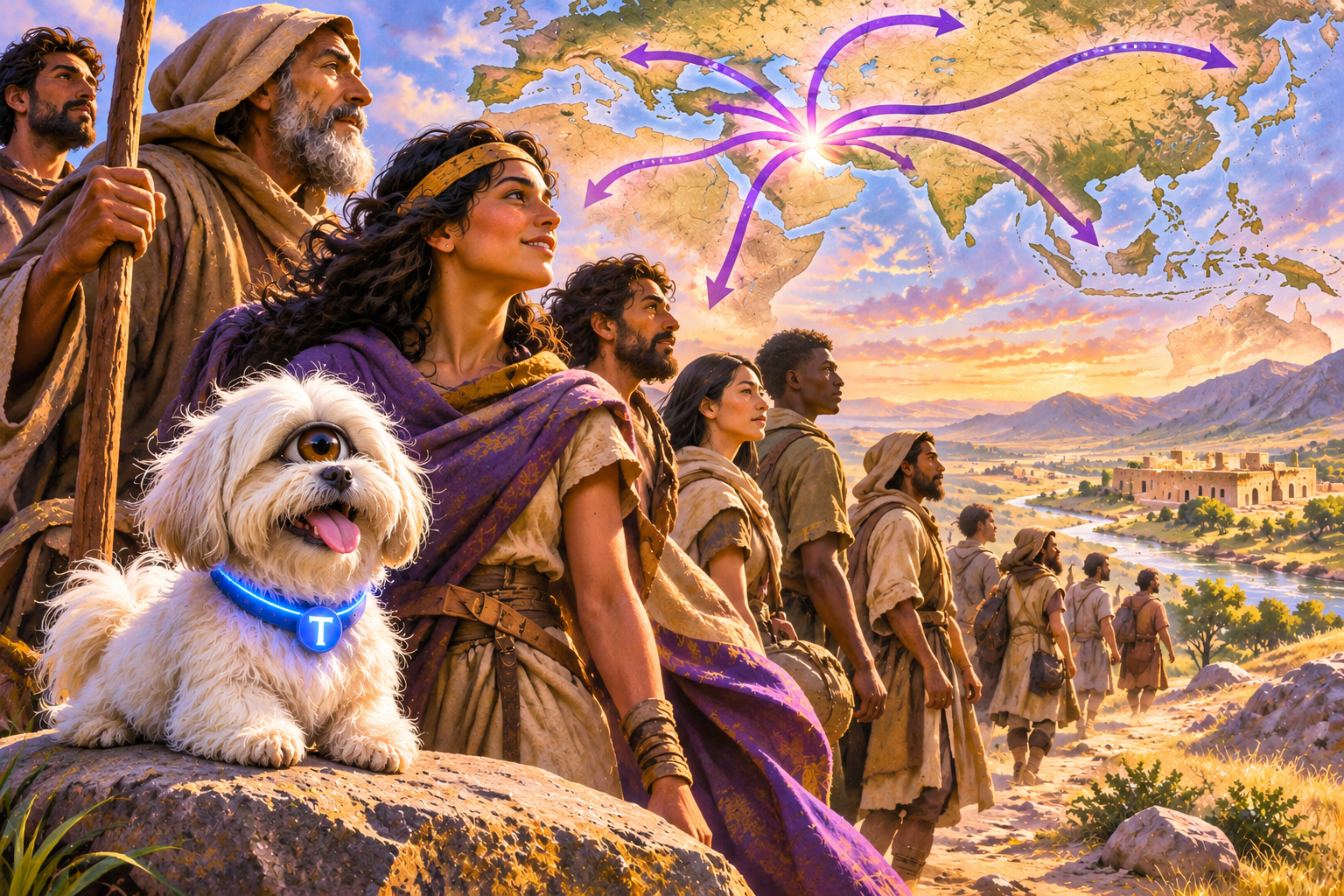
Tyrion had asked for a larger map.
I gave him a map of Eurasia.
He surveyed the sprawling coastlines, mountain ranges, rivers, and deserts with his one bright eye.
"That's not a map," he announced.
"What is it?"
"An unreasonable amount of walking."
We had left behind the Second Garden, where The Urantia Book describes Adam's descendants attempting to preserve something of their original mission. We'd investigated the book's so-called violet race—and why its biological classifications must not be mistaken for established science.
Now the story was on the move.
The map showed arrows reaching far beyond Mesopotamia.
"Who are these travellers?" Tyrion asked.
"The book calls them Andites."
"Do they have luggage?"
"Probably in our imaginary version."
"Then I hope someone packed biscuits."
When Family Trees Become Roads
In Paper 78 — The Violet Race After the Days of Adam, the narrator describes Andites as populations supposedly emerging from the mixture of Adamic descendants, Nodites, and other peoples.
The text places these alleged populations in a long history of movement, migration, and cultural influence.
The first distinction matters enormously.
Andites are a category asserted by the book, not a population independently identified by genetics or archaeology.
The fact that real people migrated and intermarried in prehistory does not demonstrate that they belonged to this proposed lineage.
Tyrion traced an arrow with his paw.
"So the book has given us a route."
"Yes."
"But a drawn route isn't proof someone travelled it."
"Exactly."
"Then perhaps the arrows should be accompanied by question marks."
He was developing excellent cartographic habits.
A Bag Full of More Than Possessions
Imagine a family preparing to leave a river settlement.
They gather what they can carry.
Food. Tools. Clothing. Perhaps a treasured object.
And something that weighs nothing at all: knowledge.
How to grow a crop. How to shape a useful implement. A song, a story, a custom, a way of organizing work.
This family is our fictional scene, not a documented Andite household.
Yet we know through independent research that real human communities have migrated, exchanged ideas and technologies, and adapted practices over time.
Tyrion inspected their belongings.
"They've forgotten something."
"What?"
"Their address book."
"Perhaps they know the way."
"That's what everybody says before getting lost."
The book uses its proposed Andite movements to explain the spread of traditions and forms of civilization across different regions.
But there is an important difference between describing a possible mechanism and identifying the actual historical source of a practice.
A tool discovered far from its presumed place of origin doesn't carry a label identifying the people who taught its makers.
Historical conclusions require evidence about chronology, geography, material culture, and, where appropriate, ancient DNA—not simply an appealing narrative of transmission.
The World Was Never Empty
Some of the book's proposed migrations move toward Europe, Asia, and North Africa.
On our map, the arrows crossed lands that were already home to people.
Tyrion noticed.
"Hang on. Who's living there?"
"Other human communities."
"So these aren't blank spaces?"
"Not at all."
"Then why does the map make them look like somebody's future destination?"
He had caught a danger lurking in many grand stories of civilization.
People who migrate encounter people who are already living, working, inventing, loving, and remembering in those places.
Cultural exchange may bring cooperation and innovation.
It may also involve rivalry, domination, displacement, and violence.
The book sometimes portrays its alleged Andites as civilizational benefactors, but we shouldn't allow that perspective to erase the capabilities or histories of other populations.
Nobody needs a special ancestral visitor to become fully human, intelligent, creative, or worthy of respect.
Tyrion stared at the map.
"Then the people at the ends of these arrows have stories too."
"Every one of them."
"Good. We're going to need a much larger Atlas."
Civilization Doesn't Have a Single Owner
The narrator connects the Andites with agriculture, trade, craftsmanship, migration, and cultural development.
The actual histories of those developments remain subjects for archaeology, anthropology, linguistics, and genetics.
There is no accepted body of evidence establishing the book's particular Andite identity or confirming that this supposed population uniquely supplied civilization to other peoples.
Different communities across the world developed remarkable abilities, sometimes independently, sometimes through contact and exchange.
And when people interact, they rarely transfer a culture unchanged.
They adapt it.
Reject some parts.
Combine others.
Invent something neither group possessed before.
Tyrion considered this carefully.
"So if someone teaches me a new trick—"
"Yes?"
"And I change it to suit myself—"
"Yes?"
"Who owns the trick?"
"That depends on what you mean by owns."
He sighed.
"I knew this would become philosophy."
But he had found the important question.
Culture is something human beings continually make together, not a trophy awarded permanently to one bloodline.
Where Are the Andites Now?
In the book's account, the Andites become increasingly mixed with other populations and eventually cease to exist as a distinct category.
The story presents their legacy as scattered among later peoples.
We must not confuse this with a verified account of ancient genetic admixture.
Modern population genetics does study ancestry and mixture over long timescales. Those findings do not, by themselves, establish the book's Adamic, Nodite, or Andite classifications.
Tyrion looked at the tangled arrows.
"So if everyone keeps meeting everyone else, the neat boxes stop being neat."
"They often do."
"And the people don't disappear just because the labels change."
"Precisely."
He studied the map again.
"Then maybe the map should show relationships instead of rankings."
Perhaps that would improve more than a few maps.
One Last Question About the Story We're Telling
We had now followed the book's account from a supposed celestial mission to a garden, through a difficult second beginning, and outward into the proposed migrations of later generations.
It was a sweeping story.
But the most important question might be what happens when such a story assigns unequal value to the people within it.
Some passages in The Urantia Book use racial hierarchies and claims about inherited superiority that conflict with modern scientific understanding and require clear ethical criticism.
The Atlas must neither hide that difficulty nor quietly adopt the book's language as our own.
The American Association of Biological Anthropologists' statement on race and racism explains why traditional racial categories do not represent discrete, inherently ranked biological divisions.
Tyrion placed his paw firmly on the map.
"I have a proposal."
"I'm listening."
"Before we go any farther, we examine the labels."
"All of them?"
"The ones that could make us forget the people."
That seemed a worthy next step.
A good account of humanity's past should expand our understanding of one another—not give us new excuses to rank human worth.
We closed the migration map.
Our next chapter would be different: not another imagined people or ancient location, but an examination of the book's own difficult racial language, the evidence, and the principle of human unity.
Tyrion looked relieved.
"Good. And afterward, perhaps a chapter on which ancient cultures invented the best snacks."
Continue the Adventure — Race, Human Unity, and Historical Context →
🔎 Factoid — Andites, Evidence, and Human History
Primary source: Paper 78 — The Violet Race After the Days of Adam and the book's adjacent papers on ancient human migration. These sources show what the text claims, not what archaeology confirms.
Independent context: The Smithsonian Human Origins evidence guide introduces the fossil, archaeological, and genetic bases for studying human prehistory. The AABA statement on race and racism provides scientific context for human variation and the rejection of racial hierarchies.
Evidence boundary: The proposed Andite population, its specific ancestry, and the historical migrations attributed to it have not been independently established. General evidence of migration, mixture, agriculture, or trade does not validate the book's named lineage. Tyrion's conversations and the travelling family are original fictional storytelling.