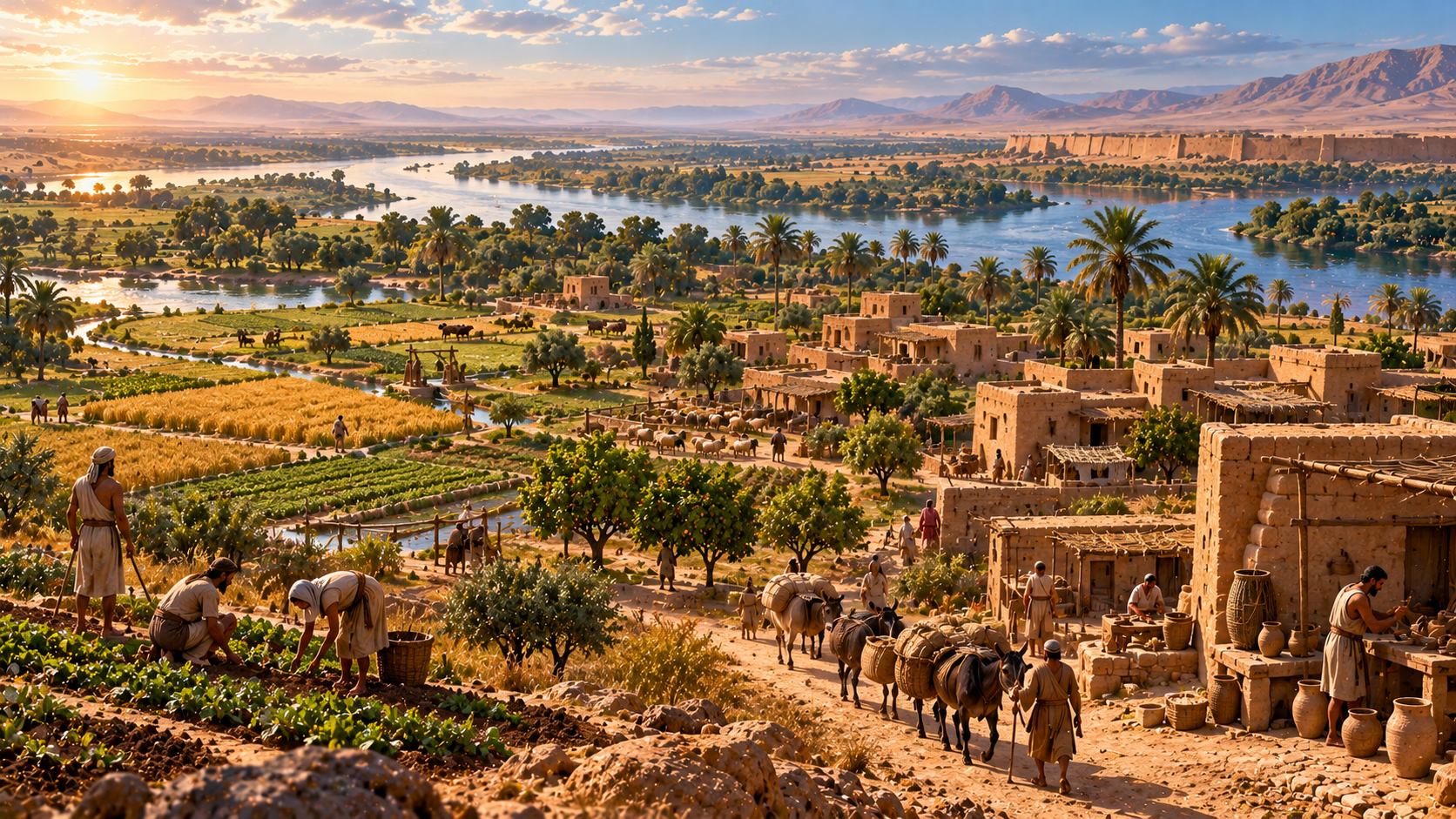
The Second Garden — Paradise Had to Start Over
Tyrion looked at the new map.
He looked at me.
Then he looked back at the map.
"Another garden?"
"Yes."
"After what happened to the first one?"
"Yes."
He considered the situation carefully.
"Did anybody remember to pack the furniture?"
We had left behind the first Eden of The Urantia Book: its shimmering avenues, carefully prepared schools, cultivated landscapes, and hopes for a better planetary future.
Now the story took us somewhere less glamorous.
No ready-made paradise.
No immaculate garden waiting for its new occupants.
Only the prospect of beginning again.
"At least tell me there's a welcome basket," Tyrion said.
"I'm afraid this time they have to grow the contents themselves."
He sighed.
"Paradise has entered the do-it-yourself phase."
Between Two Rivers, a Different Beginning
In Paper 76, the narrator describes Adam and his companions travelling toward Mesopotamia, between the Tigris and Euphrates rivers, after leaving the first Garden.
The region exists, of course. Its archaeological history is extraordinarily rich.
But the specific Second Garden, its founders, and its proposed ancient chronology have not been independently established.
The text describes a strategically defensible location. 76:1.3 suggests the two rivers came close enough that a fifty-six-mile wall could be built across the northern approach.
Tyrion stared at the plans.
"Could be built?"
"Yes."
"So it isn't already there?"
"Not according to that description."
He sat down.
"Someone forgot to order the wall."
The joke practically wrote itself.
But the setting changes the emotional stakes of the story.
In the first Eden, much of the environment had been prepared in advance. In this second settlement, people have to work with the ground beneath their feet and the circumstances they have inherited.
The first Garden represented a magnificent beginning. The second asks what remains possible after that beginning is lost.
There Were Still Children to Feed
The book's narrative moves beyond grand celestial plans into the daily demands of family and community.
People need food.
They need shelter.
They need education.
They need ways to resolve disputes before disagreements consume the community.
In our imagined visit, a worker bends over an irrigation channel while another carries provisions toward a family dwelling. Children ask questions. Someone has misplaced a tool. Someone else insists the work should have been finished yesterday.
These scenes are original storytelling, not documented prehistoric events.
Tyrion regarded the activity.
"This looks suspiciously like ordinary life."
"It does."
"I thought these were special people."
"The book portrays them as people with an extraordinary mission. It doesn't exempt them from the practical needs of living."
"Then someone ought to help with the dishes."
An excellent observation.
The story's most moving possibility may be that responsibility does not disappear when our original plans fail. The people who depend on us still need to be cared for.
And perhaps that is where real courage often begins.
A Family Carries Its History with It
The Second Garden also becomes the setting for one of the narrative's most painful family conflicts.
The text distinguishes the birthplaces of the children carefully: Cain and Sansa are born before the caravan reaches Mesopotamia (76:0.2), while Abel is born in the Second Garden (76:2.1).
The story of Cain and Abel unfolds differently from some familiar retellings, but it ends in tragedy.
Tyrion had grown quiet.
"Do we have to make a joke about that?"
"No."
"Good."
The book's account involves resentment, family identity, religious differences, and conflict that grows beyond the ability of those involved to contain it.
We have no independent historical evidence establishing the individuals and events as the book describes them. But the problem of unresolved hostility is painfully recognizable.
What happens when a family or community notices a conflict but fails to address it before someone gets hurt?
That is a question worth asking with care, not with a punchline.
The Teachers Who Wouldn't Let the Story End
Not every part of the Second Garden's story concerns conflict.
The book portrays Adam continuing to teach, organize, and guide his community despite the mission's painful change of direction.
And it describes Seth, a son born in the Second Garden, later leading a religious and educational order.
According to 76:3.4–3.5, Seth's associated priesthood combined religion, health, and education.
Tyrion's ears rose.
"Health and education?"
"Yes."
"So they weren't merely giving speeches?"
"Not according to the narrator."
"Good. I find a warm meal and a useful lesson improve almost any sermon."
In the book's account, this tradition supposedly helps preserve and transmit the Adamic mission's ideas beyond the Garden itself.
That claimed historical transmission has not been independently demonstrated.
But there is something compelling about the underlying thought.
A teacher's work may continue long after the teacher is gone.
Not because every lesson survives intact.
But because someone remembers enough to help another person begin.
The Trouble with an Ancient Family Tree
The narrative goes on to describe descendants it labels the violet race and, later, populations called Andites.
These are the book's categories and claims, not scientifically established biological races or genetically verified lineages.
Its language about hereditary improvement and racial hierarchy needs careful, explicit examination. Modern human genetics does not support dividing humanity into fixed, intrinsically ranked biological races.
Our Race, Human Unity, and Historical Context investigation addresses these issues directly.
Tyrion stared at the enormous imagined family tree.
"Does it tell us which people matter?"
"No. The value and dignity of a person don't depend on a supposed place in this genealogy."
"Good," he said. "Because I've met some excellent people whose ancestry I know absolutely nothing about."
A rather strong argument for judging our neighbours by how we treat them.
Our next chapter examines the so-called violet race carefully—what the book actually claims, and where its proposed biological history conflicts with the evidence.
The Garden That Wasn't a Paradise
As evening fell over our imagined Mesopotamian settlement, the first Garden felt very far away.
That earlier paradise had been an ambitious design.
This one had become a daily practice.
A meal prepared.
A lesson taught.
An argument confronted—or sometimes tragically avoided.
A family trying to keep going after the future it imagined had disappeared.
Tyrion watched a small light appear in a distant home.
"Do you suppose they missed the first Garden?"
"In the book's story, I imagine they would have."
"Then why continue?"
"Because there was still life to live, work to do, and people who needed them."
He was quiet a moment.
"Maybe starting over isn't the same as starting from nothing."
No.
Sometimes a new beginning carries everything the old one taught us—even the lessons we wish we had never needed.
A lost paradise may be beyond recovery. The responsibility to care for one another is not.
Tyrion turned toward the next page of our map.
"All right. What's next?"
"The descendants the book calls the violet race."
He tilted his head.
"That sounds like the sort of thing we ought to examine very carefully."
"Exactly."
"Then bring the evidence. I'll bring the biscuits."
Continue the Adventure — The Violet Race: A Claim About Human Ancestry →
🔎 Factoid — Primary Text and Evidence Boundary
Primary narrative: Paper 76 — The Second Garden. This paper describes the move to Mesopotamia, Adam's later work, Cain and Abel, Seth, and the proposed continuation of Adamic culture.
Independent context: The Metropolitan Museum of Art's Mesopotamian chronology documents real ancient populations and urban developments in the region. These findings do not verify the book's proposed settlement or lineages.
Evidence boundary: The Second Garden's named founders, chronology, Sethite transmission claims, and proposed biological categories have not been independently established. Our dialogue and imagined daily-life scenes are fictional. A historical region is not, by itself, proof of a particular claimed settlement.
🧭 Optional Detours — The Moving Department and Archaeological Dossier
Original Celestial Intermission, preserved from the earlier Atlas:
🎭 Celestial Intermission — Eden Relocation Services
Entirely fictional Reversion Directors sketch. No celestial moving company, building permit, or conversation below appears in Paper 76.
REVERSION DIRECTOR: “Adam, I have good news and bad news about the new Garden.”
ADAM: “Start with the good.”
REVERSION DIRECTOR: “Two rivers. Excellent natural defenses. Outstanding potential.”
ADAM: “And the bad?”
REVERSION DIRECTOR: “The report says a fifty-six-mile wall could be built. Apparently we forgot to order one.”
ADAM: “Do we at least have a relocation budget?”
REVERSION DIRECTOR: “Of course. All requests must be submitted before departure.”
ADAM: “We've already arrived.”
REVERSION DIRECTOR: “Then I suggest we file this under character development.”
The Department of Celestial Logistics declines to comment.
Detailed archaeological comparison, preserved:
Archaeological and Chronological Cross-Check
The location between the Tigris and Euphrates corresponds to an extensively studied real region. That geographical match alone does not establish the Second Garden as a specific archaeological site.
Chronological scale: Paper 74:0.1 dates Adam and Eve's original arrival 37,848 years before A.D. 1934. Paper 76 places the Second Garden after their departure from the first. The book's proposed sequence therefore substantially predates the well-documented later Mesopotamian agricultural and urban developments cited below.
| Claim within Paper 76 | Independent historical context | Assessment |
|---|---|---|
| An Adamic migration reached the region and a replacement settlement was founded (76:0.1–1.4). | Archaeology documents human populations and later villages in Mesopotamia, but has not identified an Adamic caravan or a settlement corresponding to the named Second Garden. | Unverified event and identity. |
| A defensible territory lay between the rivers, with room for a 56-mile northern wall (76:1.3). | Rivers and ancient settlements are real features of the region; the proposed wall's precise location and age have not been established. | Textual description; not a surveyed site. |
| The Garden transmitted unusually early agriculture, administration, writing and crafts (76:3.2–3.10). | The Metropolitan Museum's archaeological chronology documents Neolithic developments from about 10,000 BCE, southern Mesopotamian Ubaid settlement from about 6200 BCE, and the Uruk period around 4000–3100 BCE. Its Uruk overview describes a developed city by about 3200 BCE. | Independent chronology does not verify this earlier claimed source of civilization. |
| Seth's priesthood and the Adamic lineage influenced later humanity (76:3–4). | No accepted archaeological or genetic identification links a historical Sethite or violet-race population to the specifically narrated genealogy. | Proposed genealogy and cultural influence remain unverified. |
Assessment: NOT INDEPENDENTLY ESTABLISHED. This is a focused comparison of Paper 76 with general archaeological references, not a newly classified EVR investigation, a complete literature survey, or a field evaluation. Real Mesopotamian history does not, by itself, corroborate the book's named settlement or proposed population history.
The scientific/ethical complications surrounding the text's racial categories belong in our Race, Human Unity, and Historical Context investigation rather than being treated as established human groups.
Primary Sources and Independent Context
- The Urantia Book, Paper 76 — The Second Garden — the source of the claims examined here.
- The Metropolitan Museum of Art — Mesopotamia, 8000–2000 B.C. — archaeological chronology, independent of the Urantia narrative.
- The Metropolitan Museum of Art — Uruk: The First City — background on urban development, not a finding about the Second Garden.
Explore further: The First Garden · Adam and Eve · Race, Human Unity, and Historical Context · Planetary History.