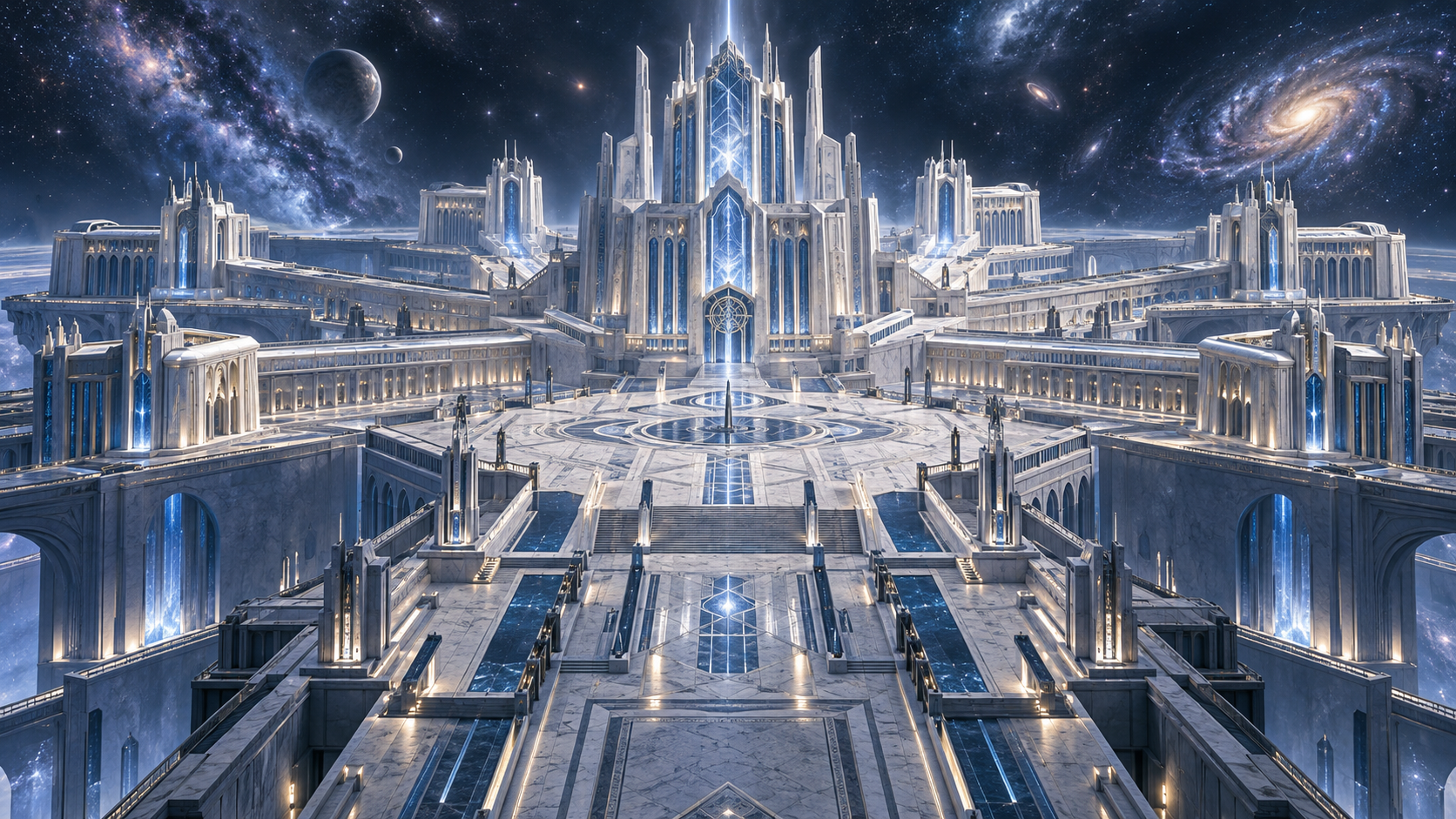
Uversa — Where Justice Must Remember Mercy
Tyrion had been unusually quiet.
Usually that meant he was asleep, hiding a biscuit, or planning something he hoped I wouldn't notice.
But this time he was staring at our next destination on the observatory map.
UVERSA.
"'Supreme tribunals,'" he read.
"Yes."
"'Final judgments.'"
"Yes."
"'One trillion inhabited or inhabitable worlds.'"
"Approximately that number, according to 15:7.11."
He lifted his fluffy head. His one central eye was wide open; both ears were perfectly normal.
"Am I in trouble?"
"For what?"
He considered the question.
"Nothing that can still be proved."
I decided not to ask.
We had visited Urantia, where ordinary people build communities. Jerusem had taught us about welcome. Edentia showed us the challenge of cooperating with different personalities. At Salvington, the story of Michael invited us to imagine what a leader might learn by experiencing the lives of others.
Now we approached the capital of Orvonton, the seventh superuniverse of The Urantia Book.
The question before us was more difficult.
What does it take to be just when a decision may change someone's life forever?
A Capital Larger Than Anything We Know
In the book's proposed hierarchy, Urantia belongs to Satania, Norlatiadek, Nebadon, and Orvonton.
Its headquarters world, Uversa, is described as an architectural sphere built for an enormous administrative role.
This isn't a discovered astronomical object. Neither Uversa nor its administration has been independently established by observation.
But the narrator describes an astonishing institution: a government serving vast numbers of worlds, with permanent citizens, schools, public assemblies, and supreme courts.
Tyrion examined the map.
"A trillion worlds. That's a lot of neighbours."
"Yes."
"And complaints."
"Probably."
"Does the capital have a customer-service department?"
"I imagine its responsibilities are rather different."
"I'd like to file a report about the shortage of biscuits."
He did have a gift for finding the personal in the cosmic.
And perhaps that was precisely what an immense civilization must struggle not to forget.
Even when a government has unimaginable responsibilities, its decisions still affect individual lives.
Three Ancients of Days
The book describes three Ancients of Days presiding over Orvonton.
In Paper 18:3.5–3.7, the narrator portrays them as supreme rulers who must act together in the most consequential matters of judgment.
One responsibility makes the scene suddenly serious.
According to the text, they alone may issue the final executive judgments concerning the eternal extinction of will creatures.
All three must participate in those decisions.
Tyrion went still.
"Extinction?"
"That's the book's description of its gravest judgment."
"Not a warning?"
"No."
He looked toward our imagined courthouse.
"Then I hope they never decide carelessly."
So do I.
The book claims that these rulers are perfect judges. That perfection is part of its narrative, not something we can independently demonstrate.
But Tyrion's concern needs no cosmic proof.
The greater the consequences of a judgment, the greater the responsibility to examine the evidence and consider the being affected.
Someone Has to Speak for the Other Side
Then we encountered a detail in Paper 15:12.1.
The book describes hearings in which Universal Censors present and interpret evidence, Mighty Messengers offer the defense of the children of time, and Those High in Authority represent the position of the higher government.
Other experienced personalities help formulate the verdict.
Tyrion listened.
"So someone presents the evidence?"
"Yes."
"And someone speaks for the beings being judged?"
"According to the narrator."
"So it isn't just one important official announcing that everyone else is wrong?"
"Not in this description."
"Good."
Of course, a description of a hearing doesn't establish that a real celestial court exists, and an idealized trial in a religious text isn't proof of justice.
But it raises a familiar question.
Can a judgment be fair if it never hears the people who must bear its consequences?
We encounter that question in our own legal systems, workplaces, schools, and families.
A grand courtroom is impressive.
A genuinely fair hearing is something much more important.
Seven Houses—and a Missing Representative
Uversa, the narrator says, has a seven-house deliberative assembly where qualified local universes can elect representatives.
In 15:11.1–11.3, the text imagines perfected administrators working alongside representatives who once belonged to evolving worlds.
Tyrion was fascinated.
"Seven houses?"
"Yes."
"Couldn't they share one?"
"Not that kind of house."
"I see. Another disappointing architectural detail."
Then he studied the representation list.
"Does Nebadon, our home universe, have a seat?"
"Not at the time described."
The text is explicit in 15:9.15–9.18: admission requires specified conditions of physical stability and spiritual harmony, and Nebadon had not yet qualified for membership and representation on Uversa.
"So not everybody is represented," Tyrion observed.
"Correct."
"Then we'd better not claim that everybody is."
Exactly.
The book's own qualification matters.
And it poses another question for us.
Who gets to participate in decisions about the larger community, and who decides when a voice is considered ready to be heard?
Even a beautiful theory of government deserves scrutiny on that point.
One Small Word in a Very Large Universe
The most striking detail about Uversa came from a passage not about its courts, but about the character of Orvonton itself.
In 15:14.2, the narrator describes the seventh superuniverse as especially associated with mercy.
Its justice is said to be tempered by mercy; its exercise of power, moderated by patience.
Tyrion read that again.
"Justice and mercy?"
"Yes."
"Not one instead of the other?"
"That's the idea."
"What if someone really hurts another person?"
"Consequences may be necessary."
"And what if someone makes a mistake because they haven't learned better yet?"
"Then that may matter too."
He considered the distinction.
Mercy isn't pretending nothing happened.
Justice isn't ignoring a person's intentions, circumstances, or capacity to change.
And compassion toward somebody who did wrong must not make us forget the person who was harmed.
The difficult task is to take responsibility seriously without losing sight of the person.
That is a question we can bring home from this story whether or not the alleged courts of Uversa exist.
A Very Small Biscuit Hearing
Tyrion looked worried again.
"Suppose," he began, "a biscuit went missing."
"Suppose."
"And suppose a very small dog was nearby."
"With one eye, two ears, and suspicious crumbs on his face?"
"Purely circumstantial."
We imagined a hearing of our own. This is original fiction, not an event claimed in The Urantia Book.
The imaginary magistrate asked Tyrion if he had taken the biscuit.
"Yes."
"Did you know it belonged to someone else?"
"Yes."
"Can you make things right?"
Tyrion offered to replace it.
"Does that erase what happened?" I asked.
"No."
"Does it matter that you want to repair the harm?"
"I hope so."
The little dog looked up.
"And can I still have dinner?"
"Yes."
He was visibly relieved.
A missing biscuit is not comparable to the grave decisions the book assigns to the Ancients of Days.
But even this tiny story lets us ask something important.
Holding someone accountable need not mean reducing their entire identity to their worst mistake.
Four Hundred and Ninety More Schools
Tyrion looked relieved when we left the courts.
Then he spotted the next part of the itinerary.
"Universities?"
"Yes."
"Again?"
"Yes."
"How many?"
According to 15:7.10, Uversa has seven groups of higher universities, each containing seventy specialized worlds.
490 educational worlds.
Tyrion sat down.
"Didn't Salvington have 490?"
"Different educational worlds."
"And Edentia had seventy major spheres and seven hundred satellites?"
"Yes."
"Do we ever get a diploma and an afternoon off?"
These university worlds are said to prepare ascending beings for the onward journey to Havona, the central universe.
In the narrator's vision, even great advancement doesn't end the need for further education.
I rather like that.
A court that believes it already knows everything may be dangerous.
A society that refuses to learn may be fragile.
And a leader who cannot admit error may struggle to exercise power wisely.
Perhaps one of the most important qualifications for authority is the willingness to keep learning.
The People Behind the Government
Uversa isn't only a courthouse, at least in the book's portrayal.
In 37:9.12, the narrator describes abandonters as permanent inhabitants who help with the headquarters' routine affairs.
In Paper 30:3, we encounter visiting courtesy colonies: star students, celestial artisans, instructors, Reversion Directors, and travellers.
Tyrion seemed delighted.
"So there are people who study the stars?"
"According to the book."
"People who make art?"
"Yes."
"People who tell jokes?"
"Reversion Directors."
He nodded.
"Then perhaps there's hope for the place."
Behind every institution are people doing the work of living.
People learning, teaching, creating, and keeping things running while officials attend important meetings.
We shouldn't forget them when admiring the buildings.
One Very Small World in an Enormous Registry
The book assigns Earth a remarkable grand-universe registry number in 15:14.8:
5,342,482,337,666.
Tyrion stared.
"No."
"What?"
"I'm not memorizing that."
"It's the number assigned to our world in the book's proposed registry."
"Print it on a card, then. Preferably one that fits on my collar."
But the following paragraph is more moving.
In 15:14.9, the narrator claims that Urantia is cared for as attentively as it would be if it were the only inhabited world in existence.
We cannot verify that cosmic registry or its alleged administration.
Still, the idea touches something real.
You might be one person among billions.
One small life in a universe of overwhelming size.
That doesn't mean your difficulties don't matter.
Or your kindness.
Or your choices.
Being small in a vast universe need not make someone insignificant.
"Even a little dog?" Tyrion asked.
"Even a little dog."
"One eye?"
"One magnificent central eye."
"Two ears?"
"Both accounted for."
He looked satisfied.
"Good. Our records are finally accurate."
The Last Stop in Our Civilization Journey
The cosmic map began to fold.
We had visited five great destinations in our Civilization Atlas.
Urantia: where ordinary people make communities possible.
Jerusem: where arriving strangers become welcome citizens.
Edentia: where the difficult art of cooperation becomes a way of learning.
Salvington: where the story of Michael invites us to imagine leadership informed by lived experience.
Uversa: where power and judgment must confront the question of mercy.
Tyrion looked at the closing map.
"Have we met everybody now?"
"Not remotely."
He sighed.
"More worlds?"
"Many."
"More offices?"
"Probably."
"Have you considered that the universe might need a smaller filing cabinet?"
I pointed to our next section.
Non-Human Intelligence Codex.
"Now we stop looking mainly at places and start meeting the different orders of beings the book describes."
Tyrion's tail began wagging again.
"New friends?"
"Perhaps."
"Any like my spornagia friend?"
"We'll discover some extraordinary characters."
He shook out his white fur.
"Then let's go. But this time, I'm asking about everyone's dietary requirements before we arrive."
He had learned something.
Perhaps we had too.
A civilization deserves admiration not merely because its rulers are powerful or its institutions magnificent, but because of the wisdom, fairness, and care with which it treats those who live within it.
And sometimes justice's greatest test is whether it remembers mercy.
Continue the Adventure — Meet the Neighbours →
🔎 Factoid — Uversa's Source Trail
The setting, named orders, and numbers above are drawn from The Urantia Book. Tyrion's dialogue and the imaginary biscuit hearing are our original fiction, not quoted or canonical episodes. The preserved Celestial Intermission is explicitly satirical.
- Uversa as Orvonton's capital and its 490 advanced university worlds: 15:7.10–7.11.
- Three Ancients of Days and final judgment: 18:3.5–3.9.
- Seven houses, representative eligibility, and Nebadon's status: 15:9.15–9.18 and 15:11.1–11.3.
- Evidence, defense, and judgment in the tribunals: 15:12.1–12.4.
- Orvonton's claimed emphasis on mercy: 15:14.2.
- Abandonters and courtesy colonies: 37:9.12 and 30:3.1–3.13.
- Earth's proposed registry number and the narrator's claim about planetary care: 15:14.8–14.9.
Evidence boundary: Uversa, the institutions and inhabitants attributed to it, and the claimed cosmic registry are not independently verified discoveries. The text's statements about justice, mercy, and the worth of individuals are worth examining without presenting its celestial world as established fact.
🧭 Optional Detours — Before We Meet the Neighbours
Just when we thought we'd escaped the paperwork, Tyrion noticed a registration desk.
He stared at its sign.
"Please tell me someone has already made fun of this."
In fact, our earlier edition of the Atlas did exactly that.
Some things are too entertaining to lose in a renovation. Here is the original Uversa Department of Administrative Affairs sketch, preserved unchanged.
🎭 Celestial Intermission — The Uversa Department of Administrative Affairs
An entirely fictional performance inspired by the Reversion Directors of The Urantia Book.
REVERSION DIRECTOR: "Welcome to Uversa! The administrative headquarters of an entire superuniverse!"
ASCENDING MORTAL: "Wonderful! Where do I report?"
REVERSION DIRECTOR: "Department of Arriving Personalities. Seventh corridor. Take a number."
ASCENDING MORTAL: "My number says 1,000,000,412."
REVERSION DIRECTOR: "Excellent! You're practically next."
ASCENDING MORTAL: "And how long is the wait?"
REVERSION DIRECTOR: "Approximately one universe age."
ASCENDING MORTAL: "ONE UNIVERSE AGE?! Is there someone I can complain to?"
REVERSION DIRECTOR: "Certainly. Complaints Department. Take another number."
The assembled Reversion Directors burst into applause.
CELESTIAL INSTRUCTOR: "Congratulations! Your first lesson in cosmic patience is now complete."
Celestial Intermissions are imaginative satire, not quotations from The Urantia Book or factual claims about celestial administration.