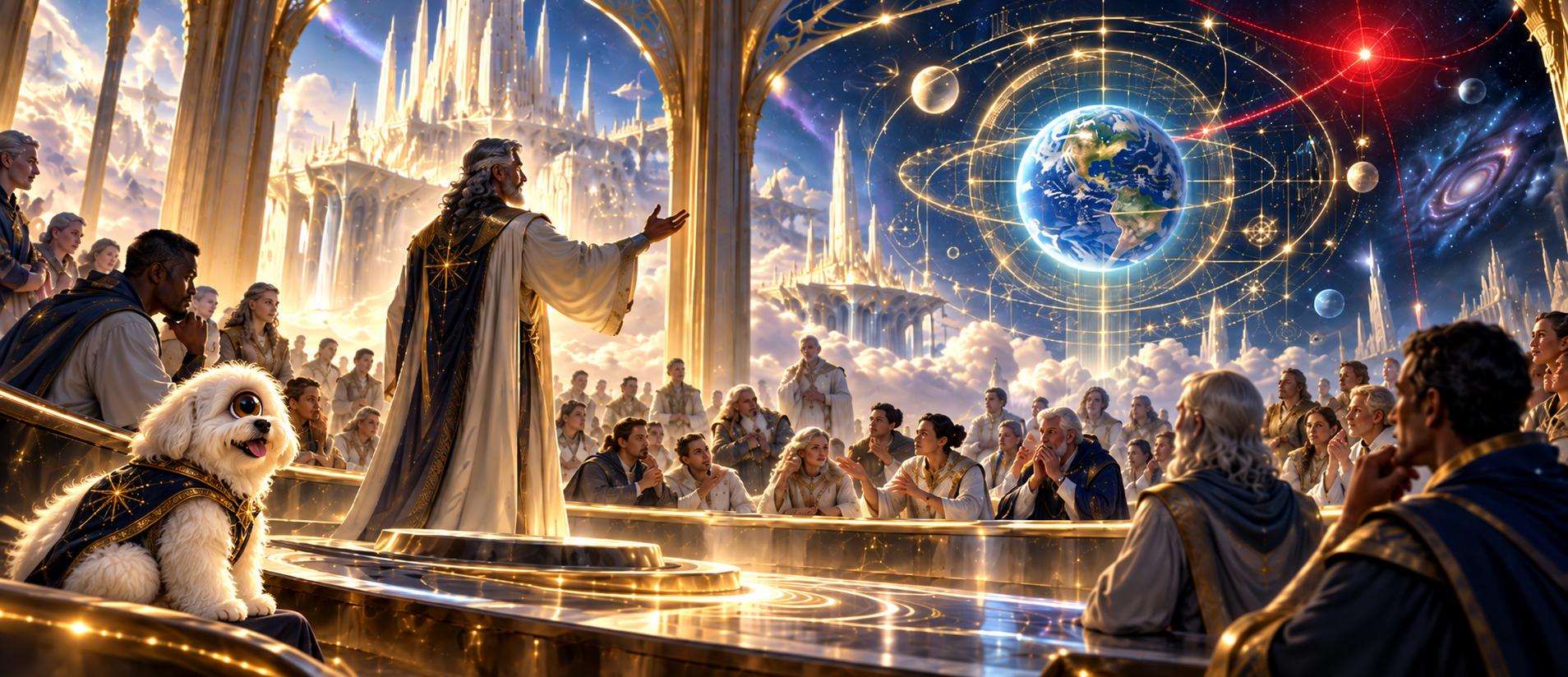
🌌 A Cosmic AdventureThe Lucifer Rebellion
The Day Heaven Developed a Management Problem
One gifted administrator. Thirty-seven rebellious Planetary Princes. A seven-hour speech. And a disagreement about freedom that reached all the way to Earth.
The warning light from the observatory was still flashing.
Now a second message appeared on our imaginary cosmic map:
JERUSEM — DECLARATION OF LIBERTY ISSUED.
Tyrion stared at the blinking light.
"Has anyone tried turning the universe off and on again?"
"Not quite the kind of problem we're dealing with."
"Then this is going to involve a meeting, isn't it?"
As it happens, several.
The Most Qualified Person in the Room
Meet Lucifer.
Forget, for a moment, the horns and pitchfork of popular art. In The Urantia Book, Lucifer begins as a magnificent Lanonandek Son—one of the book's orders of celestial administrators. Brilliant, experienced, and highly regarded, he governs Satania, a system that, at the time of his rebellion, contains 607 inhabited worlds.
His seat of government lies on Jerusem. His jurisdiction stretches across a cosmic neighbourhood so immense that Earth's largest bureaucracies would resemble a garden-club committee.
Imagine the résumé. Imagine the references. Imagine the length of the job interview.
Lucifer has every reason to know the machinery of the system. But somewhere along the way, according to the book, confidence becomes self-importance, and self-importance grows into an idea with catastrophic consequences:
What if the entire system is wrong—and I am the one who should put it right?
Intelligence may help us see a problem. It does not guarantee that we can see the problem in ourselves.
Tyrion considered this carefully.
"I once decided that everyone in the house should share their food with me."
"How did that work?"
"Excellent policy. Poor public support."
A Declaration of Liberty—with Conditions
About 200,000 years ago, in the book's chronology, Lucifer issues his manifesto at an annual assembly held on Jerusem's sea of glass.
Imagine the gathering: an important celestial administrator rises before the assembled hosts and announces a programme bearing the spectacularly appealing name Declaration of Liberty.
Lucifer's lieutenant, Satan, becomes a leading advocate of the cause.
"Wait," Tyrion interrupts. "Lucifer and Satan are two different people?"
"In this story, yes. Lucifer is the system ruler; Satan is his chief lieutenant. And Earth has a planetary administrator of its own."
"Three levels of management," Tyrion says. "This can only end in paperwork."
The manifesto challenges three things at once.
First: the Universal Father. Lucifer argues that this unseen divine Father does not exist and that his supposed authority has been manufactured.
Second: Michael's government. Michael, the Creator Son of Nebadon, stands above the local system rulers. Lucifer disputes his right to exercise that authority and argues for local autonomy.
Third: the long journey of mortal growth. According to the book, human beings may ascend through successive stages of learning toward Paradise. Lucifer ridicules that prolonged education and calls for a more immediate form of self-determination.
These are hardly small complaints. They involve existence, authority, education, and the meaning of freedom itself.
But there is an extraordinary twist.
While challenging higher government in the name of liberty, Lucifer establishes a government of his own, complete with officials, legislative machinery, and tribunals. Under the proposed arrangement, allegiance is redirected to Lucifer.
Tyrion blinked.
"So we're free from the old management?"
"That's the proposal."
"And we answer to the new management?"
"That's also the proposal."
He stared at the map.
"Have they considered calling it a change of management?"
It would be funny if the stakes were not so terrible.
And Then Earth Became Involved
Not every world follows Lucifer. But thirty-seven Planetary Princes bring their planetary administrations into the rebellion.
One of them is Caligastia, the Planetary Prince of Urantia—Earth.
The book portrays his betrayal as deliberate. During a visit, Satan had already explained the proposed rebellion to him. Caligastia agreed to join before the declaration was publicly announced.
Here on Earth, Caligastia now demands a drastic reorganization of planetary authority. Loyal administrators are told to surrender their offices.
And one man—well, one superhuman administrator—refuses to accept the arrangement.
His name is Van.
Van first appeals through the established system. The reply comes back supporting Caligastia. So Van answers with an address so determined, so comprehensive, and so apparently exhausting that it lasts seven hours.
Seven. Hours.
Tyrion closed his eye.
"Even if I agreed with every word, I'd still need a walk."
The speech does not end the crisis.
Urantia's communication circuits are cut. The planet is isolated. Celestial personalities who had expected guidance from outside must now decide which side to take.
In the book's narrative, the struggle continues for more than seven years.
The consequences are not a cartoon battle between shining heroes and amusing villains. Trust fractures. People are misled by leaders they admired. Some hold fast. Others choose disastrously.
And one particularly remarkable figure comes into view.
The Human Who Wouldn't Budge
His name is Amadon.
Amadon is human—a modified mortal associate of Van, and one of the book's descendants of Andon and Fonta. Compared with the high celestial officials around him, he possesses little universe experience.
On paper, the comparison seems hopeless.
Caligastia has enormous intelligence and experience. Amadon has something less spectacular, but ultimately more important to the story: he refuses to betray his convictions.
He stands beside Van through the long ordeal.
There is something quietly wonderful about this contrast. The sophisticated ruler gets lost in his own certainty; the much less experienced human recognizes a moral line and does not cross it.
The book does not ask us to admire Amadon because he knows everything.
It asks us to notice what he does with what he knows.
For once, Tyrion says nothing.
He simply sits beside the little blue world on the map.
A War Without Starships
Back on Jerusem, another surprising thing happens.
There is indeed a war in heaven, as the book describes it. But not the kind a film director would immediately recognize.
No battle fleets streak across the sky. No planets explode to provide a dramatic ending before the credits.
Gabriel, acting for Michael, opposes the rebellion by making his case. Lucifer and his followers make theirs. The uncertain move between competing arguments, and personalities must decide where their allegiance belongs.
The account does not make this harmless. On the contrary, its stakes concern enduring spiritual destinies.
Meanwhile, Michael refrains from direct intervention in the conflict.
And on another world, Panoptia, a young woman named Ellanora helps lead the population in refusing the rebellion, despite the defection of their Planetary Prince.
Not every great act in a story requires a sword.
Sometimes it requires the courage to disagree when agreement would be easier.
Why Didn't Heaven Stop It?
Here, perhaps, is the hardest question in the entire adventure.
If the rebels are doing so much harm, why not stop them immediately?
The book's answer is neither quick nor comfortable.
It says that freedom would mean very little if creatures were permitted to choose only what their superiors preferred. It also portrays justice as restrained by mercy: an opportunity for wrongdoers to recognize their error, repent, and return.
That delay, the book acknowledges, can bring suffering to others. It does not pretend that patience is painless.
In time, Lucifer loses his authority. The book later describes his confinement following Michael's bestowal on Urantia, while the larger judicial process remains unresolved in the narrative as presented.
Many who had been misled are described as accepting mercy. The leading rebels, however, refuse.
Tyrion finally lifts his head.
"So mercy isn't saying nothing happened?"
"No."
"And justice isn't necessarily deciding everything before anyone has a chance to change?"
"No."
He thinks about this.
"That's rather more difficult than the biscuit policy."
Yes. It is.
The Freedom That Leaves Room for Others
The deepest argument arrives in Paper 54.
Liberty, in that paper's account, is not simply the power to do whatever we please. It must leave room for other personalities to exercise their own freedom.
The rebellion promises independence, yet threatens the very participation and personal growth that freedom is supposed to protect.
That gives us a question worth bringing home from the stars:
What happens when my idea of freedom requires taking yours away?
There is an everyday version of that question in every family, workplace, friendship, and society. We can argue about who should lead, which rules deserve to survive, and when authority must be challenged. But the difficulty remains: how do we defend our own liberty without making somebody else less free?
Perhaps the most memorable figure in the entire affair is not the magnificent executive with his declaration and his elaborate new government.
Perhaps it is Amadon—standing firm, not because he possesses the greatest mind in the room, but because he refuses to surrender his judgment.
The warning light in the observatory dims.
Tyrion looks at our tiny blue planet.
"Before we go anywhere else, there's something I need to know."
"What?"
"Where, exactly, are we?"
An excellent question.
We began with a rebellion in a place called Satania, on a world called Jerusem, under a universe government called Nebadon.
And we still haven't figured out where any of those places supposedly are.
Tyrion puts one paw on the corner of the map.
"Then perhaps," he says, "we should start with directions."
Continue the Adventure — Where in the Universe Are We? →
🔎 Factoid — The Story Behind the Story
This is an original literary retelling of The Urantia Book, not a claim that the events have been independently established. The fictional observatory, Tyrion's comments, and modern comparisons are our own. The book's named personalities and principal narrative events are sourced below.
- Lucifer's status and 607 inhabited worlds: 53:0–1
- Declaration of Liberty, its three challenges, the sea-of-glass assembly, and the new government: 53:3–4
- Gabriel's nonphysical conflict, 37 seceding princes, Panoptia, and the rebellion's aftermath: 53:5–9
- Caligastia's betrayal, Van's seven-hour address, seven-year crisis, and Amadon: 67:1–3
- True and false liberty, the delay of justice, and mercy: 54:1–6
Return to the Observatory · Explore another question · Send a thought or correction