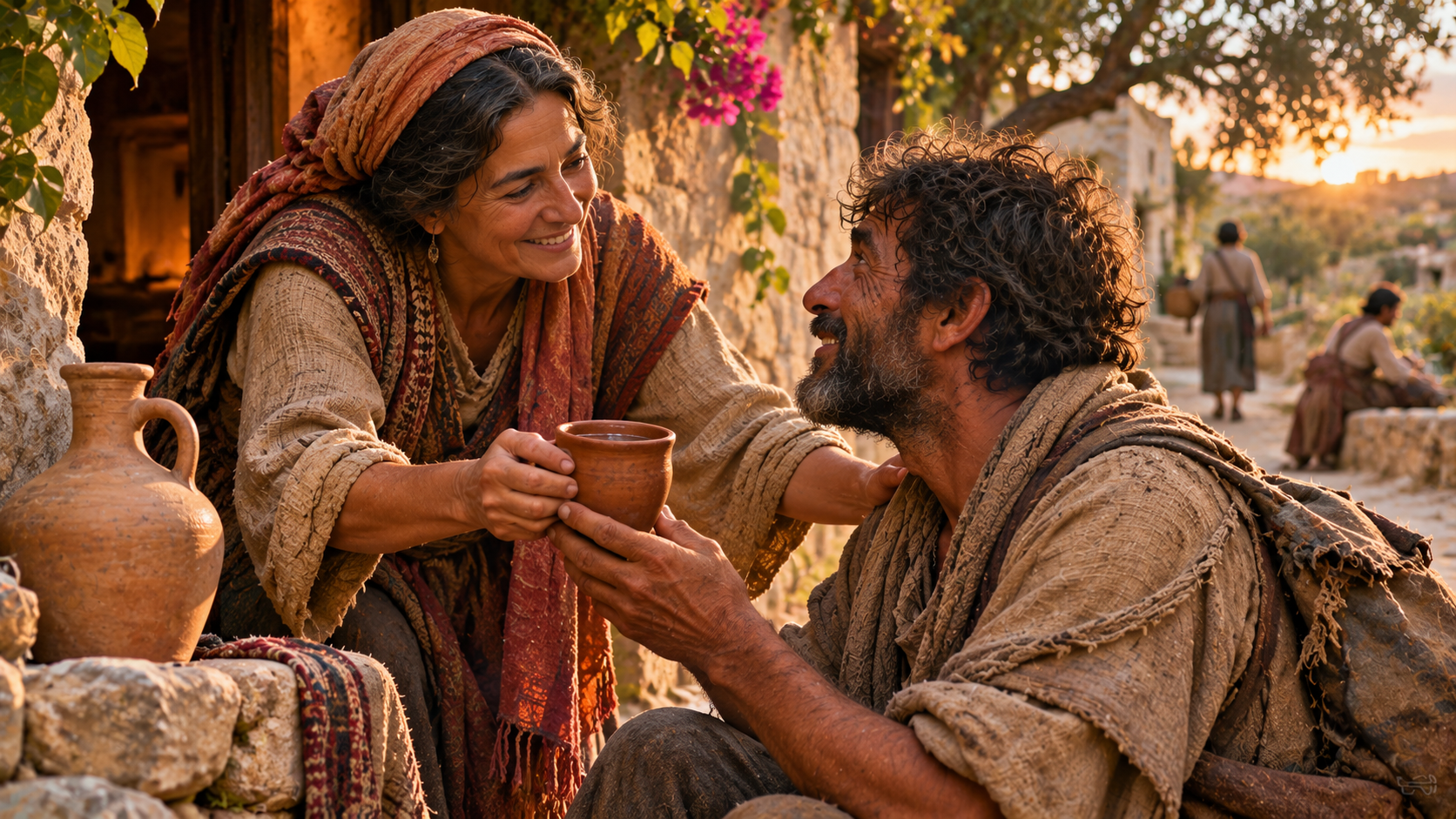
The Extraordinary Power of an Ordinary Kindness
The morning after our encounter with free will, Tyrion arrived at the observatory carrying one biscuit.
Not a packet. Not a secret reserve hidden beneath his collar.
One biscuit.
“I have decided to become generous,” he announced.
“That's wonderful.”
“I intend to share this.”
“With whom?”
“That,” he admitted, “is the part I haven't worked out.”
He placed the biscuit on the table and stared at it with the solemn expression of someone negotiating the fate of a solar system.
Then the door opened.
A tired stranger stepped inside, carrying a heavy bag and looking as though the day had already asked too much.
Tyrion glanced at the biscuit.
“Oh, no,” he whispered. “A practical examination.”
The Grand Problem of Doing Something Small
We've travelled through worlds so enormous that ordinary human concerns sometimes seemed almost comically tiny.
A billion worlds in Havona. Seven superuniverses. Celestial administrations and cosmic destinies.
Now imagine something much smaller.
Someone holds a door for a person whose hands are full.
A friend listens without checking the time.
A stranger notices that somebody has been left out and makes room at the table.
No choir sings. No heavenly official announces a promotion.
Yet something has changed.
The Urantia Book repeatedly associates spiritual growth with living love—with what we do for other people rather than merely what we say we believe.
Paper 100 — Religion in Human Experience presents religious living as something tested and expressed through experience. Paper 140 — The Ordination of the Twelve emphasizes the personal and practical demands of Jesus' teachings.
These are teachings within the book's spiritual vision, not scientific measurements of a soul.
But the everyday question is one anyone can ask:
How does an idea about love become an action?
The Stranger in the Doorway
The visitor put down the bag.
“Long walk?” I asked.
“A little longer than I expected.”
Tyrion nudged his biscuit behind his paw.
The stranger sank into a chair.
There was water nearby. There was another chair. There was time to listen.
And there was the biscuit.
I looked at Tyrion.
He looked at me.
“Don't look at me like that,” he said. “I'm considering the ethical dimensions.”
“Of what?”
“Portion control.”
The stranger smiled for the first time.
And Tyrion, with an enormous sigh, pushed his biscuit across the table.
“There,” he said. “I've made a significant contribution to planetary welfare.”
It was a modest act.
But it was real.
Of course, Tyrion and our visitor are fictional characters in an imagined observatory. No such incident is reported in the book. The scene is a way of exploring its ethical themes, not a claimed historical event.
Who Counts as a Neighbour?
Perhaps one of Jesus' most challenging teachings concerns the size of the circle we draw around the word neighbour.
It's easy enough to be kind to somebody who agrees with us, likes us, and remembers our birthday.
The real challenge arrives when the other person is unfamiliar, inconvenient, or entirely different from us.
In Paper 164 — At the Feast of Dedication, The Urantia Book recounts the story of the good Samaritan, a teaching also found in Luke 10:25–37.
Its moral force does not depend on the injured traveler belonging to the rescuer's group. The question shifts from Who deserves my concern? to Will I act as a neighbour?
This is a powerful connection to the difficult questions we faced at the end of our planetary-history journey.
No inherited label tells us who deserves compassion.
If our cosmic adventure has taught us anything worth bringing home, let it be that.
Tyrion considered the implications.
“Even cats?”
“Even cats.”
“Must spiritual progress always involve my most deeply held objections?”
“Sometimes.”
“Distressing.”
When Kindness Is More Than Being Nice
Kindness isn't always a smile, a compliment, or giving away a biscuit.
Sometimes it means telling a difficult truth gently.
Sometimes it means defending someone who is being treated unfairly.
Sometimes it means respecting a boundary rather than demanding gratitude.
And sometimes it means recognizing that another person's suffering cannot be solved with an inspirational sentence.
We should be especially careful here.
The book's language about spiritual growth should never be turned into an excuse to tell people to accept mistreatment, remain in danger, or neglect their own needs.
Real compassion includes wisdom, honesty, safety, and respect—for the person offering help as well as the person receiving it.
Tyrion looked thoughtful.
“So being loving doesn't mean letting everyone take everything I own?”
“No.”
“And I'm allowed to say no?”
“Of course.”
He retrieved his empty biscuit tin.
“Excellent. My theology has become considerably more sustainable.”
A Universe Worth Loving
There is a remarkable contrast in The Urantia Book.
Its universe is immense, crowded with orders of personalities, and described in staggering administrative detail.
Yet its central religious message repeatedly returns to relationships.
People matter.
Service matters.
The way we treat one another matters.
The book's celestial claims remain open to inquiry; we shouldn't claim to have verified them simply because we find a moral teaching beautiful.
But we can test the usefulness of that teaching in a very immediate way.
When we walk away from this page, will we notice someone we might otherwise have overlooked?
Will we listen a little more carefully?
Will we make room?
Not every opportunity requires a grand sacrifice. Sometimes all that's needed is the ordinary courage to be considerate.
The stranger picked up the bag to leave.
“Thank you,” they said.
Tyrion tried to look dignified.
“Think nothing of it.”
After the door closed, he turned to me.
“Was that enough?”
“Enough for what?”
“To change the universe.”
I looked at the empty table.
“I don't know whether the universe changed.”
“Then what did?”
“For a moment, someone's day.”
Tyrion considered that.
Then his tail began to wag.
“Perhaps,” he said, “we should start there.”
The universe may be too large for us to comprehend. But the person in front of us is close enough to love.
🔎 Factoid — What the Sources Say
The book's religious teaching: Paper 100 — Religion in Human Experience and Paper 140 — The Ordination of the Twelve connect spiritual living with personal relationships and action.
The good Samaritan: The familiar parable appears in Luke 10:25–37 and is retold in Paper 164. The two accounts can be read and compared directly.
Evidence boundary: The observatory visitor and Tyrion's dialogue are original fiction. The religious interpretation belongs to the book; the practical value of kindness can be discussed without assuming its celestial cosmology has been established.