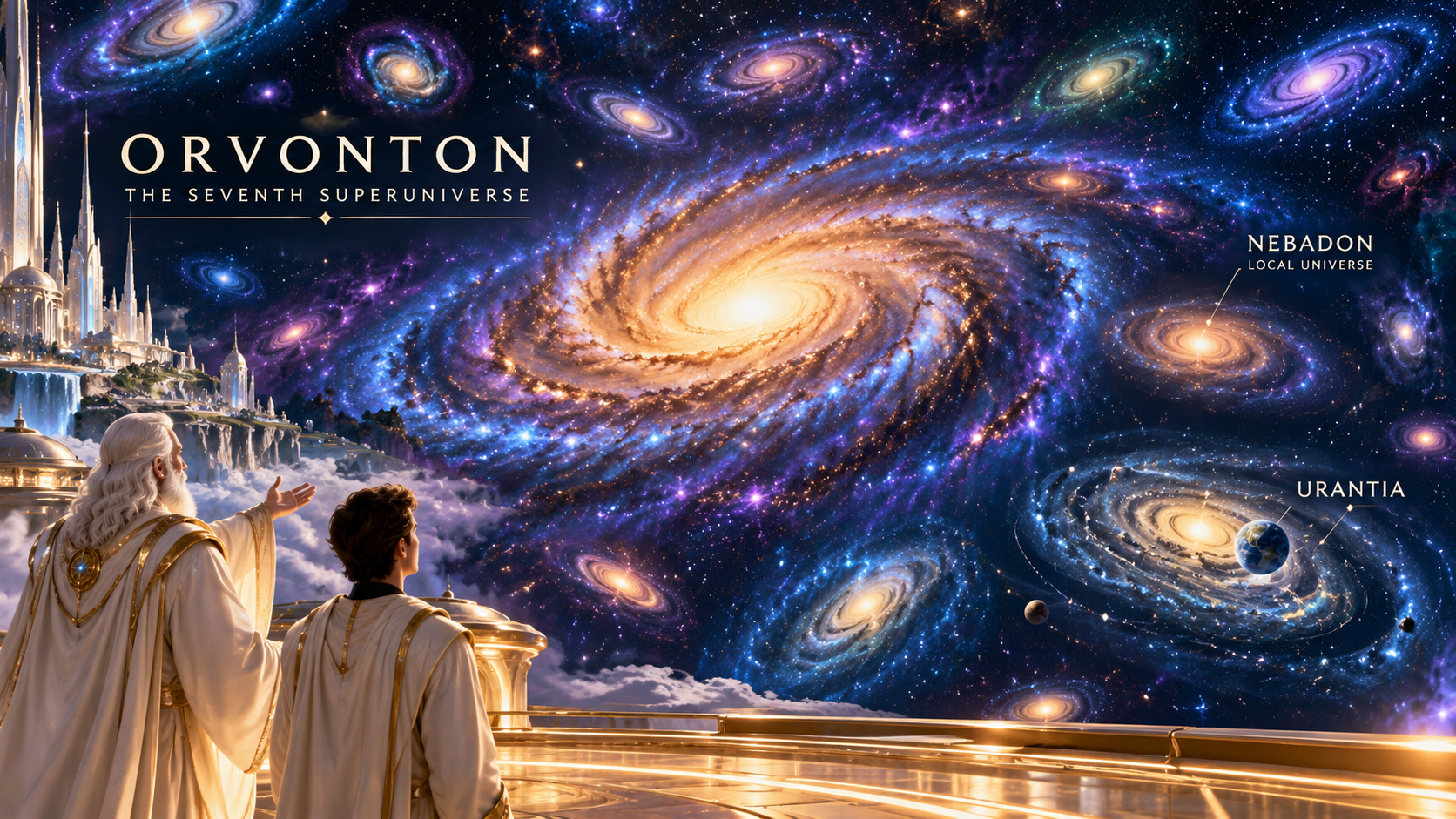
Orvonton — Our Cosmic Neighbourhood
"So we aren't the only beginners."
That was Tyrion's final thought as we left the seven superuniverses behind us on the observatory map. He had discovered that even a universe could still be growing.
Now he had another question.
"Which one is ours?"
One of the seven vast regions began to glow.
ORVONTON.
"The seventh superuniverse," I said. "According to The Urantia Book, it's the one containing our little Earth."
Tyrion's single central eye brightened.
"At last! A neighbourhood with an address. Does that mean we're almost home?"
"Not exactly. It's an enormous neighbourhood."
"How enormous?"
I expanded the map.
He stepped backward.
I expanded it again.
He sat down.
"Well," he said, "I hope the neighbours are friendly."
Before this visit was over, we would discover what the book says about that very question.
Somewhere in All Those Stars
Look into a clear, dark sky and you may see a pale band of light running across it.
That's the Milky Way—our galaxy seen from inside, an extraordinary reality studied by astronomers.
Now consider what The Urantia Book claims about it.
In Paper 15, Section 3, the narrator identifies the vast Milky Way starry system as the central nucleus of Orvonton, the seventh superuniverse. The text also associates practically all the stars visible to the unaided human eye with this superuniverse.
In the book's grand cosmic picture, our own galaxy is not the whole neighbourhood. It is only part of a proposed far larger organization of evolving worlds.
Tyrion looked at the stars.
"So we live inside the Milky Way, which the book says belongs to Orvonton."
"That's the claim."
"And can we see the headquarters?"
"No astronomer has identified the headquarters the book describes."
"Have we tried looking behind the Moon?"
"That's not quite how astronomy works."
Here's the distinction we must keep: the Milky Way is real and observable. Orvonton as a celestial government is a claim made by the book, not a discovery established by astronomy. Even a magnificent star field doesn't, by itself, reveal an invisible administration.
But the book's story now has a wonderfully tangible point of contact with our lives.
Those stars above our rooftops are where its author asks us to begin imagining our cosmic neighbourhood.
Welcome to Uversa—Population: A Lot of Opinions
The map shifted to a luminous headquarters world called Uversa.
According to the book, Uversa is not an ordinary planet that formed around a star. It is an architectural sphere: a world specially constructed to serve as the headquarters of Orvonton.
There, says Paper 15, three Ancients of Days preside over the seventh superuniverse. A vast hierarchy of counsellors, administrators, teachers, and other personalities takes part in its government.
"Three senior administrators," Tyrion said. "That sounds manageable."
"There's more."
The narrator describes a deliberative assembly with seven houses, including representatives chosen from ascending mortals associated with local universes admitted to its councils. It also describes supreme tribunals for matters of momentous consequence.
Tyrion's ears drooped.
"Seven houses? Three administrators? Courts?"
"Yes."
"So we've travelled all this way, and heaven still has meetings."
"Apparently."
"Did nobody learn anything from Van's seven-hour address?"
To be fair, the book portrays Uversa's government as extraordinarily harmonious, rather than as an earthly parliament with familiar quarrels. Its assembly represents an intriguing idea: the wisdom of beings who originate in perfection and the experience of beings who have grown through evolutionary life can work together.
That's a much better story than merely imagining a cosmic office block.
But there is a qualification that matters to our own neighbourhood. In 15:9.15–9.18, Nebadon, the local universe that contains Earth, had not yet qualified for membership or representation on Uversa.
Tyrion looked astonished.
"So our own universe doesn't have a seat?"
"Not yet, in the book's account."
"All these meetings, and we're not even invited?"
"Perhaps the qualifications are more complicated than we thought."
The institution itself remains part of the book's account—not a verified government, or a location where anyone from Earth has attended a meeting.
A University System Beyond Imagination
Tyrion suddenly noticed something more encouraging.
"Education?" he read. "Now we're talking. Does this involve field trips?"
Quite possibly the longest ones you could imagine.
The book describes seven groups of seventy specialized worlds surrounding Uversa, devoted to advanced spiritual training. In its account, ascending mortals arriving from the worlds of time undertake further preparation before the great onward journey to Havona.
That's 490 educational spheres associated with the headquarters.
"Four hundred and ninety?" Tyrion said.
"Yes."
"And I'm supposed to finish all my studies before we're allowed to visit Havona?"
"That is part of the journey as described."
He thought for a moment.
"Do they at least let you bring a friend?"
The book also places important educational centres at the minor-sector and major-sector levels. An ascending mortal doesn't suddenly step from an ordinary life into unlimited wisdom. The story presents understanding as something progressively acquired.
Perhaps that is one of the loveliest elements in the whole account: no one is expected to start the adventure already knowing everything.
The text even describes seven university groups of seventy worlds each—490 places devoted to advanced preparation. That's not an observed educational system; it's part of the book's enormous picture of spiritual ascent.
Tyrion looked at our small blue planet on the map.
"Then a beginner isn't somebody who has failed?"
"No. A beginner is somebody who has something ahead of them."
He considered this with surprising seriousness.
"I like that better."
So do I.
The Strange Art of Being Merciful
Then we reached a passage that made Tyrion stop joking.
In 15:14.2, the narrator describes Orvonton as especially associated with love and mercy, with justice tempered by mercy and power conditioned by patience.
Remember the Lucifer rebellion?
We encountered a government that, in the book's narrative, did not rush immediately to crush everyone who had been misled. We also encountered the painful question of how long mercy should be extended when wrongdoing continues to cause harm.
Orvonton is presented as a vast setting in which that tension between accountability and patience matters profoundly.
Tyrion looked thoughtful.
"If someone does something wrong, mercy doesn't mean pretending they didn't?"
"No."
"And justice doesn't mean refusing them every chance to change?"
"Not necessarily."
He leaned against the rail.
"That seems more difficult than just declaring somebody a bad dog."
It is.
The story doesn't offer a neat formula for every human moral dilemma. Mercy isn't permission to keep hurting people, and accountability cannot simply be wished away. Nor does a beautiful description of celestial justice establish the literal existence of Uversa.
But it leaves us with a question worth bringing home:
Can we be fair without becoming cruel—and forgiving without becoming careless?
That question would matter even in a universe with no celestial headquarters at all.
Our Address, Down to the Last Digit
"Fine," Tyrion said at last. "Suppose I wanted to write home. What's our address?"
I consulted the book's extraordinary registry.
According to 15:14.5–14.8, the book's proposed address runs:
URANTIA → SATANIA → NORLATIADEK → NEBADON → ENSA → SPLANDON → ORVONTON
A world inside a system, a constellation, a local universe, a minor sector, a major sector, and finally a superuniverse.
Tyrion studied the names.
"That's an address?"
"Yes."
"I thought we lived in a house."
"The house is considerably easier to find."
The complete hierarchy—including the headquarters worlds and numerical designations—is waiting in a collapsible Factoid at the end of this chapter, for readers who enjoy celestial paperwork.
Tyrion looked very tired.
"That isn't an address. That's an entire filing cabinet."
And then I found something even more astonishing.
The book supplies Earth's supposed grand universe registration number:
5,342,482,337,666.
Tyrion stared at the digits.
"Is that the postal code?"
"No."
"An account number?"
"No."
"Will I have to memorize it?"
"Only if you plan to impress somebody at a celestial dinner party."
The number comes from the text. There is no independent planetary registry by which to confirm it. Yet its narrative purpose is striking: to make one little world locatable within a cosmos of unimaginable scale.
But the narrator has another surprise waiting for us.
The World That Still Matters
In 15:14.9, the book says that Urantia receives loving attention as though it were the only inhabited world in existence.
Think about that for a moment.
We have just considered a superuniverse that the book estimates could contain approximately one trillion inhabitable worlds—not a verified census of living civilizations. We've seen its alleged headquarters, its education centres, and an extraordinary registry number.
And now the narrator insists that a single small planet deserves loving care even amid all those worlds.
Tyrion looked back toward the vast evolutionary regions we had just visited.
"Those places are still growing. So is Earth."
"Yes."
"Then being unfinished doesn't make a world unimportant."
Perhaps that is the most beautiful idea we've encountered in Orvonton.
It doesn't say Earth is the most important world. It suggests that being one among many need not make us invisible.
It's an idea we can test against our own lives, even if we cannot test the book's celestial registry.
In a classroom, a family, a workplace, or a crowded city, one person can disappear into the numbers. But a number is not the whole story of a life.
Tyrion looked again at the tiny blue dot on the map.
"That's us?"
"Yes."
"Even with all those other worlds?"
"Yes."
He sat beside the dot, his small white paws resting on the observatory table.
"Then perhaps we should take good care of it."
And for once, no joke could improve on that.
The Neighbourhood Watch Arrives
Just as I began closing the map, a sign appeared above an imaginary celestial help desk:
COSMIC NEIGHBOURHOOD WATCH — ENQUIRIES WELCOME.
Tyrion perked up immediately.
"Excellent. I have a question about borrowing sugar."
What follows is one of our original fictional celestial intermissions.
🎭 Celestial Intermission — The Cosmic Neighbourhood Watch (fictional)
An entirely fictional exchange between an ascending mortal and a Reversion Director. This is satire, not a quotation from The Urantia Book.
ASCENDING MORTAL: "So, let me get this straight. Orvonton is our cosmic neighbourhood?"
REVERSION DIRECTOR: "Correct. The seventh superuniverse."
ASCENDING MORTAL: "Wonderful! Do we have neighbours?"
REVERSION DIRECTOR: "An extraordinary number."
ASCENDING MORTAL: "Are they friendly?"
REVERSION DIRECTOR: "Generally. Although some have not yet developed the capacity for neighbourly conversation."
ASCENDING MORTAL: "Oh. How far away is the house next door?"
REVERSION DIRECTOR: "You'll have to be more specific."
ASCENDING MORTAL: "The closest one."
REVERSION DIRECTOR: "In your planetary system, constellation, local universe, or superuniverse?"
ASCENDING MORTAL: "I just wanted to borrow a cup of sugar."
The Reversion Director consults an enormous celestial directory.
REVERSION DIRECTOR: "We can arrange that. Your nearest available supplier is approximately three administrative jurisdictions away."
ASCENDING MORTAL: "Delivery?"
REVERSION DIRECTOR: "Certainly."
ASCENDING MORTAL: "How long?"
REVERSION DIRECTOR: "That depends. Are you measuring in Earth years or eternity?"
ASCENDING MORTAL: "Can I at least speak to a human?"
REVERSION DIRECTOR: "Human by origin, yes. But here in Orvonton, you're an accredited spirit."
ASCENDING MORTAL: "Excellent. Does that qualify me for free sugar delivery?"
REVERSION DIRECTOR: "Different department."
The ascender quietly decides to drink his coffee without sugar.
An original fictional sketch, not a celestial communication, book quotation, or factual account of cosmic transportation.
The Next Door: The Universe of Michael
Our cosmic map could keep unfolding outward forever. Instead, Tyrion moved a little closer to the glowing dot marked URANTIA.
"All right. We've found our superuniverse. What's the next neighbourhood inside it?"
NEBADON.
According to the book, Nebadon is our local universe, home to the constellation Norlatiadek, the system Satania, and our little Earth.
"Wait," Tyrion said. "Nebadon? Isn't that the universe whose Creator Son Lucifer challenged?"
"Exactly. Michael's universe."
Tyrion's ears perked up.
"So we're finally going to meet the person Lucifer was arguing with?"
"We're about to learn what the book says about him."
He picked up his travel bag.
"Excellent. And if he has seven houses of government, I'm going to need more biscuits."
Continue the Adventure — Nebadon: The Universe Where a Creator Learned to Understand →
🔎 Factoid — The Orvonton Source Trail
Our observatory, Tyrion's conversation, and the Neighbourhood Watch skit are original fictional narration. The proposed cosmic organization is drawn from Paper 15 — The Seven Superuniverses of The Urantia Book.
- Orvonton as the seventh superuniverse and its proposed relation to the Milky Way: 15:1.5–1.6; 15:3.1–3.3
- Uversa as an architectural headquarters and advanced educational centre: 15:7.1–7.11
- Evolutionary human origin and the transition to accredited spirit status: 30:4.10; 30:4.20–4.22
- Three Ancients of Days, deliberative assembly, and supreme tribunals: 15:10–12
- Nebadon's lack of representation on Uversa: 15:9.15–9.18
- Orvonton's theme of love, justice, mercy, and patience: 15:14.1–14.3
- Earth's proposed administrative address and grand-universe registry number: 15:14.5–14.8
- The narrative's statement about attentive care for Earth: 15:14.9
Evidence boundary: The Milky Way is an observable galaxy. Orvonton's government, Uversa, the alleged registry number, and the accompanying spiritual-administrative structure have not been independently established by astronomy. The Atlas distinguishes the text's claims from externally verified discoveries.
🔎 Factoid — Earth's Full Cosmic Address
Paper 15:14.5–14.8 supplies the book's expanded administrative address. These are textual designations, not verified astronomical jurisdictions.
- Orvonton: the seventh superuniverse, headquartered on Uversa.
- Splandon: its fifth major sector, with headquarters called Umajor the fifth.
- Ensa: the third minor sector within Splandon, with headquarters called Uminor the third.
- Nebadon: local universe number 84 of Ensa, headquartered on Salvington.
- Norlatiadek: constellation number 70 of Nebadon, headquartered on Edentia.
- Satania: system number 24 of Norlatiadek, headquartered on Jerusem.
- Urantia: Earth, inhabited world 606 of Satania.
The book also gives Urantia the alleged grand-universe registry number 5,342,482,337,666. The number comes from its narrative and has not been confirmed by an independently existing planetary registry.
🧭 Optional Detours — More of the Cosmic Neighbourhood
The main adventure continues to Nebadon above. Curious readers can explore another route and return here whenever they like: