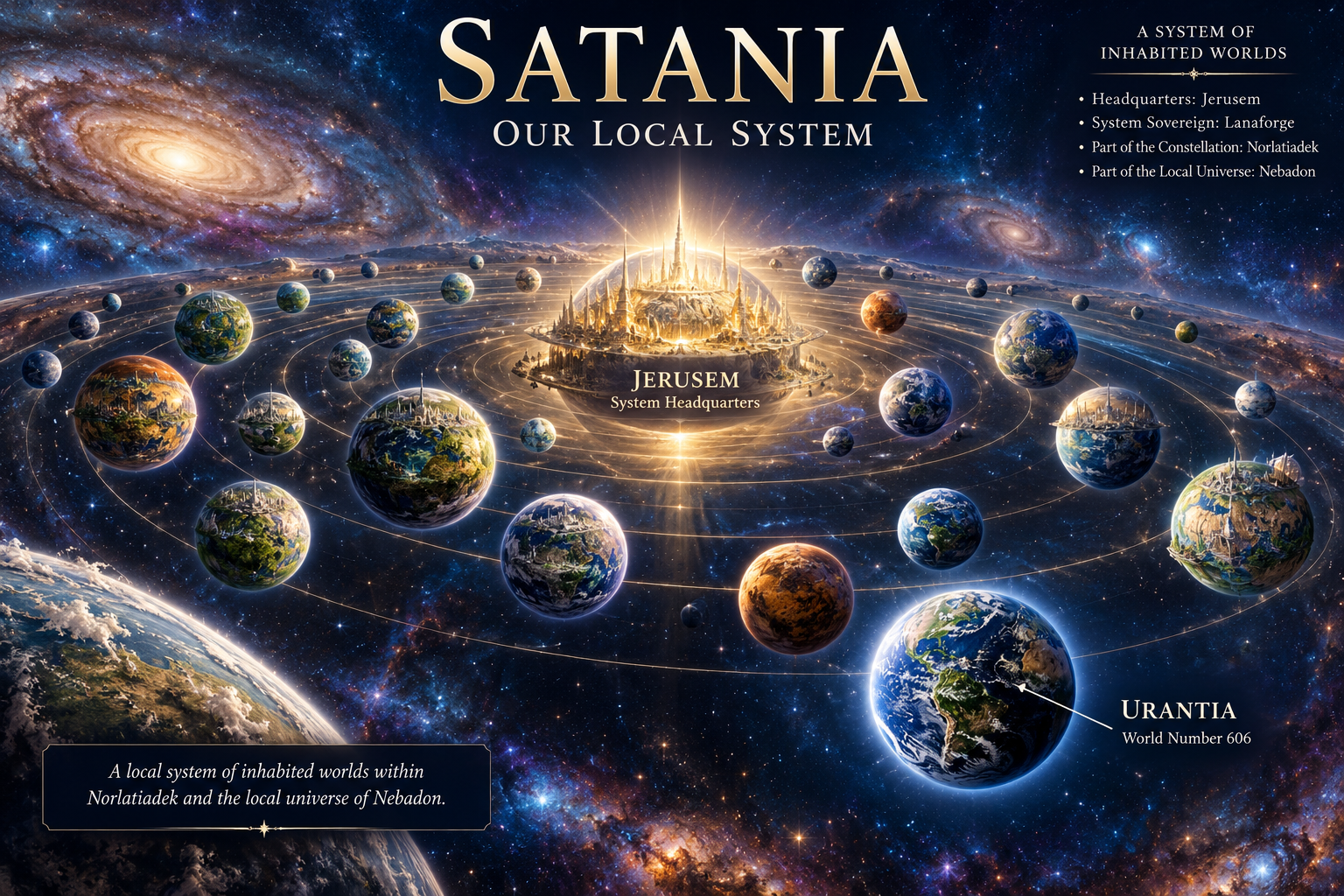
Satania — Where Heaven Had to Begin Again
The observatory map was finally beginning to look manageable.
We had travelled from the eternal Isle of Paradise, through Havona, across the seven superuniverses, into Orvonton, Nebadon, and the beautiful constellation of Norlatiadek.
Now one small region lit up.
SATANIA.
Tyrion froze.
"Wait. Satania?"
"Yes."
"After all those magnificent gardens and friendly creatures, we're going somewhere called Satania?"
"It's the local system that contains Earth, according to The Urantia Book."
He stared at the name.
"That sounds less like a holiday destination and more like the sort of place where you ought to check the reviews first."
We had, in a sense, already read the reviews.
This was the system Lucifer had governed. The system where a brilliant administrator issued his Declaration of Liberty. The system where thirty-seven Planetary Princes followed the rebellion, and where our own world became entangled in its consequences.
And now, after travelling across an imagined universe, we were back at the scene of the trouble.
Only something had changed.
The warning light was no longer flashing.
First, a Rather Unfortunate Name
"Before we go any further," Tyrion said, "is Satania named after Satan?"
The question is understandable.
In the book, Satania names a local system—an administrative family of inhabited worlds. Satan is a particular celestial personality, a close associate of Lucifer, the system's former sovereign.
Those are different things.
The narrative connects Satan and Lucifer to the rebellion in Satania, but the resemblance between the names doesn't by itself establish their etymology. Nor does the name imply that every inhabitant of the system is wicked.
"Good," Tyrion said. "Because I was beginning to worry about the neighbours."
There is a second distinction worth carrying with us: the book's local system is not our astronomical solar system. It describes a much larger association of planetary systems and inhabited worlds.
Earth, in this account, occupies a very modest place within it.
But a modest place is not necessarily an unimportant one.
A World Count with a Backstory
The book says that Satania had 607 inhabited worlds when Lucifer rebelled.
Later, in its broader description of inhabited planets, Paper 49:0.3 reports 619 inhabited worlds, along with 36 planets approaching life endowment and nearly 200 more developing toward that stage.
Tyrion squinted at the figures.
"Hang on. Six hundred and seven. Then six hundred and nineteen."
"Those are the two counts given in different narrative contexts."
"So there are twelve more than before?"
"The figures differ by twelve, yes. But the book doesn't give us a complete dated register showing precisely how those worlds came to be counted."
He nodded.
"Then we shall not invent the missing paperwork."
A splendid editorial principle.
The book also says that worlds receive their numbers in the order they become registered as inhabited by will creatures.
Which brings us to ours.
Urantia is world number 606.
"Six-oh-six?" Tyrion asked.
"Yes."
"Out of 619?"
"That's the textual count in Paper 49."
He contemplated this.
"Does that mean our planet received a poor performance review?"
"No. It's a registration number, not a score."
"Good. I was preparing a formal appeal."
Those numbers describe the book's own proposed cosmic census. No independent astronomical census has confirmed the inhabited worlds of Satania.
But the story is about to become considerably more interesting than the arithmetic.
Jerusem: The Capital with No Rainy Days
At the centre of the system appears Jerusem.
Not Jerusalem on Earth—Jerusem, the headquarters sphere of Satania.
The book describes it as an architectural world, nearly a hundred times as large as Earth, specially constructed rather than formed through ordinary planetary evolution.
It has highlands and beautiful open spaces. Thousands of small lakes are connected by waterways. There are no raging rivers, expansive oceans, earthquakes, rainstorms, or blizzards.
Tyrion perked up.
"No blizzards?"
"That's what the text says."
"No freezing rain?"
"No."
"And no one insisting we go for a walk in a snowstorm?"
"You're usually the one insisting."
"Please don't complicate my argument with facts."
Jerusem's light is equally unusual.
The book describes a system of gentle, evenly distributed illumination rather than a normal cycle of sunlit day and dark night. Most of the time, light seems to sift from the sky in every direction. For a portion of the Jerusem day, it gradually fades to something resembling a peaceful, moonlit evening.
There is no ordinary sunset.
No season of bitter winter.
No storm rolling across the hills.
At least, that is how the book pictures it.
Visit Jerusem in the Civilization Atlas →
The Sea of Glass—and Five Billion Seats
The map brought us toward an extraordinary crystal landing field, the sea of glass.
We had seen one at Edentia, but Jerusem's seemed to have developed into an entire centre of celestial activity.
In Paper 46, arriving transports are said to land at the crystal receiving field. Nearby, visitors can find a great broadcasting centre, where reports from across the universe are received.
And surrounding the broadcasts is an amphitheatre that, according to the book, can accommodate more than five billion material and morontia beings, besides innumerable spirit personalities.
Tyrion nearly fell off his cushion.
"Five billion seats?"
"More than five billion."
"Can you imagine trying to find your friend in the audience?"
"I suspect they have arrangements for that."
"And the line for refreshments!"
This is one of the book's more charming possibilities: a headquarters world where keeping informed about the wider universe is a favourite recreation.
Not merely politics, not merely administration—curiosity shared on an astonishing scale.
Perhaps the most civilized thing about an advanced society would be that people remain eager to learn what is happening beyond their own little corner.
The Man Who Took Over After Lucifer
Eventually the map displayed a new name beside the office of System Sovereign.
LANAFORGE.
Tyrion became suspicious again.
"Another boss?"
"The one who succeeded Lucifer, according to the book."
"Did he also announce a seven-hour manifesto?"
"Not that the text reports."
"A promising start."
Lanaforge is described as a primary Lanonandek Son, like Lucifer. But his history is different.
The text says Lanaforge had already remained loyal during an earlier rebellion in Nebadon, when a superior officer turned against Michael's government. That record of steadfast service helped distinguish him as a successor in troubled Satania.
Under the narrative's account, the system's administration still required extraordinary arrangements. Some powers ordinarily held by a System Sovereign remained under the supervision of the Constellation Fathers, because the rebellion had not yet been fully adjudicated at the point described by the narrator.
So Jerusem did not simply return to business as usual.
It was governing a community trying to recover from a profound rupture of trust.
Tyrion looked at the capital.
"How do you repair something like that?"
A difficult question.
You can replace an official. You can reorganize an office. But how do you restore a society after people have been frightened, misled, divided, or betrayed?
That requires more than an organizational chart.
The Surprisingly Sociable Sovereign
And then I found a detail that changed the mood entirely.
The book says Lanaforge meets with various groups of Jerusem citizens during regular informal gatherings on the sea of glass.
These occasions are not for government business. The narrator describes them as social and spiritual times when personalities come together simply to enjoy one another's company.
"No meetings?" Tyrion asked.
"Not administrative ones."
"No legislation?"
"Not at those gatherings."
"No urgent committee reports?"
"Apparently not."
He brightened.
"So the new sovereign hosts social evenings where everybody can relax?"
"That's the idea."
"Now that is leadership."
After everything we had learned about Lucifer, this detail seemed especially poignant.
An administrator's purpose need not be to dominate a community. Perhaps it can also be to help its members feel that they belong to one another.
Not every gathering needs an agenda.
And not every problem is solved by somebody giving a speech.
Van, who had once spoken for seven hours during the rebellion, might have found that observation rather refreshing.
Fifty-Seven Worlds—and the First Seven Steps Homeward
Jerusem isn't alone.
The book describes a system headquarters cluster of 57 specially constructed spheres: Jerusem itself, seven major transition worlds, and 49 smaller satellites.
Among those satellites are the seven mansion worlds, surrounding the first transition sphere.
The narrative gives these worlds a special place in the mortal ascension story. They are where surviving mortals from Satania's many inhabited planets are said to begin a new phase of education and personal growth after their lives on their native worlds.
"Seven mansion worlds?" Tyrion asked.
"Yes."
"Does everybody receive a mansion?"
"That's not quite what the name means."
"Does it come with a garden?"
"The text describes places for learning and development."
"Another school."
He sighed.
"At least eternity seems committed to education."
The striking idea isn't that spiritual life amounts to endless classroom attendance.
It's that, in the book's portrayal, a growing person isn't expected to become perfect all at once.
There is room to learn slowly.
Room to correct mistakes.
Room to discover how to get along with others.
Room to become something more without losing the personal story that brought you there.
That is a beautiful vision, even if the alleged worlds themselves are not astronomically established.
Tyrion Meets the Cosmic Gardeners
Then we entered one of Jerusem's enormous landscaped regions and discovered creatures called spornagia.
The book describes them as intelligent helpers associated with the cultivation and care of its landscapes.
And here's the detail that instantly captured Tyrion's attention.
In 46:7.7, the narrator compares them to a combination of the faithful qualities of a horse and the affectionate character of a dog, while giving them a level of intelligence beyond that of our most intellectually capable primates.

Tyrion stood tall.
"Finally," he said, "a civilization that understands my importance."
"They're described as different from earthly animals."
"Yes, but the dog part is clearly a mark of excellence."
The book even makes the unusual claim that spornagia possess individuality and experience a type of reincarnation, though they do not have what the text calls surviving souls.
That raises philosophical questions about intelligence, personality, and continued identity—questions much larger than this particular garden.
For the moment, however, Tyrion had already decided that any world with doglike celestial gardeners deserved a favourable review.
"Five stars," he announced.
"Out of five?"
"Six, if they serve biscuits."
The Part of Jerusem That Hasn't Healed
Our tour brought us to a monumental record of the system's history.
According to 46:8.1–8.3, a portion of Jerusem's great historical panorama remained erased, awaiting restoration after Satania's readmission into full fellowship with Norlatiadek.
This was a consequence of Lucifer's rebellion.
The book's narrator also describes certain rebellious personalities as held in detention on spheres associated with the transition-world system, and a continuing separation affecting some previously isolated worlds—including Urantia.
Those conditions belong to the time frame and spiritual history narrated by the book. They are not observed events or independently established facts about the present cosmos.
Still, the unfinished memorial felt strangely human.
The system had beautiful gardens, shining lakes, extraordinary broadcasts, and a new sovereign trying to restore confidence.
But one section of its own history had not yet been repaired.
Tyrion grew quiet.
"Why not just replace the missing part?"
"Because, perhaps, the problem wasn't only that the picture had been damaged."
He looked back at the empty space.
"So a community can look beautiful and still be healing?"
"Yes."
That may be the most important thing this stop has to teach us.
Recovery isn't the same thing as pretending nothing happened.
If a community has suffered through deception, betrayal, or conflict, its future need not be defined forever by those events.
But healing asks for honesty, patient work, responsibility, and a willingness to restore relationships where restoration is possible.
And sometimes it takes a long time.
The Road Home
At last our observatory map showed one tiny blue world shining among the many points of Satania.
URANTIA — WORLD 606.
"That's it!" Tyrion exclaimed. "We're home!"
"Almost. We've still got one more chapter."
He groaned.
"Please tell me Earth doesn't have another six layers of administration."
"No. This time the next place is the planet we know."
The oceans. The forests. The cities. The ordinary people trying to get through their days.
After all this grand cosmic spectacle, the final destination looked wonderfully familiar.
Tyrion took one last look toward Jerusem and the sea of glass.
"Do you think they ever finish fixing that missing piece of their history?"
"The book expresses hope for the system's eventual restoration."
He nodded.
"I hope so too."
Then he turned toward our tiny Earth.
"Come on. I want to go home."
🔎 Factoid — The Satania Source Trail
This chapter retells descriptions from The Urantia Book. The observatory, Tyrion's dialogue, imagined visit, and modern comparisons are original fiction.
- Satania's administration, the 57 headquarters spheres, and the mansion worlds: Paper 45:0–1
- Planetary human mortals from multiple worlds sharing a mansion-world destiny: 30:4.10
- Lanaforge's appointment and the rebuilding of system confidence: 45:2–3
- Social gatherings at the sea of glass: 45:2.5–2.6
- Jerusem's light, climate, landscapes, and broadcasting centre: Paper 46:1–3
- Spornagia, their work, qualities, and the text's reincarnation claim: 46:7.1–7.8
- The unfinished historical panorama and system isolation: 46:8.1–8.3
- World numbers: 607 during Lucifer's rebellion; 619 in the subsequent description; Urantia numbered 606: 53:1.1 and 49:0.3
Evidence boundary: The physical descriptions of Jerusem, the alleged inhabited worlds, Lanaforge's administration, and the rebellion's aftermath are claims of the book, not independently established observations or verified history. The narrative's themes of growth and restoration can be explored without assuming its cosmological claims are scientific findings.
Continue the Adventure — Urantia: Our Place in the Cosmos →
🧭 Optional Detours — Before Returning to Earth
There is still the small matter of 619 inhabited worlds and a planetary registration office whose paperwork has become rather complicated.
Naturally, the Atlas's entirely fictional Reversion Directors have already conducted an investigation.
Satania's Planetary Registration Office — 619 Worlds and a Waiting List →
An original five-act satire, inspired by the book's world counts—not a canonical scene or evidence of celestial bureaucracy.